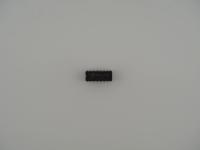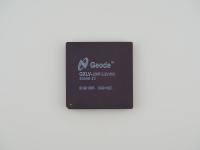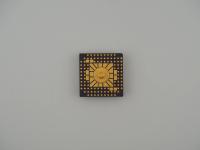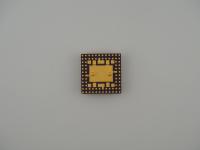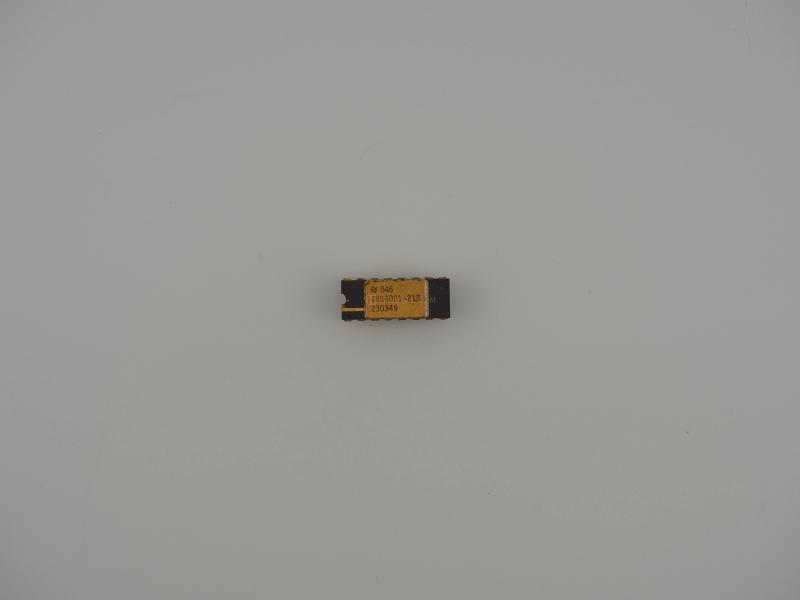

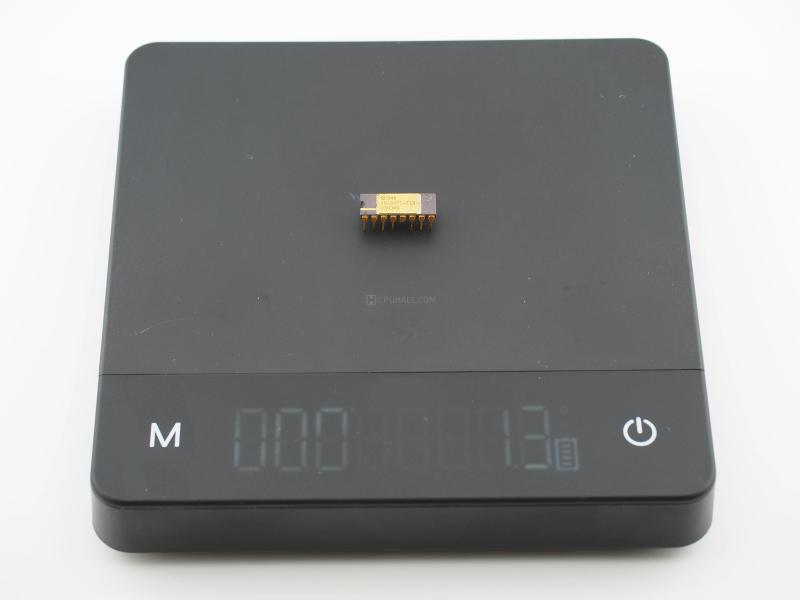
Holding this specific unit under the macro lens is a masterclass in vintage semiconductor aesthetics. Weighing in at exactly 1.3 grams on the scale and measuring roughly an inch in length, this artifact is a breathtaking example of side-brazed ceramic packaging. The contrast between the matte black ceramic body and the heavy gold-plated top cap screams high-budget late 1970s fabrication.
When observing the top plate, I can clearly read the original factory laser etchings against the reflective gold surface:
(National Semiconductor Logo) 846
INS4001-21B
230349
The stylized wave logo instantly gives away the manufacturer as National Semiconductor. The physical textures here are remarkable. You can see microscopic tooling marks and slight patina on the gold lid, indicating its age and the reality of handling these ancient components. Flipping it over reveals the absolutely pristine gold side-brazed pins. The brazing process leaves these gorgeous, thick metallic joints along the flank of the package, a technique reserved for high-reliability components that needed to survive extreme thermal cycling.
To understand this artifact, we have to look past the gold and into the silicon logic itself. This is not a standalone processor. The INS4001 is a critical organ of the MCS-4 microcomputer system, originally designed by Intel. Specifically, it is a 2048-bit (256 x 8-bit words) metal-gate PMOS Read-Only Memory chip.
However, calling it just "memory" is a massive understatement of its engineering brilliance. Because the companion 4004 microprocessor was notoriously pin-starved in its tiny 16-pin package, Intel's engineers had to get creative. They offloaded the Input/Output duties to the memory chips. This means this INS4001 artifact houses both the mask-programmed ROM containing the system's executable code and a fully programmable 4-bit I/O port.
Running at a blistering 740 kHz, these chips ran hot and required a rather strange dual power supply arrangement of -15V and +5V. The side-brazed ceramic package I am holding wasn't just for show. It was a thermal necessity to keep the primitive PMOS logic from literally cooking itself during sustained operation.
The history of the 4001 is inextricably linked to the birth of the microprocessor itself. In 1971, Intel released the 4004 to power a high-end desktop calculator for the Japanese company Busicom. But the 4004 was useless without the 4001 ROM to hold the calculator's instruction set.
A common myth in the hardware community is that Intel was the sole producer of the MCS-4 family. That is entirely false. As the microprocessor market exploded, large industrial and military contractors demanded "second sources" to ensure their supply chains would not collapse if a single factory caught fire. National Semiconductor stepped in to clone and manufacture the MCS-4 architecture under license. Finding a National Semiconductor variant like this one is an absolute treat for a collector. It represents the very beginning of semiconductor intellectual property licensing, setting the stage for the massive x86 clone wars that would dominate the 1990s.
I am completely confident in the identification of this piece. The visual clues are definitive. The "INS" prefix was National Semiconductor's standard nomenclature for their second-source Intel parts.
The 846 date code etched onto the gold cap tells a fascinating story. This code indicates the chip was packaged in the 46th week of 1978. This is incredibly late for an MCS-4 component. By 1978, the Intel 8086 had already been released, and the 8-bit revolution was in full swing. The fact that National Semiconductor was still fabricating a 4-bit metal-gate PMOS chip in late 1978 proves that some industrial or military customer had a legacy system they desperately needed to keep alive, demanding fresh replacement parts long after the architecture was commercially obsolete. The 21B suffix likely refers to the specific mask-programmed ROM code baked into the silicon for that exact customer.