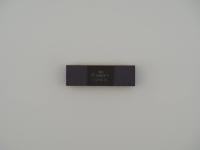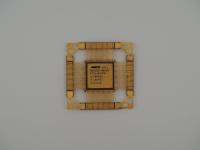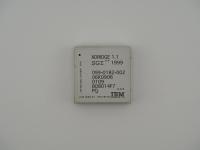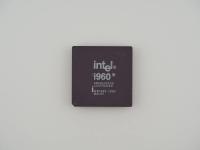

This is not cost-optimized consumer silicon. This is heavy industrial hardware built for absolute stability. The substrate is a gorgeous, deep purple ceramic, offering a stark visual contrast to the brilliant gold plating.
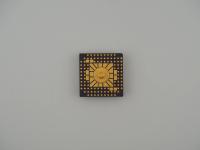
The bottom of the chip features a massive, perfectly flat gold central pad, completely devoid of pins in a 7x7 inner grid. This pad is designed to dump heat directly into a socket thermal plane or provide an incredibly clean ground reference.
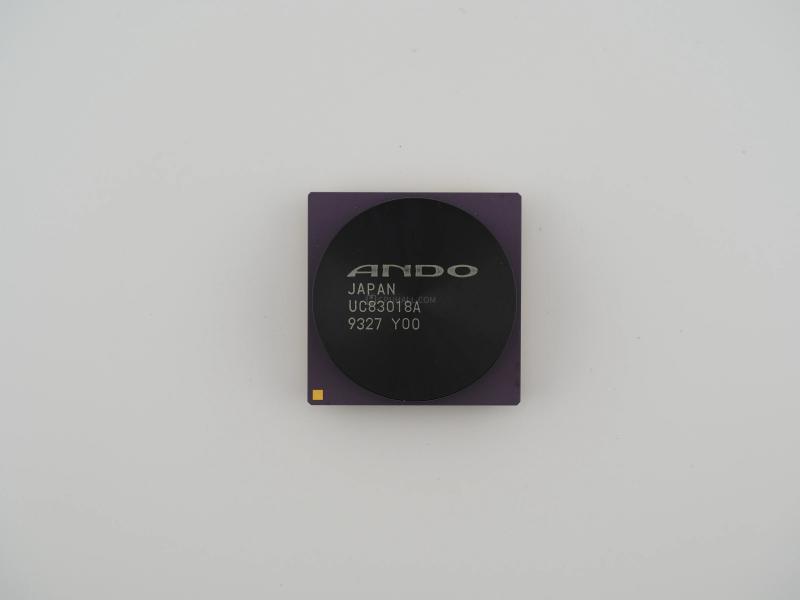
Flipping the artifact over reveals a monolithic, machined black aluminum cap with subtle concentric ridges. The surface text is stark, highly legible, and etched directly into the metal:
ANDO
JAPAN
UC83018A
9327 Y00
A square gold pad sits isolated in the bottom left corner of the purple ceramic, serving as the Pin 1 orientation marker. The aesthetic is pure, brutalist Cold War era tech, even though the date code places it slightly later.
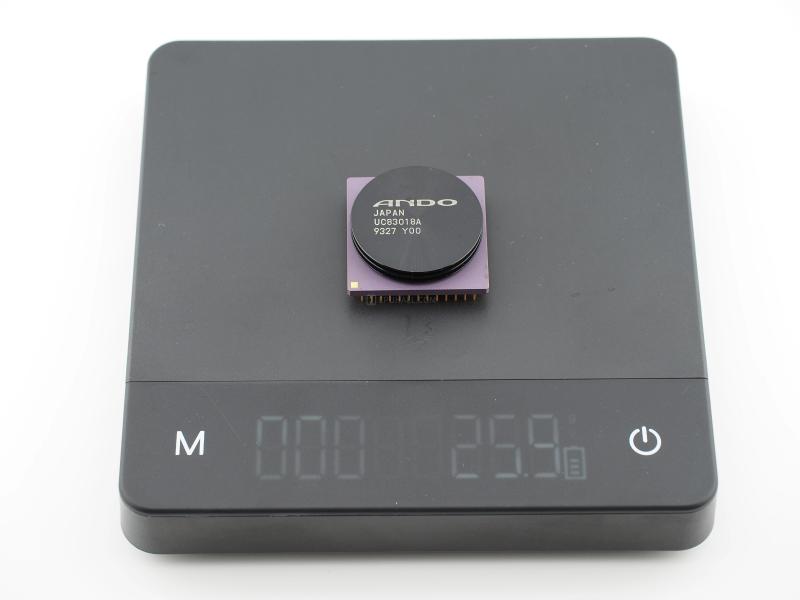
This package is a classic ceramic Pin Grid Array (PGA) consisting of approximately 116 pins arranged in an outer 13x13 grid matrix. The massive black cap on top is not just for show, as it acts as an integrated heat spreader for a silicon die that clearly ran hot.
Chips with this specific packaging profile (large upper heat spreader coupled with a massive bottom grounding/thermal pad) were built to handle high-frequency switching and significant current loads. This is an Application-Specific Integrated Circuit (ASIC) or a highly complex custom gate array. In the early 1990s, custom logic like this was strictly reserved for million-dollar enterprise hardware where off-the-shelf microcontrollers simply lacked the necessary I/O density or switching speed. The dense pin count and extreme thermal management suggest this silicon was pushing the fabrication limits of its era.
The ANDO logo tells the real story here. Ando Electric Co., a prestigious Japanese engineering firm eventually absorbed by Yokogawa, did not make personal computers. They manufactured ultra-high-end Automated Test Equipment (ATE) and optical communication analyzers.
This chip is not a processor that ran operating systems or calculated physics vectors. It was the judge and jury for other silicon. In 1993, the semiconductor industry was rapidly transitioning to the Pentium era and exploring cutting-edge telecommunications. Ando's logic analyzers and LSI testers were the multi-million-dollar machines standing at the end of the fabrication lines, verifying if Intel, NEC, and Toshiba chips were actually functioning correctly. This specific UC83018A was likely a core logic controller inside an Ando DIC-series LSI tester, orchestrating precise electrical signals to stress-test the very CPUs we normally collect.
Identifying custom ATE logic is often an exercise in reading the negative space. Because Ando built internal tools for industrial clients, there are no public datasheets or marketing brochures for the UC83018A.
The 9327 date code places its manufacturing window exactly at the 27th week of 1993. The UC prefix is a strong indicator of a custom CMOS gate array, a very common naming convention used by Japanese fabricators like NEC or Toshiba when spinning up custom ASICs for third-party clients. While I cannot definitively pin down the exact Ando chassis this was pulled from without a corresponding service manual, the physical evidence is undeniable. The extreme thermal mass, the proprietary gold grounding plane, and the Ando branding confirm this is a surviving fragment of the heavy iron that kept the 1990s semiconductor boom honest.