
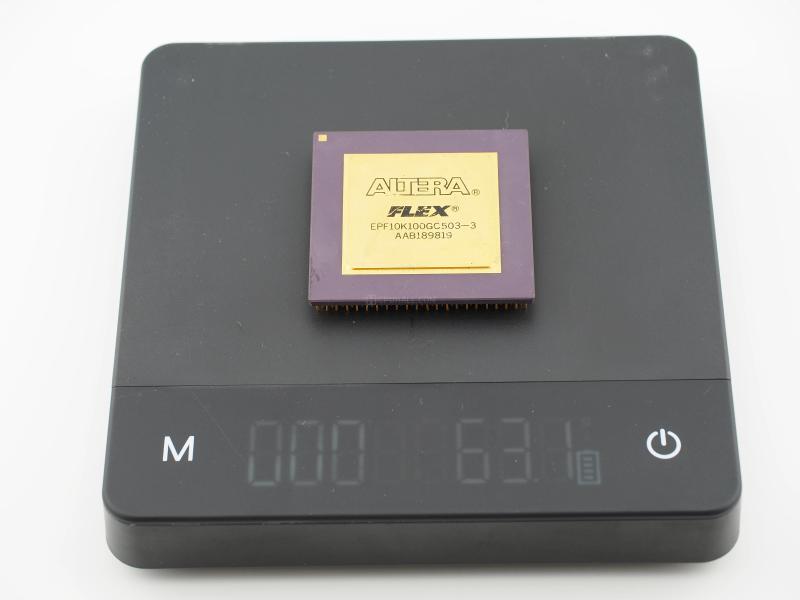
Tipping the scales at a hefty 63.1 grams, this artifact is not a delicate modern flip-chip. It is a formidable slab of late 90s industrial logic.
Flipping it over reveals a dense forest of 503 heavily gold-brazed pins, perfectly uniform and completely surrounding yet another central gold plate. The black laser etching stands out sharply against the gold caps on both sides of the package
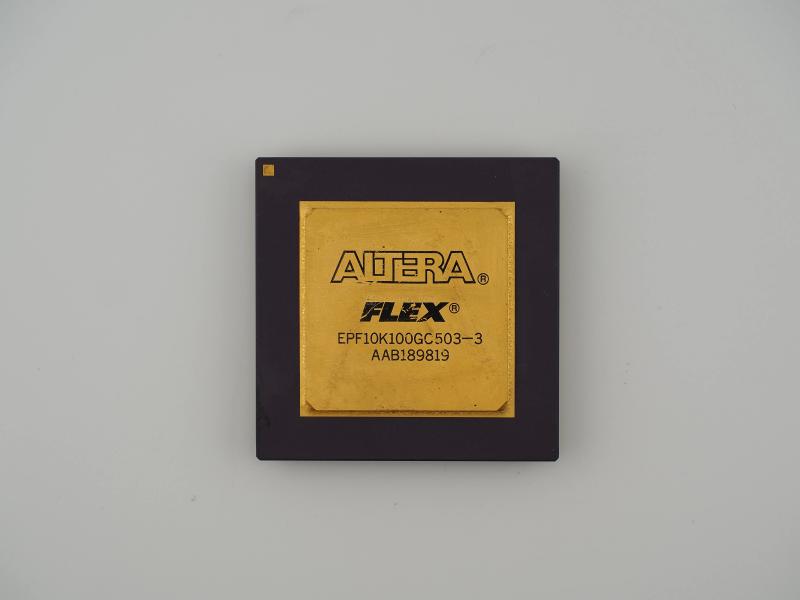
Top Face Text:ALTERA
FLEX
EPF10K100GC503-3
AAB189819
Bottom Face Text:NAB1802001
PHILIPPINES
9819 A N
Diving into the silicon itself, the EPF10K100GC503-3 is an absolute beast from a structural standpoint. The architecture here is Altera's legendary FLEX 10K family, and that "100" in the part number denotes an impressive 100,000 typical usable gates. In 1998, throwing around a hundred thousand reprogrammable logic gates was serious, high-end compute power. The "GC503" refers to its massive Ceramic Pin Grid Array package, designed to handle the heavy thermal load and vast I/O requirements of complex circuit designs. The "-3" denotes the speed grade, indicating a mid-tier performance bin for this specific line.
The real engineering magic of the FLEX 10K series was the introduction of the Embedded Array Block (EAB). Before this innovation, FPGAs relied entirely on Logic Array Blocks (LABs). Altera integrated dedicated blocks of RAM directly into the fabric alongside the logic gates. This meant engineers could build microcontrollers, digital signal processors, or custom memory controllers right on the chip without needing external SRAM chips. It was a massive leap forward in making programmable logic a viable replacement for custom silicon.
During the late 1990s, the war between Altera and Xilinx was absolute heavy metal thunder. They were constantly trying to out-innovate one another, pushing the limits of gate counts, integrated features, and die sizes. FPGAs like this FLEX 10K were essentially programmable clay for hardware engineers. They allowed companies to bypass the massive upfront costs of fabricating custom ASICs for low-volume telecom gear, early network core switches, and military hardware.
The persistent myth of the early FPGA is that they were strictly relegated to "glue logic" simply connecting more important processors together. Chips like this 100,000-gate leviathan proved they could be the main event. You could physically rewire the hardware architecture on the fly. If a bug was found in a deployed satellite or a telecom tower, a firmware update would rewrite the internal logic pathways. It felt like absolute black magic to software developers at the time.
Looking at the surface markings, the history of this specific unit is laid out perfectly. The bottom plate clearly shows a date code of 9819, putting its birth at the 19th week of 1998. The PHILIPPINES stamp denotes the fabrication and assembly origin, which was a highly respected and heavily utilized hub for premium semiconductor packaging during this era. The top part number perfectly aligns with Altera's official nomenclature, confirming its identity and specifications beyond a shadow of a doubt.
Given its pristine physical condition, the massive ceramic package, and zero bent pins, this chip likely lived its life in a high-end enterprise environment. It was almost certainly socketed into a heavy-duty telecommunications router, an industrial control system, or perhaps an expensive ASIC prototyping board. It is a flawless survivor from the golden age of programmable logic.