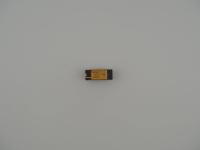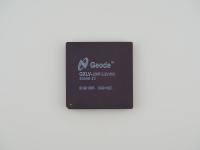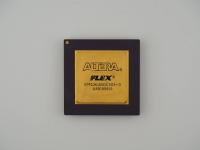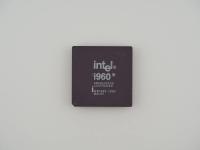

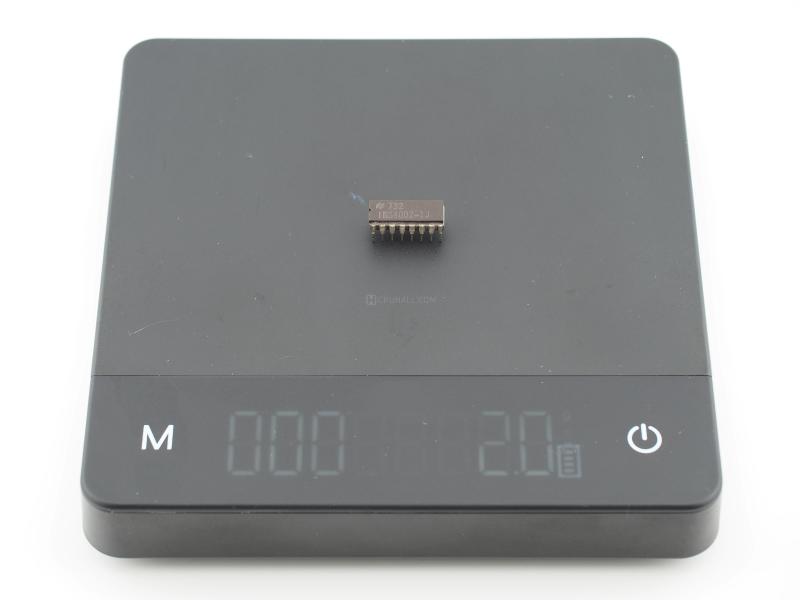
Holding this piece under the lights, the first thing that strikes you is just how unassuming it looks. Sitting on the scale, it barely registers at 2.0 grams. Measuring right around 19mm, this DIP-16 package looks like any other generic logic chip you might find in a junk bin. But look closer.
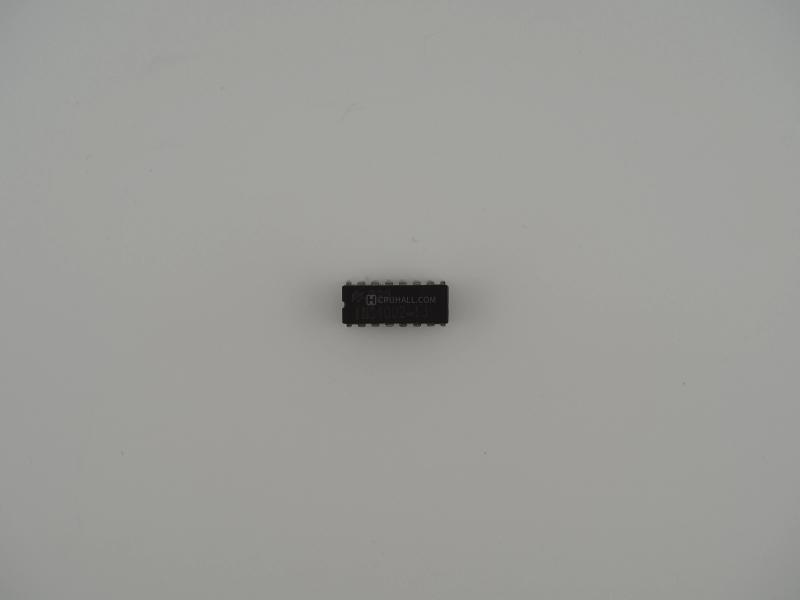
The top face features the classic, wavy "N" logo of National Semiconductor alongside a very crisp transcription:
(National Semiconductor Logo) 732
INS4002-1J
Flipping the artifact over reveals a different story. The underside has a matte, almost chalky texture. Stamped onto this surface in a slightly faded white ink are the markings:
EF4 1121X
The pins are heavily oxidized and show the unmistakable dark tarnish of vintage tin plating that has survived decades of atmospheric exposure. The 1J suffix typically denotes a Cerdip or specialized ceramic package in NatSemi nomenclature, but the dark, monolithic block here feels and looks remarkably like a standard plastic or frit-sealed black ceramic package. The date code 732 strongly points to the 32nd week of 1977.
To understand the INS4002, we have to talk about the legendary Intel MCS-4 architecture. This is not a processor. It is a 320-bit RAM chip. Yes, you read that correctly: 320 bits. That is precisely 40 bytes of memory.
The memory array is organized into four registers. Each register holds twenty characters, and each character is 4 bits wide. But the 4002 was not just dumb storage. The original Intel 4004 CPU was severely pin-constrained because Intel insisted on using a standard DIP-16 package. To get around this limitation, Federico Faggin and the Intel engineering team offloaded the I/O capabilities to the support chips. This means the INS4002 also contains a dedicated 4-bit output port.
When the CPU needed to talk to the outside world, it sent instructions over the proprietary 4-bit multiplexed bus to the 4002, telling the RAM chip to latch data onto its output pins. The -1 designation in the part number is also critical. Intel designed the 4002 in two variants: Option 1 and Option 2. They had different chip select wiring so hardware engineers could bank them together to expand the total system memory without needing complex external decoding logic. Fabricated on early PMOS (p-channel metal-oxide-semiconductor) nodes, these chips ran warm, required complex multi-voltage power supplies, and operated at a blisteringly slow 740 kHz.
The Intel 4004 family changed the world. Originally commissioned by the Japanese company Busicom for a desktop calculator, the MCS-4 chipset became the first commercially available microprocessor family. But Intel could not keep up with the explosive demand, nor did early industrial customers want to rely on a single, relatively new company for their critical silicon.
Enter the second-source agreements. National Semiconductor stepped up to clone the MCS-4 family, branding it the INS4000 series. Finding a NatSemi version of an Intel classic is a fantastic piece of semiconductor history. It represents an era where cross-licensing was the only way to build trust in the nascent microcomputer market.
It is incredibly humbling to look at this chip and realize it holds 40 bytes. Today, we measure cache in megabytes and system memory in gigabytes. If I wanted to host the cpuhall.com logo alone, I would need thousands of these chips wired in parallel. Yet, in the 1970s, a handful of these ICs were enough to control industrial machinery, run complex calculators, and kickstart the digital revolution.
Identification of this artifact is highly confident. The surface markings leave zero ambiguity regarding its function and origin. The "INS" prefix is National Semiconductor's standard identifier for second-sourced Intel parts. The "4002-1" maps flawlessly to the official Intel databooks for the MCS-4 320-bit RAM Option 1.
The underside stamping of EF4 1121X is a classic internal foundry or batch code. While exact decoding of NatSemi's internal batch numbers from the late 1970s is notoriously difficult without internal corporate records, "EF" often denoted specific fabrication plants or assembly lines in Southeast Asia. The fact that this chip survived in such solid physical condition, despite the oxidized pins, makes it a prime archival specimen for the museum.