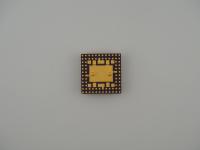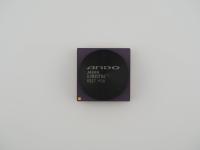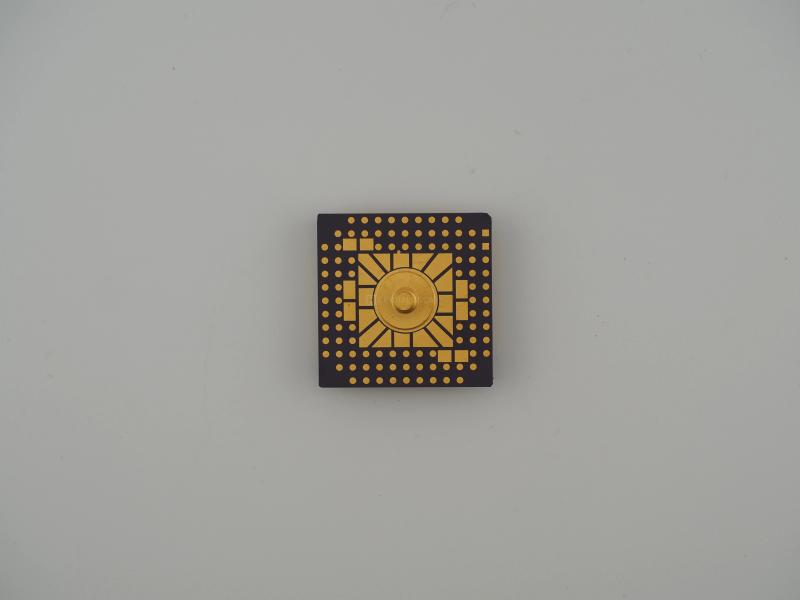

Holding this piece in my hand, I am immediately struck by its sheer density and uncompromising build quality. This specific unit represents the absolute pinnacle of ruggedized 1990s hardware manufacturing. It is built on a stunning, deep purple ceramic substrate, a material choice that instantly screams military or aerospace application. The top of the package features an array of exposed gold traces and test pads arrayed in concentric squares around a central, aggressively threaded gold stud.
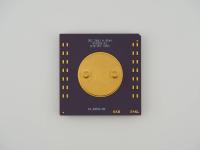
Flipping the artifact over reveals a cavity-down orientation. A massive, slightly domed gold cap protects the silicon die. The laser etching on the cap is incredibly crisp, and under macro lighting, the micro-contrast of the black lettering against the reflective gold is perfect. I was able to easily transcribe the following surface text:
(National Semiconductor Logo) H9736AB
FC2190UE
ML31E44X34
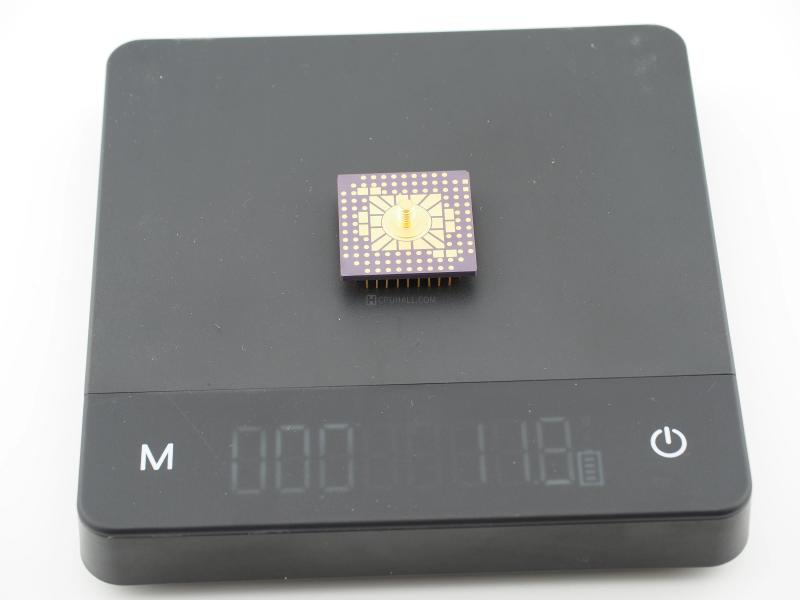
The pins themselves are beautifully brazed onto the ceramic. By my count, we are looking at an 11x11 outer grid populated only on the outermost three rows, resulting in exactly 96 gold pins. There is virtually no wear on the pins, suggesting this piece was either a highly prized spare or pulled from a socket with extreme care.
When examining the engineering of this package, the most glaring feature is that threaded central stud. In standard consumer hardware, heatsinks are clipped to a socket. In extreme environments where severe vibration or extreme G-forces are present, clips fail. This stud exists so that a custom, heavy-duty thermal mass could be physically bolted directly to the ceramic substrate. This ensures the thermal interface never separates during turbulence or mechanical shock.
The cavity-down packaging choice is also highly deliberate. By placing the die on the underside of the package, the thermal path to the top surface is vastly shortened. Heat transfers straight from the silicon through the ceramic and directly into whatever massive heatsink was bolted to that stud. The heavy use of gold plating is not just for our aesthetic enjoyment today. Gold is impervious to oxidation, ensuring perfect electrical contact in highly humid, corrosive, or extreme vacuum environments.
Given the 1997 date code, this silicon was likely fabricated on a 0.35-micron or 0.25-micron process. The fact that they went to such extreme lengths to cool what is ultimately a relatively low-pin-count package tells me that this specific die was pushing a tremendous amount of current for its size, likely operating at extremely high frequencies or handling massive analog-to-digital workloads.
National Semiconductor is a legendary name that sparks a lot of nostalgia in heavy metal hardware circles. While most people remember them for their consumer logic chips or their brief, weird ownership of the Cyrix x86 processor line, their true bread and butter was always in analog and specialized industrial components. They were absolute masters of creating rock-solid silicon that could survive the end of the world.
There is a persistent myth among collectors that any chip with a threaded stud is automatically a piece of Soviet or Russian aerospace hardware. While the Soviets certainly loved bolting things down, this artifact proves that American fabricators like National Semiconductor utilized the exact same mechanical solutions for their defense contractors. Pieces like this are artifacts of the post-Cold War military industrial complex, an era where the defense budget was shrinking, but the demand for computerized weapons systems and advanced radar logic was skyrocketing.
Researching a custom Application-Specific Integrated Circuit (ASIC) is always an exercise in forensic deduction. Unlike a consumer Pentium Pro where we have thousands of pages of published datasheets, the documentation for a chip like this was likely classified or limited to internal defense contractor catalogs.
Here is my analytical process for this artifact. The stylized "N" logo undeniably belongs to National Semiconductor. The first line of text, H9736AB, contains a standard date code format. The 9736 translates cleanly to the 36th week of 1997.
The primary part number FC2190UE is where the true mystery lies. The FC prefix in military electronics often designates "Flight Control" or "Fire Control," though without the original system schematic, that remains a highly educated guess on my part. The third line, ML31E44X34, is likely an internal fabrication batch code or a specific contractor requisition number. The ML could stand for Military Logic.
While I cannot definitively tell you if this chip was destined for a fighter jet, an industrial robotics platform, or a satellite, the physical evidence is conclusive. The thick purple alumina ceramic, the brazed pins, the bolted thermal interface, and the proprietary pinout all confirm this is a high-reliability, ruggedized ASIC designed for the most demanding environments imaginable. It is a brilliant, heavy metal addition to the museum.