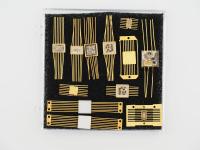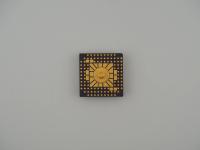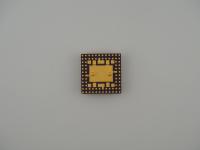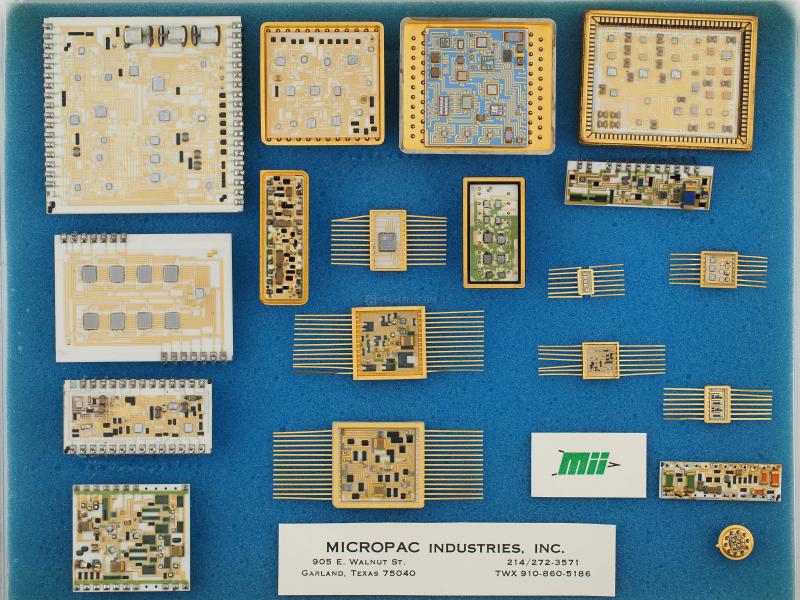

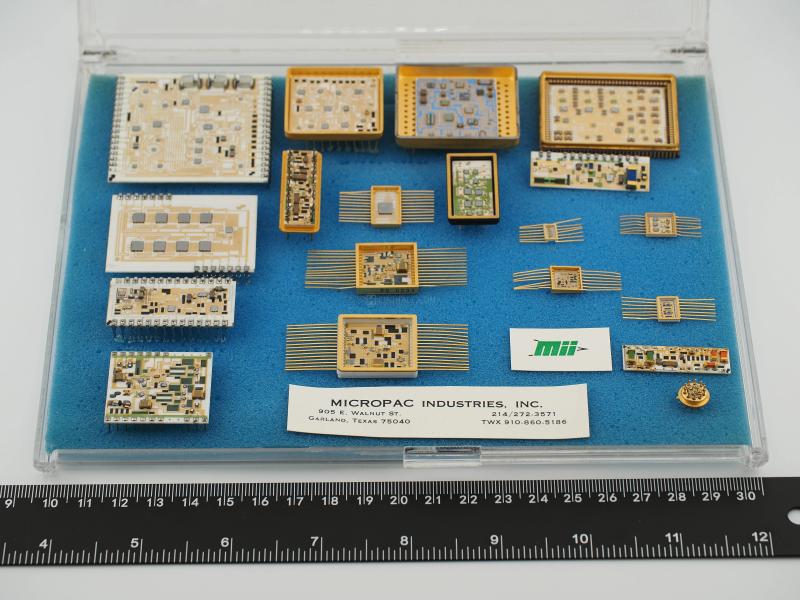
This is a manufacturer's sample kit from Micropac Industries, intended to showcase their multi-chip module (MCM) and hybrid microcircuit capabilities to defense contractors.
MICROPAC INDUSTRIES, INC.
905 E. WALNUT ST.                     214/272-3571
GARLAND, TEXAS 75040               TWX 910-860-5186
Logo: mii (Green with arrow)
Mask/Substrate ID: 9676
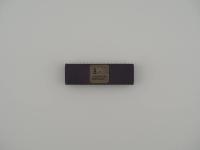
Stamped Part Number: 59 0233
Looking closely at the layout in my collection, we have several distinct packaging form factors. Some are flat-packs with gold leads extending out horizontally, designed for surface mounting in high-vibration environments. Others utilize a dense, gold-plated PGA (Pin Grid Array) base.
The undisputed visual centerpiece of this collection is the open-cavity PGA module featuring a vibrant blue substrate (clearly visible with the 9676 marking). Examining it under magnification reveals a breathtakingly complex network of gold traces printed over a blue dielectric layer. Attached directly to this substrate are multiple bare silicon logic and power dies. Dozens of microscopic gold wires bond the raw silicon to the surrounding traces, which then route out to the heavy gold-plated castellations on the perimeter of the package.
To the left, we have naked white alumina ceramic substrates heavily populated with screen-printed thick-film resistors (the dark grey squares). Some of these resistors show tiny, precise laser-trimming cuts used to dial in exact resistance values. The level of high-fidelity craftsmanship required to assemble these is staggering.
The engineering philosophy here completely bypasses the commercial computing world. These modules were built to comply with MIL-PRF-38534, specifically Class H (Military) or Class K (Space) standards.
Why use a hybrid microcircuit instead of a single, highly integrated silicon chip? In the world of extreme aerospace engineering, you often need to combine highly sensitive analog sensors, high-voltage power controllers, and digital logic into a single package. A single silicon foundry cannot optimize for all of those at once. By utilizing a thick-film hybrid approach, Micropac engineers could source the best individual bare dies from different manufacturers and integrate them onto a single, thermally matched ceramic substrate.
The materials are chosen for survivability. Standard fiberglass PCBs will outgas in a vacuum, warp under extreme thermal cycling, and offer poor thermal dissipation. The alumina ceramic substrates used here provide incredible rigidity and thermal conductivity. The Kovar metal packages and heavy gold plating ensure that the pins will not oxidize over decades of operation. Furthermore, packaging multiple bare dies together minimizes trace length, reducing parasitic capacitance and improving signal integrity in high-frequency or high-power military radars and communications equipment.
Micropac Industries was founded in 1963 in Garland, Texas. They are part of the massive, quiet network of specialized contractors that form the backbone of the American military-industrial complex. While companies like Intel and IBM fought for desktop dominance, Micropac focused on the extremes.
There is a running myth in consumer tech that modern, smaller transistors are always better. In the aerospace sector, the opposite is often true. As transistors shrink, they become highly susceptible to Single Event Upset (SEU) caused by cosmic rays and ionizing radiation outside the Earth's atmosphere. A stray cosmic particle can flip a bit in a modern CPU, causing a catastrophic software failure. These heavy metal, larger-node hybrids are inherently radiation-hardened. They are blunt instruments built to shrug off the harsh reality of deep space and nuclear environments. They powered the telemetry, power distribution, and guidance systems of an era defined by high-stakes aerospace dominance.
Researching the exact function of the chips in this display case presents a unique challenge. Because Micropac specializes in custom, application-specific designs for clients like Lockheed Martin, Northrop Grumman, and NASA, there are no public datasheets for these specific modules.
Based on the visual evidence, I can authoritatively state that the prominent blue module marked 9676 is a mixed-signal hybrid. The 9676 is almost certainly an internal mask identifier or project code rather than a commercial part number. The presence of surface-mounted passive capacitors alongside bare silicon logic dies suggests it functions as a Solid State Power Controller (SSPC) or a specialized telemetry interface. Micropac was renowned for its power management modules and optoelectronic isolators, both of which require exactly this kind of ruggedized, multi-die packaging.
The fact that the lids are omitted from these Kovar packages tells me this specific kit was used by a sales engineer in the 1990s to physically demonstrate Micropac's wire-bonding density and thick-film printing precision to defense procurement officers. Having this intact showcase in my collection is a rare window into the classified hardware that orbits above us right now.