
This artifact is a pristine example of Digital Equipment Corporation's legendary heavy-metal packaging, serving as the primary computational brain for their high-end machines, rather than just peripheral system logic.
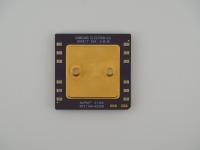
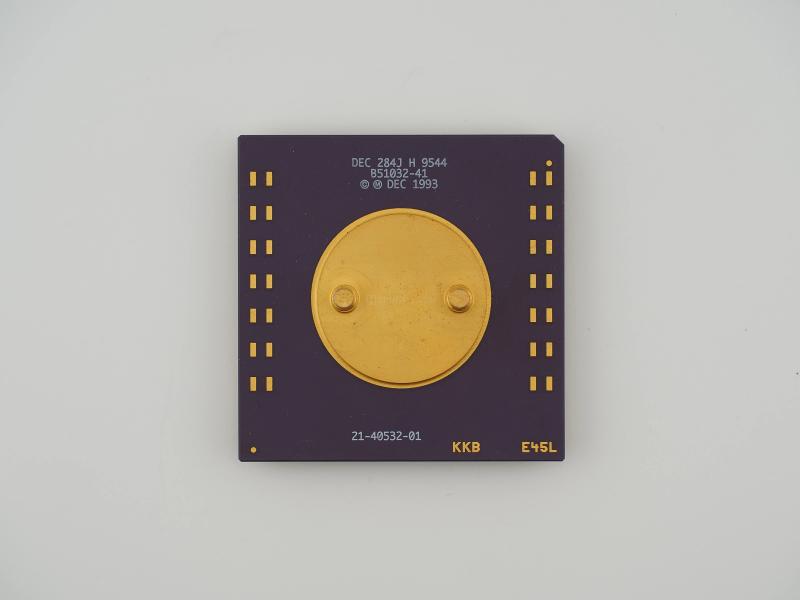
The top and bottom surfaces feature crisp laser etchings set against beautifully textured plum-purple ceramic:
Top Surface:DEC 284J H 9544
B51032-41
(C) (M) DEC 1993
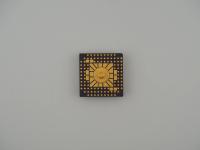
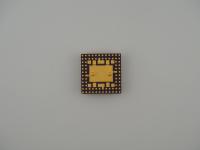
Bottom Surface:21-40532-01
KKB E45L
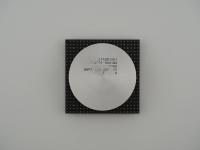
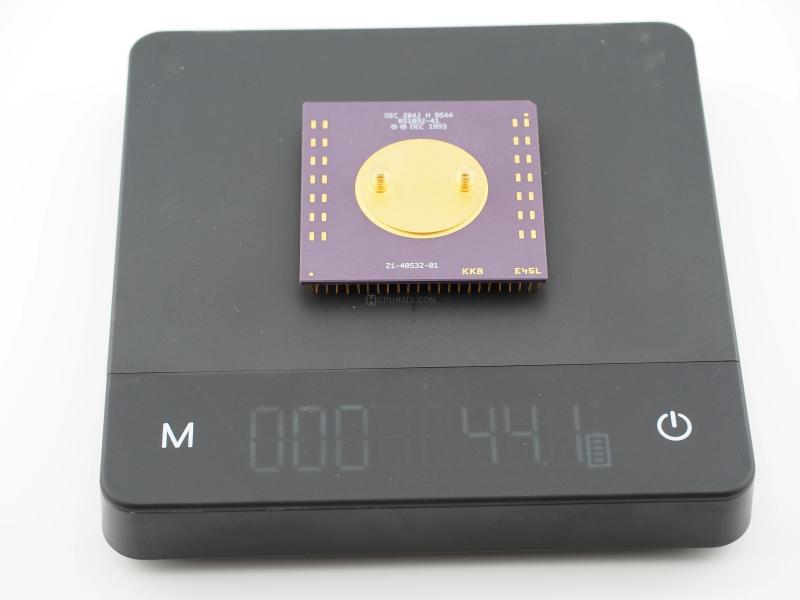
While the copyright dates to 1993, the 9544 date code indicates this specific Alpha chip was baked in the 44th week of 1995. Aesthetically, it is a masterclass in 1990s industrial design. The top features a massive, perfectly circular gold-tungsten heat spreader. Flanking the center are two structural mounting studs brazed directly onto the cap. Flipping the chip reveals a thick, central gold ground plane surrounded by a massive array of gold-plated pins in a staggered CPGA-431 (Ceramic Pin Grid Array) layout, with a chamfered corner indicating the socket orientation.
DEC left absolutely nothing to chance with the Alpha 21064A. Fabricated on a 0.5-micron CMOS-5 process, the EV45 was a die-shrink and cache upgrade over the original EV4 (CMOS-4). Pushing clock speeds well past 200 MHz in the mid-1990s meant these processors consumed upwards of 25 to 30 watts—a staggering amount of heat for the era.
The physical engineering of this chip directly reflects those thermal and electrical demands. The two gold studs were engineered to securely bolt down a massive heatsink, ensuring perfect thermal contact with the spreader and preventing the physical warping of the ceramic under extreme thermal cycles. Meanwhile, the 431-pin footprint was strictly necessary to accommodate the Alpha's massive 64-bit data and address buses, allowing it to move data at speeds that competing Intel chips simply could not match at the time.
The Alpha AXP represents one of the most ambitious and highly regarded microprocessor architectures ever created. It was designed from the ground up as a pure 64-bit RISC architecture with an intended 25-year lifespan. When a technician cracked open a DEC AlphaServer 1000 or a high-end AlphaStation workstation, seeing this purple ceramic monolith immediately signaled peak 1990s computing supremacy.
During this era, DEC held the crown for the world's fastest microprocessors. The Alpha chips were so blazingly fast that they were frequently chosen to render CGI for Hollywood blockbusters and power massive enterprise databases. The uncompromising, over-engineered nature of this purple-and-gold packaging became the physical embodiment of DEC's ethos: building hardware that was incredibly expensive, blisteringly fast, and built like a tank.
Identifying this specific piece as a main processor rather than a peripheral controller comes down to a few definitive physical and textual clues that align perfectly with DEC's internal nomenclature:
21-40532-01 and the internal 284J mask/fab code are the definitive DEC designations for the 21064A processor line.