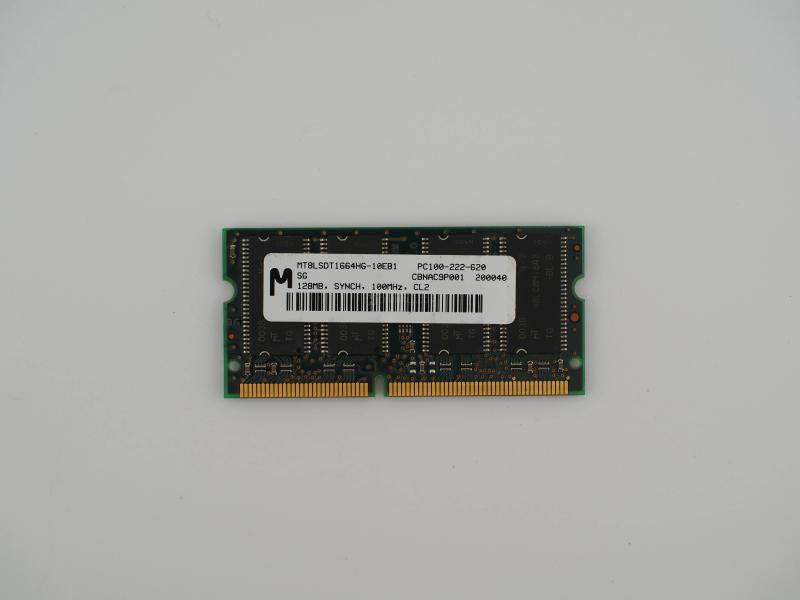

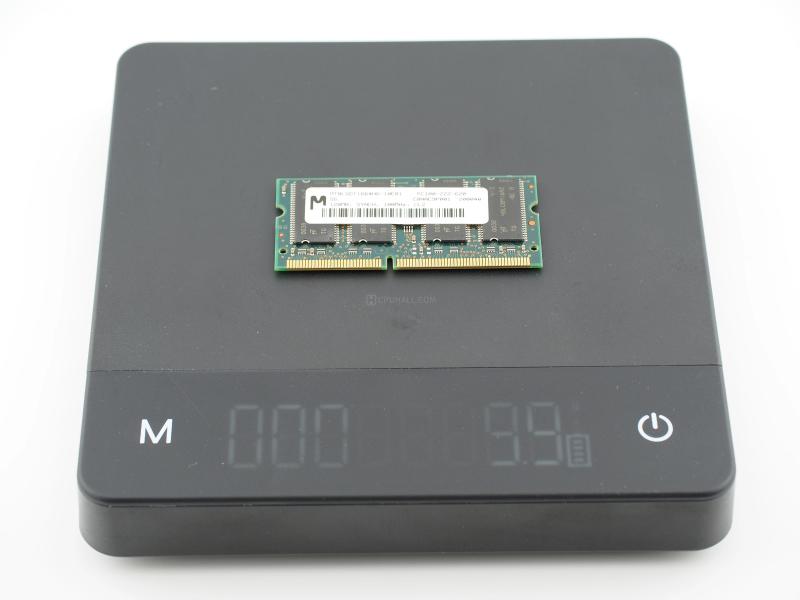
This specific unit is a classic mobile memory module, tipping the scales at a featherweight 9.9 grams and measuring exactly 68 millimeters across its gold-plated edge connector. The quintessential dark green PCB is heavily populated with surface-mount components, bearing the unmistakable branding of two tech giants: Micron Technology and IBM.
Micron Primary Label: MT8LSDT1664HG-10EB1
Micron Specs: 128MB, SYNCH, 100MHz, CL2 | PC100-222-620
Micron Batch: CBNAC9P001 200040
IBM FRU Label: * 11838L2982Z1Z17G0BV05Y *
IBM FRU Number: 38L2982
IBM Date Code: 2000-11-27
IBM QC Sticker: 11/00
Memory ICs: MT 48LC8M16A2 -8E B (Date code 0038)
Inspecting the surface, the TSOP (Thin Small Outline Package) memory chips dominate the real estate. There are eight discrete memory ICs in total, split with four on the front and four on the back. The stark white IBM FRU (Field Replaceable Unit) barcode sticker is practically pristine, accompanied by a small circular "11/00" quality control roundel. The gold pins along the 144-pin edge connector show only faint insertion wear, indicating this module lived a relatively settled life inside a single machine before being pulled for the collection.
Diving into the silicon layout, this module is a textbook execution of PC100 Synchronous Dynamic Random Access Memory. The "Synchronous" part was the defining upgrade of this era, meaning the memory clock was tied directly to the system bus clock, vastly improving data transfer efficiency over older asynchronous EDO RAM.
The core capacity is derived from eight Micron MT48LC8M16A2 chips. Decoding that part number reveals the internal architecture: these are 128-Megabit chips arranged as 8 Meg x 16 bits. When you multiply 16 Megabytes (128 Megabits) by the eight chips on the board, you arrive precisely at the 128MB total capacity. The -8E suffix on the chips denotes the speed grade, indicating an 8-nanosecond access time. This easily clears the requirements for the 100 MHz bus speed it is rated for, allowing the module to achieve a snappy CAS Latency of 2 (CL2). Operating at a standard 3.3 volts, this module would run warm but well within the thermal limits of a cramped laptop chassis.
In late 2000, slapping 128MB of memory into a mobile machine was a serious productivity move. This was the era of Windows 2000 and the impending shadow of Windows XP. Laptops were transitioning from luxury executive toys into true desktop replacements. The PC100 SO-DIMM standard was the lifeblood of this transition, giving mobile processors like the Mobile Pentium III the breathing room they needed to handle complex spreadsheets, early wireless networking, and multimedia playback.
Because of the heavy IBM branding, this specific memory stick was almost certainly the factory heart of an IBM ThinkPad, likely an early T-Series like the legendary ThinkPad T20 or T21. IBM was notorious for strict hardware whitelists and FRU verification. If you called IBM for support and you had third-party memory without that exact FRU sticker, they would often blame your upgrades for any system instability. Having genuine IBM-stamped Micron memory was the gold standard for corporate IT departments keeping fleets of black bento-box laptops alive in the field.
The physical evidence on this piece leaves no room for mystery. The manufacturer date codes are wonderfully synchronized, painting a clear timeline of global manufacturing at the height of the dot-com boom. The bare memory ICs were stamped out by Micron in week 38 of the year 2000. They were surface-mounted onto the PCB shortly after, yielding the Micron assembly code 200040 (week 40 of 2000). Finally, IBM took delivery, tested it, and slapped on their final FRU sticker dated 2000-11-27 with the 11/00 roundel for good measure.
It is a perfect, self-contained slice of early 2000s supply chain logistics. While it does not command the jaw-dropping prices of a gold-capped mainframe processor, these humble SO-DIMMs are the unsung heroes of computing history. They allowed millions of workers to take true computing power out of the office and into the world.