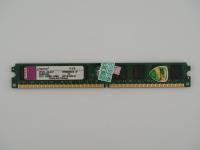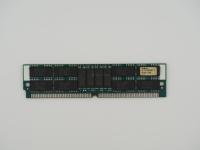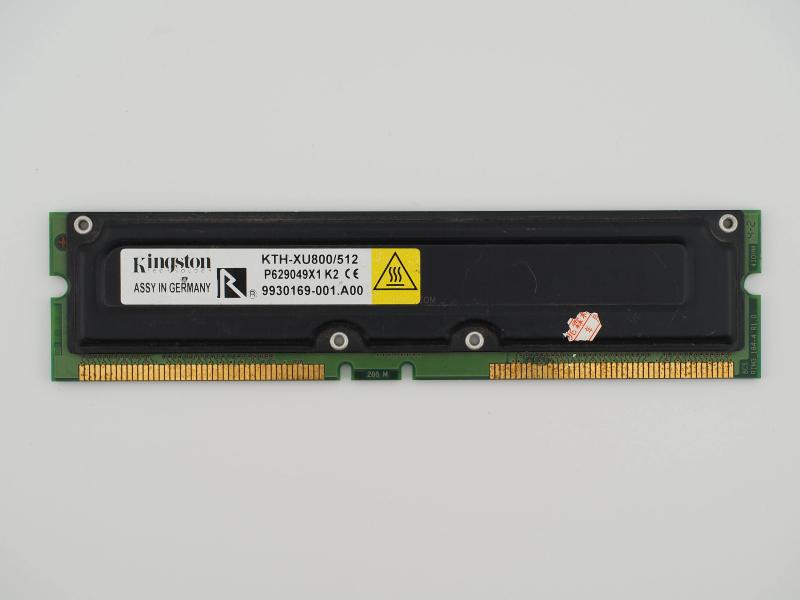

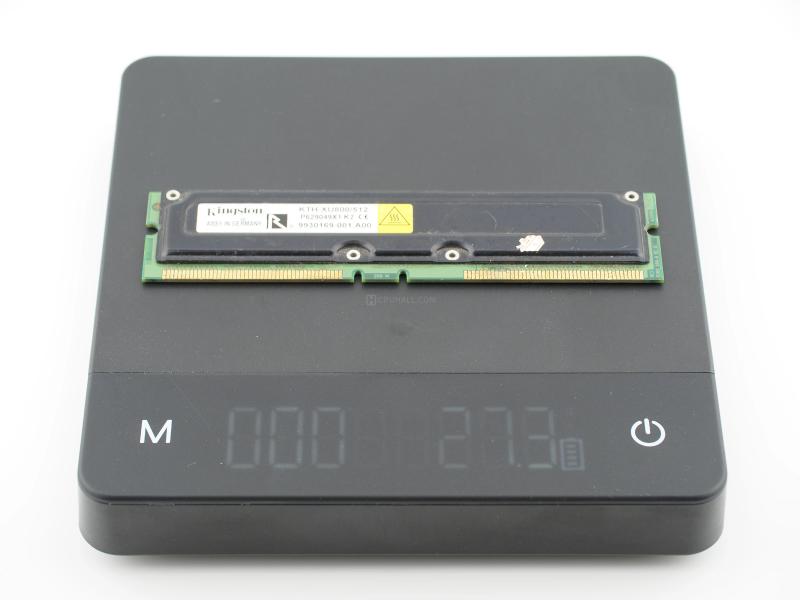
When examining this artifact, the very first thing that jumps out is the stark yellow burn hazard sticker. You do not see warnings like this on modern consumer DDR modules. Holding this specific unit, I immediately noticed the substantial feel of it. Weighing in at exactly 27.3 grams, a large portion of that mass comes from the heavy-duty black aluminum heatspreader enveloping the integrated circuits.
The laser-printed label provides exact traceability.
Kingston Technology
ASSY IN GERMANY
KTH-XU800/512
P629049X1 K2 CE
9930169-001.A00
PCB Markings: RIM3_184-4 R1.0 / 0119 94V-0
Looking closely at the exposed green PCB on the rear, the 0119 silkscreen points directly to a manufacturing date of the 19th week of 2001. The gold contacts along the 184-pin edge remain highly reflective and free of major oxidation. The distinctive dual-notch layout strictly prevented users from attempting to force this into standard SDRAM slots. It is a beautiful, brutalist piece of hardware that speaks perfectly to the era of its creation.
To understand why this module required a thick metal shroud and a literal burn warning, we have to look at the architecture. This is Direct Rambus DRAM (DRDRAM), operating at 800 MHz (400 MHz double-pumped). In the late 1990s and early 2000s, standard SDRAM was crawling along at 100 MHz or 133 MHz on a wide 64-bit bus. Rambus flipped the entire engineering paradigm on its head.
Instead of a slow and wide parallel bus, RDRAM utilized a narrow 16-bit serial bus running at blistering speeds. This specific PC800 module was capable of 1.6 GB/s of bandwidth. However, pushing silicon to 800 MHz in 2001 generated a tremendous amount of thermal energy. The black aluminum heatspreader was not a cosmetic gamer addition. It was a strict thermal requirement to keep the underlying silicon from experiencing thermal runaway.
The 184-pin RIMM interface also required absolute electrical continuity across the entire memory channel. If you had a motherboard with four RIMM slots and only bought two of these Kingston modules, you could not just leave the other slots empty. You had to install "CRIMMs" (Continuity RIMMs), which were dummy sticks containing nothing but terminating resistors, just to complete the circuit.
The story of Rambus is one of the most dramatic sagas in computer hardware history. Intel bet their entire early Pentium 4 architecture on RDRAM, believing that standard SDRAM could not scale to feed their heavily pipelined NetBurst processors.
This led to a disastrous market launch. RDRAM was punishingly expensive to manufacture, largely due to strict trace-routing requirements on motherboards and the hefty royalties demanded by Rambus Inc. Consumers balked at paying two to three times the price of standard memory just to build a new system. The intense heat, high latency, and exorbitant cost made RDRAM the villain of early 2000s tech forums.
A persistent myth is that Rambus was fundamentally bad technology. It was actually brilliant engineering. The Nintendo 64 and PlayStation 2 both successfully utilized Rambus technology for their memory architectures. It simply was not the right fit for the volatile, cost-sensitive PC desktop market. Eventually, the open standard of DDR (Double Data Rate) SDRAM caught up in bandwidth, vastly undercut Rambus in price, and rendered these beautiful, hot-running RIMM modules entirely obsolete.
Identifying the exact origin of this Kingston module requires breaking down its specific part number. The KTH prefix in Kingston's nomenclature is critical here. It stands for Kingston Technology HP.
Unlike generic "ValueRAM" meant for custom PC builders, this stick was specifically binned and programmed for Hewlett-Packard and Compaq workstations. During the RDRAM era, motherboards were notoriously finicky about memory densities and chip configurations. System integrators like HP required guaranteed compatibility for their high-end CAD stations and servers. This 512MB module was a massive, incredibly expensive upgrade part in 2001, likely purchased for an HP Kayak PC Workstation or an early Compaq Evo system serving enterprise environments. The "Assy in Germany" text further supports this, as European assembly often serviced regional enterprise contracts for HP at the time.