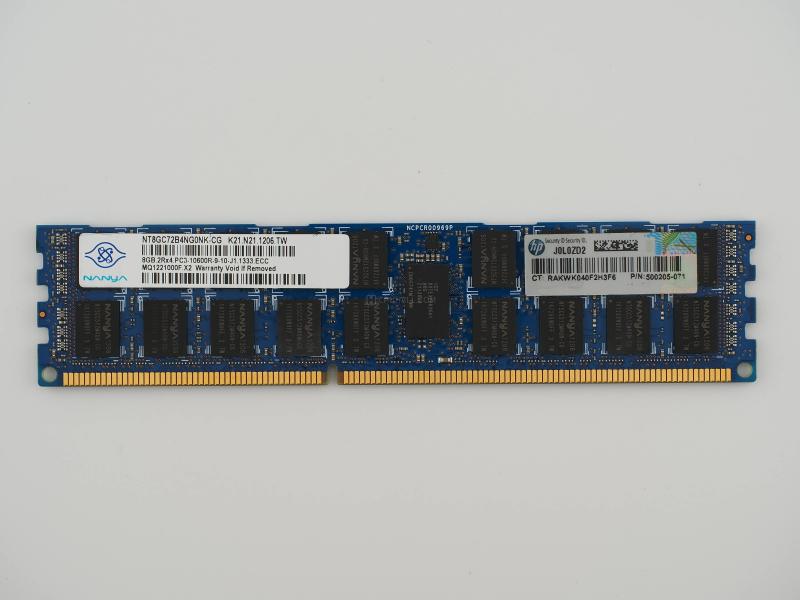

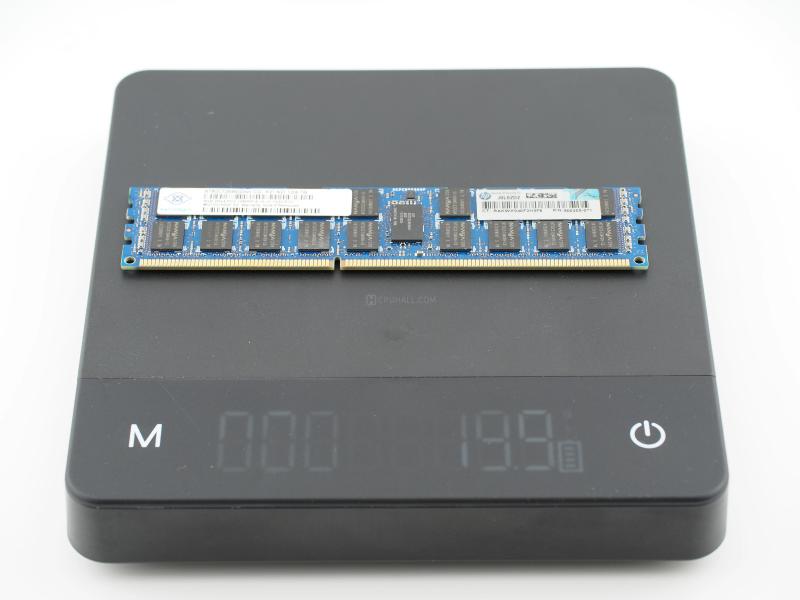
I love sorting through server pulls, and holding this piece immediately grounds you in the utilitarian reality of enterprise hardware. Dropping it on the scale, it weighs exactly 19.9 grams, a perfectly standard heft for a fully populated, double-sided server DIMM. The PCB features a classic, vibrant Nanya blue solder mask that contrasts beautifully with the gold pins along the 240-pin edge connector.
Looking closely at the surface text, the micro-contrast on the BGA packages is wonderfully sharp. The laser etching on the black epoxy resin of the memory modules is perfectly legible, and the microscopic surface mount resistors arrayed along the bottom edge (the tiny 300 and 330 ohm resistor packs) are flawlessly aligned. The prominent HP holographic security sticker adds a nice touch of corporate authenticity.
Front Label (Nanya):NT8GC72B4NG0NK-CG K21.N21.1206.TW
8GB.2Rx4.PC3-10600R-9-10-J1.1333.ECC
MQ1221000F.X2 Warranty Void If Removed
Front Label (HP OEM):Security ID Security ID.
hp J0L0ZD2
CT: RAKWK040F2H3F6 P/N: 500205-071
Memory ICs (x36 total across both sides):NANYA1206
NT5CC512M4GN-CG
147268W0FF 3 TW
Register/Buffer IC (Center front):IDT
SSTE32882KA1
AKG
Z1130CH
CH05741M TWN
Diving into the technical weeds, this artifact is a fascinating example of high-density signal management. The beating heart of this stick is not the memory itself, but that central IDT SSTE32882KA1 chip. This is the Registering Clock Driver (RCD). In a standard unbuffered desktop system, the CPU memory controller has to talk directly to every single memory chip. When you scale up to massive server boards with 18 or 24 RAM slots, the electrical load on the CPU memory controller becomes completely unmanageable. The IDT register chip solves this by acting as a middleman. The CPU sends command and address signals to the register, and the register buffers, amplifies, and rebroadcasts those signals to the 36 individual Nanya memory chips on the PCB.
The Nanya chips themselves, marked NT5CC512M4GN-CG, are 2-gigabit DDR3 ICs organized in a 512M x 4-bit configuration. Because the stick is labeled 2Rx4, we know it is a dual-rank configuration. It uses a standard 1.5V operating voltage, generating a fair bit of heat under sustained database loads, though clearly not enough to warrant the aluminum heat spreaders you see on modern DDR4 or DDR5 enterprise memory. The ECC (Error Correcting Code) implementation adds an extra 8 bits of data width per 64-bit channel, allowing the system to silently fix single-bit memory errors caused by cosmic rays or electrical interference.
This specific architecture represents the absolute workhorse of the early 2010s cloud computing explosion. When Intel launched the Nehalem and Westmere Xeon architectures, data centers purchased memory just like this by the literal shipping container. It is the unsung hero that ran the early virtualized world on hypervisors like VMware ESXi 5.0.
Because millions of these were manufactured, they carry a very specific, slightly funny legacy in the hardware community today. Almost every IT professional or homelab enthusiast has a plastic bin overflowing with these exact 8GB PC3-10600R sticks. They are too small for modern, heavy-duty server deployments but far too reliable to throw in the recycling bin. There is also a persistent hardware myth among novice PC builders who find these dirt cheap online and try to jam them into consumer desktop motherboards. They expect a massive 64GB cheap memory upgrade, only to be greeted by an angry motherboard beep code. Standard desktop BIOS microcode simply has no idea how to talk to that IDT register chip.
The provenance of this artifact is rock solid and requires very little guesswork. The prominent HP sticker with the 500205-071 part number confirms this was sold as a Hewlett-Packard Enterprise OEM option part. Checking the historical documentation, this exact part number corresponds to an 8GB PC3-10600 Registered CAS-9 memory kit deployed extensively across the legendary HP ProLiant G6 and G7 server generations, particularly the DL380.
The date codes on the Nanya memory ICs provide the final piece of the timeline. Reading 1206, this indicates the memory packages were fabricated in the 6th week of 2012. This places the assembly of this stick right at the tail end of the DDR3-1333 era, perfectly coinciding with the transition period from the older Xeon 5600 series to the massive LGA-2011 Sandy Bridge-EP processors. The holographic security elements on the HP sticker remain intact, proving this is a genuine enterprise channel pull and not a grey market reproduction.