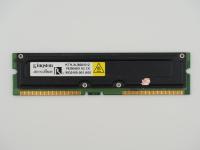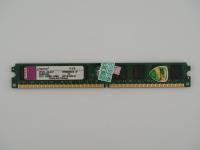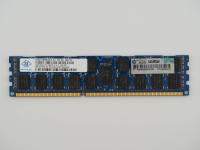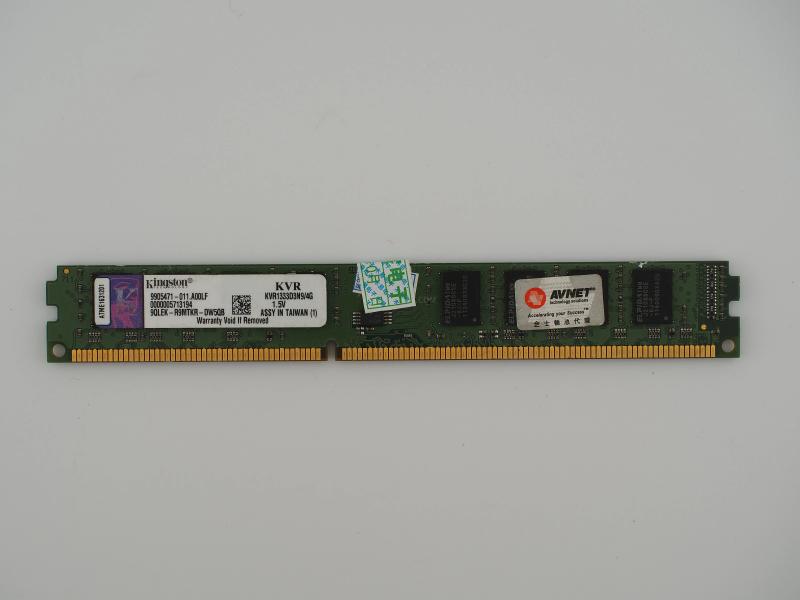

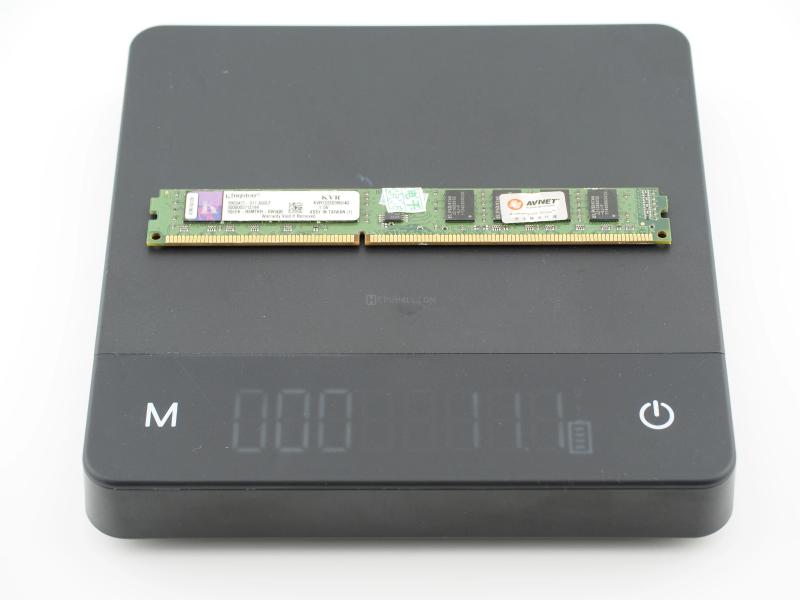
This is not a boutique, over-engineered gaming module hiding behind a pound of anodized aluminum. It is a bare, unapologetic slab of green fiberglass PCB, populated with exposed black silicon and speckled with a chaotic array of distributor stickers. Placing it on the scale, it registers a mere 11.1 grams.
What makes this module visually striking to a collector is the low-profile form factor. Measuring up against the ruler, the PCB height is just around 18.3 mm, making it a standard Very Low Profile (VLP) or simply Low Profile DIMM. The gold plating on the 240 pins is still remarkably bright, showing only minor insertion wear.
The surface text tells the entire story of its commercial life. Here is the exact forensic breakdown of the silicon and paper trails:
Kingston Holographic Security Label: ATME1631201
Kingston Specifications Label:9905471-011.A00LF
0000005713194
9QLEK-R9MTKR-DW5QB
KVR1333D3N9/4G
1.5V
ASSY IN TAIWAN (1)
Distributor Sticker (Over RAM IC):AVNET technology solutions
Accelerating your Success
金士顿总代理 (Kingston General Agent)
Local Retail Warranty Sticker (Green):电子木易电子 (Mu Yi Electronics)
Tamper dates checked for 10月 (October)
Elpida Memory ICs:ELPIDA TWN
J2108BCSE
-DJ-F
11340933C20
1140090X420
The micro-contrast on the Elpida laser etching is incredibly sharp. The 1134 date code clearly stamps the birth of these chips to the 34th week of 2011. The mixture of the official Kingston hologram, the massive AVNET distributor badge, and the small green Chinese shop tamper sticker gives this piece a rugged, traveled aesthetic. It is a working-class hero of the computing world.
Diving into the technical weeds, this module is an incredible snapshot of mainstream memory architecture from the early 2010s. The Kingston ValueRAM (KVR) line was designed to meet strict JEDEC industry standards without any overclocking headroom fluff.
The core of this artifact relies on sixteen discrete memory ICs (Integrated Circuits), with eight soldered to the front and eight to the back. These are Elpida J2108BCSE-DJ-F modules. Breaking down that specific part number reveals the internal geometry. The J designates DDR3 SDRAM. The 21 indicates a 2-Gigabit density per chip, organized as 256 Megawords by 8 bits (x8 organization). Multiply 2Gb by 16 chips, and you get exactly 32 Gigabits, which translates perfectly to the 4 Gigabytes of total module capacity.
The -DJ suffix is the speed bin. It natively supports a clockspeed of 1333 MT/s (PC3-10600) with a CAS Latency (CL) of 9. It runs at the JEDEC standard 1.5 volts, which was the baseline before DDR3L brought voltages down to 1.35V. The chips are packaged in standard 78-ball FBGA (Fine-Pitch Ball Grid Array) enclosures.
The low-profile nature of the PCB is a masterclass in trace routing. Shrinking the vertical height of a DIMM by nearly half while maintaining signal integrity at 1333 MHz requires tight manufacturing tolerances. These VLP modules were heavily favored by system integrators building cramped OEM desktops or 1U rackmount servers where every millimeter of airflow was absolutely critical.
The history of this specific stick is tied to the dramatic rise and fall of Elpida Memory. Founded in 1999 as a joint venture between NEC and Hitachi (with Mitsubishi's DRAM business absorbed later), Elpida was the last great Japanese champion of dynamic random-access memory. At their peak, they produced some of the finest, highest-yielding silicon on the market.
However, the DRAM market is notoriously brutal. A massive price crash in the late 2000s, coupled with a strong Japanese Yen, bled the company dry. In early 2012, just months after the silicon on this very artifact was fabricated, Elpida filed for bankruptcy. They were eventually acquired by Micron Technology in 2013. Therefore, holding an Elpida-branded DDR3 chip from late 2011 is essentially holding a relic from the final days of Japan's independent DRAM empire.
Kingston, on the other hand, survived and thrived by acting as the ultimate aggregator. Kingston does not fabricate their own silicon. They buy wafers or packaged chips from giants like Samsung, Hynix, and Elpida, assemble them onto PCBs, and validate them. This module is a perfect representation of that symbiotic relationship.
There is no mystery regarding the identity of this module, but its specific physical journey is fascinating to track.
The "ASSY IN TAIWAN" print on the main label confirms Kingston populated the PCB at their Taiwanese facilities. From there, it entered the global supply chain, landing in the hands of Avnet. The silver Avnet sticker specifically features the text "金士顿总代理", marking Avnet as the authorized general distributor for Kingston within the Greater China region.
The green sticker layered haphazardly over the PCB traces is the final piece of the puzzle. "木易电子" (Mu Yi Electronics) is a classic moniker for a local computer hardware vendor in a Chinese electronics market (like Huaqiangbei in Shenzhen or Zhongguancun in Beijing). These fragile paper stickers are applied over screw holes or components as a crude anti-tamper warranty seal. If the builder returns the part and the sticker is torn, the warranty is void.
This specific 4GB module lived its life powering a desktop in the Chinese domestic market. It survived its commercial deployment, was eventually stripped from its motherboard during an upgrade cycle, and has now found its way to my desk. It is a flawless, functioning artifact of globalized technology distribution.