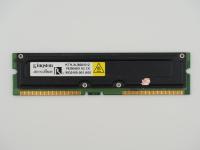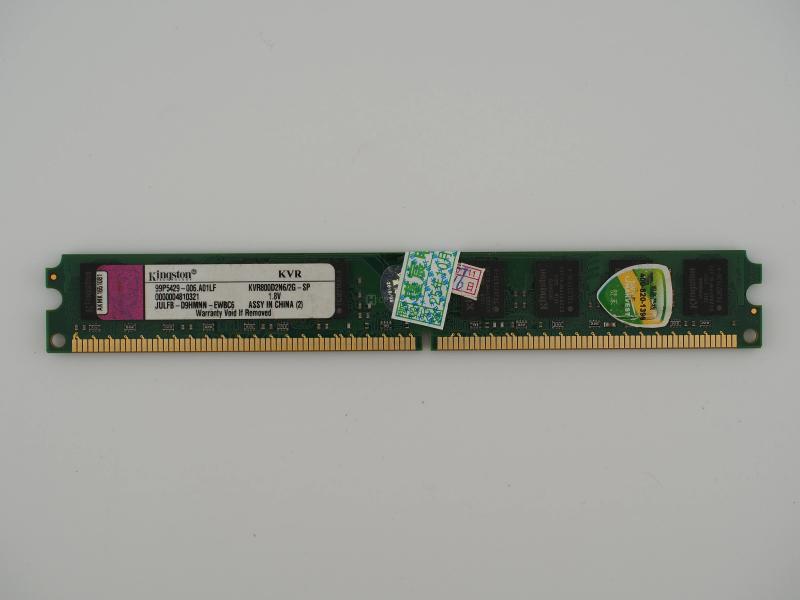

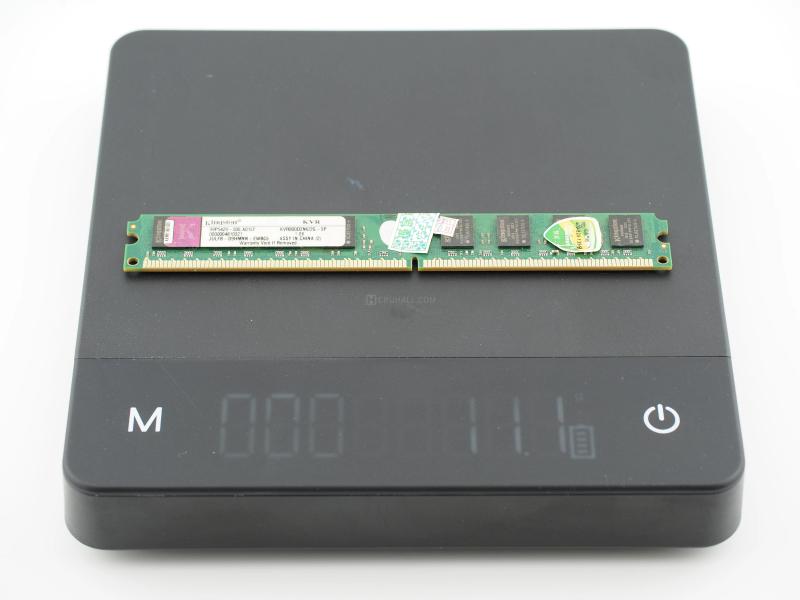
We are looking at a classic 2GB Kingston ValueRAM DDR2 module. Dropping it on the scale, it registers a feather-light 11.1 grams, and lining it up against the calipers confirms the standard 13.3 centimeter span of a 240-pin DIMM.
The visual details on this specific unit are wonderfully preserved. The classic green solder mask is flawless, and the gold contact pins show minimal insertion wear. What I always love checking on these modules is the security labeling. Kingston was battling a massive wave of counterfeits during this era, and this artifact features the genuine color-shifting magenta anti-counterfeit strip on the left side of the main specification label.
There is also a fantastic piece of localized provenance on this stick. Slapped right over the central PCB traces is a shield-shaped holographic sticker for a Chinese distributor, reading "Joint Harvest 赞本" with a toll-free service hotline. It is these little supply chain artifacts that give standard hardware a distinct life story.
Here is the exact transcription of the surface data from the labels and the silicon packages:
Main Specification Label:
Kingston KVR99P5429-006.A01LF KVR800D2N6/2G-SP
0000004810321 1.8V
JULFB-D9HMNN-EWBC6 ASSY IN CHINA (2)
Warranty Void If Removed
Holographic Distributor Sticker:服务热线
400-820-1399
Joint Harvest
赞本
DRAM IC Surface Etching (Per Chip):Kingston
S0356976
1018 S0CX
D1288TPMFGL25S
TGK853A3G-A
Diving into the technical weeds, the KVR800D2N6/2G-SP part number tells us exactly what this module was built to do. It is an 800 MT/s DDR2 module, often referred to as PC2-6400, operating with a CAS Latency of 6 (the N6 in the part number). It runs at the JEDEC standard 1.8 volts, making it a drop-in workhorse for almost any motherboard of the era.
Looking at the memory ICs themselves, we have Kingston-branded chips. It is a 2 Gigabyte stick, and counting the packages reveals an 8-chip layout per side, meaning it utilizes 16 chips in total. The part number D1288TPMFGL25S indicates these are 1 Gigabit capacity dies organized as 128M x 8-bit.
Kingston is technically a fabless memory manufacturer. They do not bake the silicon wafers themselves. Instead, they purchase DRAM dies in massive bulk from fabricators like Elpida, Nanya, or Hynix, and then package and test the chips in-house. This allowed them to bin the memory aggressively for their ValueRAM line, ensuring extreme compatibility at a rock-bottom price point for system builders.
In the museum, we have exotic mainframe ceramic modules and one-off engineering samples, but pieces like this Kingston ValueRAM represent the actual backbone of global computing. During the massive transition from Windows XP to Windows Vista and Windows 7, millions of these exact sticks were slotted into Core 2 Duo and early AMD Athlon 64 X2 systems.
The lore surrounding ValueRAM is entirely based on its legendary reliability. While gamers and overclockers were spending huge premiums for Corsair Dominator or OCZ memory with massive heat spreaders, IT departments and budget builders knew that standard bare-PCB Kingston memory would almost never fail. It lacked the aesthetic flair of aluminum heat sinks, but DDR2 at 1.8V rarely generated enough thermal load to require them anyway.
A common myth from this era was that branded chips (like Corsair or Kingston) were inherently faster than generic green sticks. In reality, under the plastic packaging, they often rolled off the exact same Elpida or Qimonda fabrication lines. The difference was strictly in the testing, the binning process, and the warranty.
When authenticating a piece of common hardware like this, the date codes tell the most concrete story. Scanning the laser etching on the Kingston memory packages, we see the code 1018. This perfectly dates the fabrication of these DRAM chips to the 18th week of 2010.
This date is actually quite fascinating for DDR2 memory. By mid-2010, Intel's Nehalem architecture and AMD's AM3 platform were already pushing the industry heavily toward DDR3. The fact that this DDR2 module was manufactured in 2010 suggests it was produced for the massive upgrade market. Millions of users were trying to squeeze a few more years out of their aging LGA 775 motherboards, and dropping in an extra 2GB or 4GB of DDR2 was the cheapest way to make Windows 7 run smoothly. The "Joint Harvest" sticker further solidifies this as a component likely sold into the bustling Chinese DIY or repair market, a secondary life for a mature technology.