
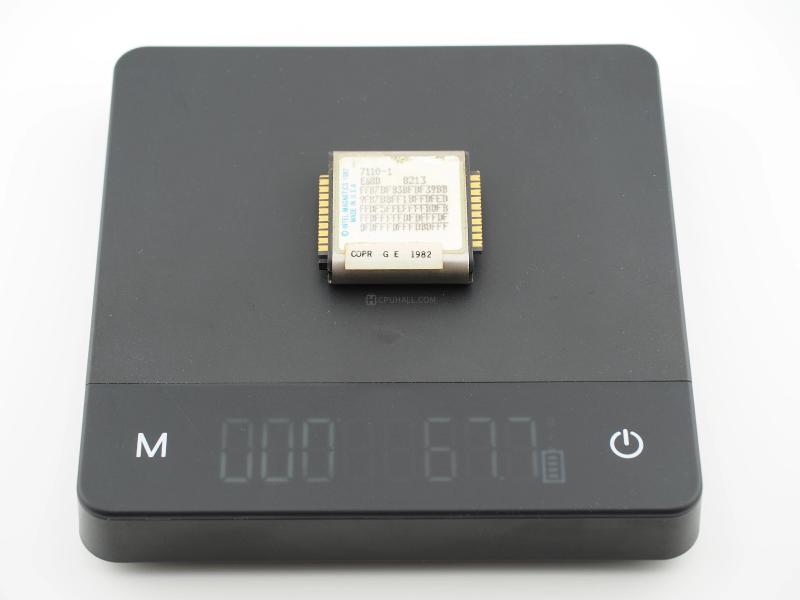
Holding this piece, the very first thing I noticed is the sheer, undeniable density of it. Weighing in at exactly 67.7 grams, this is not your typical delicate silicon wafer. It feels like a solid ingot of Cold War industrial engineering. It is an Intel 7110-1 Magnetic Bubble Memory module, and it is easily one of the most mechanically bizarre and visually fascinating pieces of hardware in my entire collection.
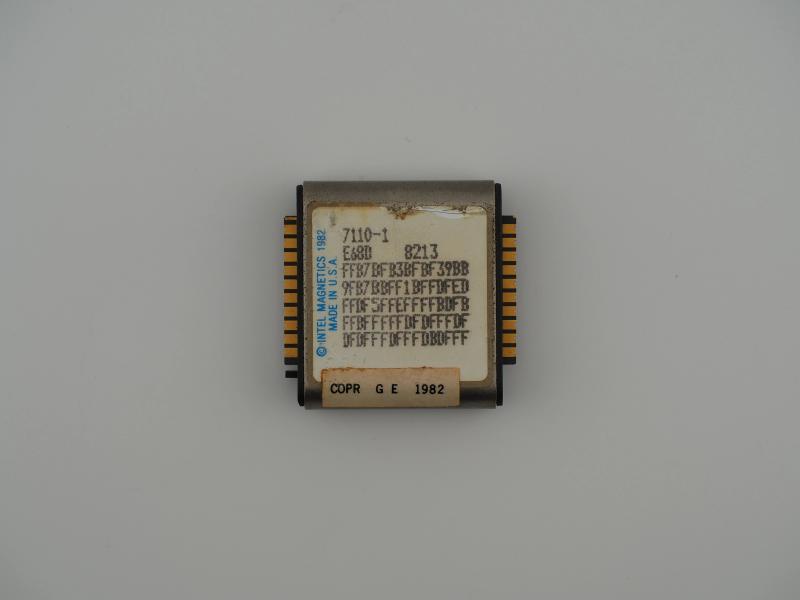
Looking closely at the top ceramic and metal surface, the printed labels are an absolute treasure trove of diagnostic history. The top text is clear and proudly announces its lineage.
© INTEL MAGNETICS 1982
MADE IN U.S.A.
7110-1
E68D    8213

FFB7BFB3BFBF39BB
9FB7BBFF1BFFDFED
FFDF5FFEFFFBDFB
FFBFFFFFDFDFFFDF
DFDFFFDFDFFDBDFFF

COPR  G E  1982
The gold edge contacts on this module are radically different from standard memory packages. Rather than standard pins, it utilizes specialized flat gold pads set within deep notches, designed to be clamped into a heavy-duty socket. The physical texture of the thick, non-magnetic metallic casing serves a vital purpose, acting as a massive shield to protect the delicate internal magnetic fields from external interference.
To understand why this block is so heavy and complex, we have to look at how magnetic bubble memory actually works. This is not solid-state memory in the way we understand flash storage today. Instead of trapping electrons in floating gates, bubble memory relies on microscopic magnetic domains (the "bubbles") moving through a thin film of synthetic garnet.
Inside this heavy casing are two orthogonal electromagnetic coils. When energized by a controller like the Intel 7220, these coils generate a rotating magnetic field. This field physically pushes the magnetic bubbles along predetermined tracks at rapid speeds. Because the bubbles are maintained by permanent magnets housed inside the casing, the memory is entirely non-volatile. You can rip the power out, and the data stays physically magnetically frozen in place.
The most striking visual element of this artifact is that block of hex code printed on the top label. That is not a serial number. That is a hard-coded bad loop map. Fabricating microscopic magnetic tracks in garnet in the late 1970s and early 1980s was an incredibly imperfect science. Intel knew that every single chip would have defects. The 7110-1 has a total of 320 magnetic loops, but only 256 of them are required to function to achieve its 1-megabit capacity. The hex dump on this label was read by the memory controller to map out the dead loops. Every single Intel 7110 leaving the factory had a totally unique hex label printed on it, making each piece a literal one-of-a-kind artifact.
Bubble memory is the ultimate high-tech dead end. In the late 1970s, the industry was convinced that bubble memory was going to completely eradicate the spinning hard disk drive. It offered non-volatile storage with zero moving mechanical parts. Intel believed in it so heavily that they spun off an entirely separate division, Intel Magnetics, just to conquer this new frontier.
However, the reality of manufacturing these chips was brutal. They were expensive, difficult to scale, incredibly sensitive to temperature fluctuations, and quite slow compared to emerging DRAM technologies. As the 1980s progressed, standard hard drives plummeted in price and skyrocketed in capacity, while battery-backed CMOS RAM and eventually EEPROM flash memory consumed the low-capacity solid-state market.
Yet, bubble memory found a legendary foothold in environments where a spinning hard drive would instantly shatter. Military applications, aerospace, and heavy industrial CNC machinery loved the 7110 because it was virtually immune to vibration and shock. You could bolt an Intel 7110 into an industrial lathe, shake it to death, and the data would remain pristine.
Researching the exact provenance of this specific unit reveals some fascinating cross-industry collaboration. The date code 8213 tells us this module was packaged in the 13th week of 1982. The 7110-1 designation confirms it is the standard 1-megabit part (roughly 128 Kilobytes of usable storage).
The most intriguing detail is the secondary paper sticker applied to the bottom: COPR G E 1982. While bubble memory patents were largely dominated by Bell Labs and Intel, General Electric was a massive consumer of these specific chips for their heavy industrial machinery. GE Fanuc CNC controllers from the early 1980s famously utilized Intel bubble memory cassettes to store machining programs. The addition of a secondary copyright sticker strongly suggests this unit was an OEM part allocated directly to GE for use in their industrial control systems. The wear on the label and the slightly oxidized state of the metal casing further corroborate its life on a factory floor rather than in a pristine lab environment.
This heavy block of garnet, magnets, and gold is a beautiful reminder of an era when the entire computing industry bet heavily on the wrong horse, resulting in some of the most spectacularly over-engineered components in hardware history.