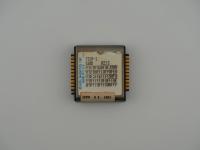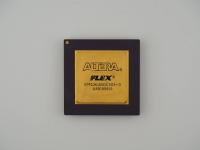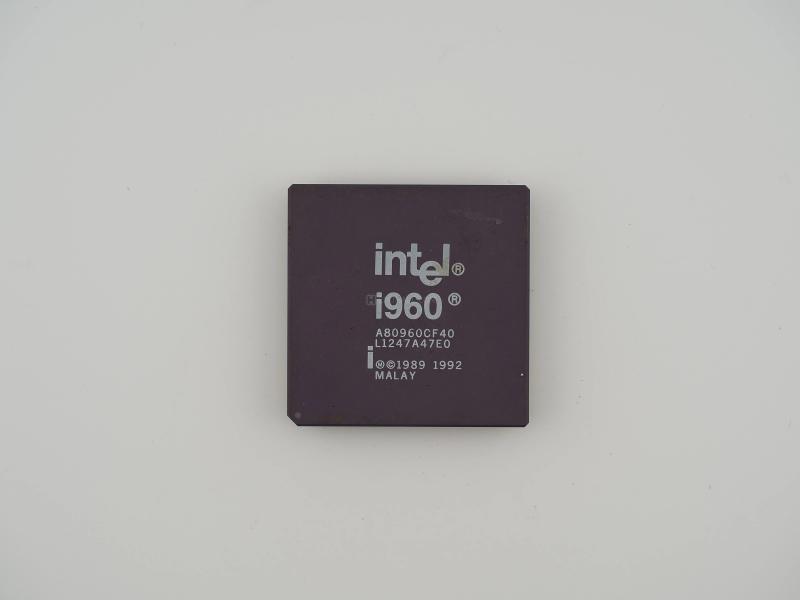

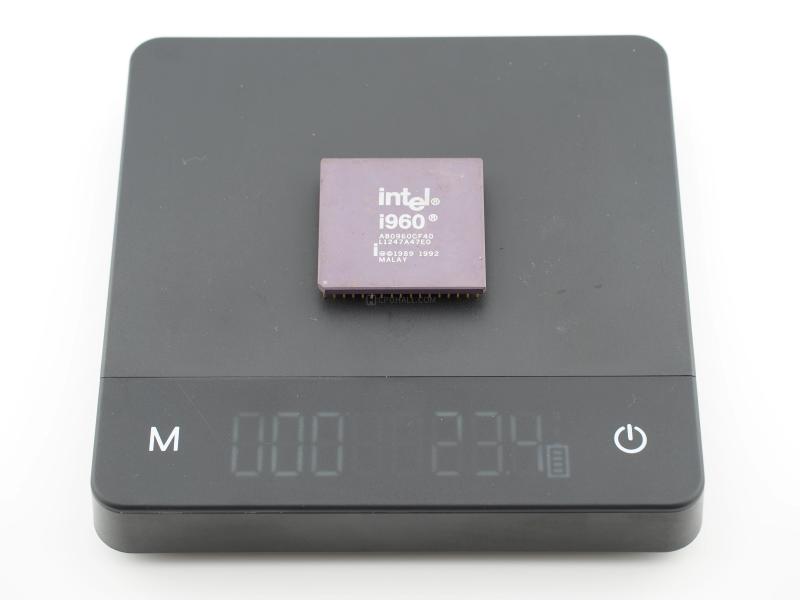
Tipping the scales at exactly 23.4 grams, this specific unit is housed in a gorgeous, deep purple-grey ceramic substrate that feels incredibly dense. The contrast between the dark ceramic and the stark white, perfectly preserved laser etching is exactly why I love collecting this era of hardware.
Flipping the chip over reveals a pristine 132-pin gold grid. The pins are arranged in a classic three-row deep square around a central black cavity slug. The gold brazing on the pins is immaculate, catching the light perfectly in the macro box.
Here is the exact surface text transcribed from the face of the artifact:
intel (R)
i960 (R)
A80960CF40
L1247A47E0
i (M) (C) 1989 1992
MALAY
The silicon under that black central slug represents a fascinating pivot in microprocessor design. The 80960CF is a 32-bit RISC architecture. The "C" series of the i960 family holds a very special place in engineering history because it was the world's first commercially available superscalar microprocessor. It could dispatch and execute multiple independent instructions during a single clock cycle, a feature that would not become mainstream in desktop x86 processors until the Intel Pentium.
This specific chip runs at 40 MHz. The "CF" variant was a slight evolution over the base "CA" model, integrating a larger 4KB instruction cache alongside a 1KB data cache to keep the superscalar pipeline fed with data. It lacks a Memory Management Unit (MMU) or a Floating Point Unit (FPU), which perfectly highlights its intended use case. This was not meant to run operating systems with virtual memory. This silicon was designed to crush integer math and handle raw input/output operations as fast as physically possible.
The story of the i960 is one of failure turned into massive, unexpected success. The architecture originally spawned from a joint venture between Intel and Siemens called BiiN. The goal was to create a highly secure, object-oriented processor for fault-tolerant banking and military systems. The BiiN project completely collapsed under its own massive ambition and complexity.
Left with millions of dollars in R&D and a bizarre, highly complex RISC architecture, Intel executives made a brilliant move. They stripped out the bloated object-oriented microcode, streamlined the instruction set, and aggressively marketed the chip to the embedded market.
It was an absolute triumph. While Intel's other RISC processor, the i860, struggled to find an identity, the i960 quietly powered the infrastructure of the 1990s. If you used a high-end X-Terminal, a hardware RAID controller, a core network switch, or a premium laser printer during that decade, you were almost certainly relying on an i960. More famously, a radiation-hardened version of the i960 architecture was chosen to power the core flight computers of the F-22 Raptor fighter jet.
Visual identification of this artifact is definitive. The part number A80960CF40 tells the entire story without any guesswork. The "A" prefix specifically designates the 132-pin Ceramic Pin Grid Array (CPGA) package we see here. The "CF" dictates the core revision with the expanded cache, and the "40" confirms the 40 MHz clock multiplier.
The dual copyright dates of 1989 1992 align perfectly with the release timeline of the CA and CF iterations. The FPO lot code L1247A47E0 combined with the MALAY stamp indicates this piece was fabricated and packaged at Intel's assembly plant in Penang, Malaysia. Finding one in this physical condition, with zero bent pins and zero thermal paste residue, is a genuine treat. It likely spent its life as a spare replacement part or was pulled from an embedded board that lived in a perfectly climate-controlled server room.