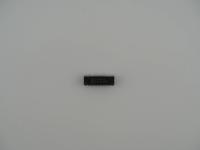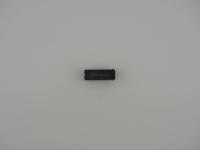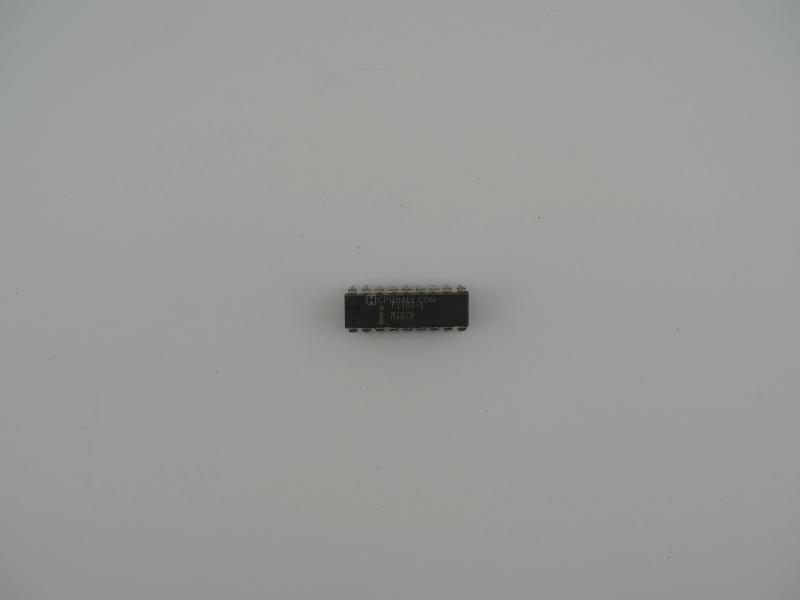

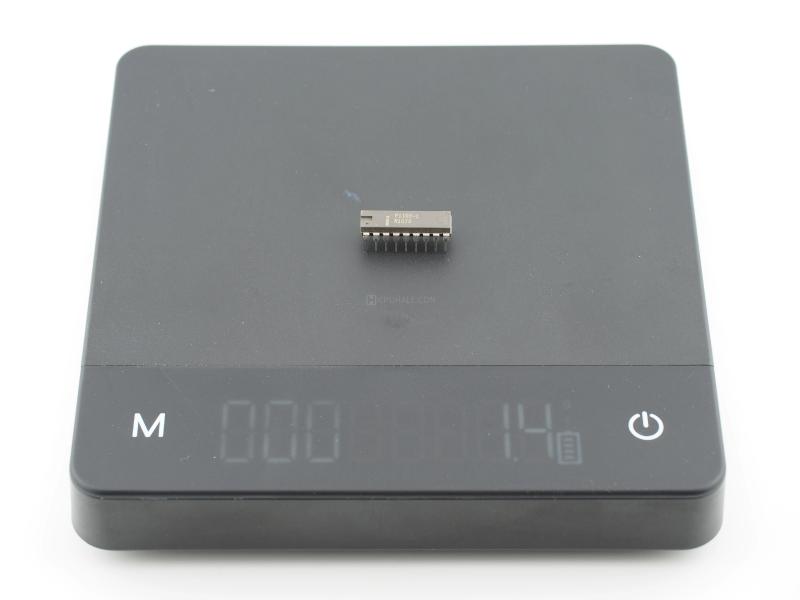
Holding this artifact, I am always struck by how profoundly ordinary it looks from the outside. I placed this specific unit on my digital scale, and it barely registered at a feather-light 1.4 grams. Laying it next to the ruler, the dark plastic package spans just about 22 millimeters. It is a standard 18-pin Dual In-line Package.
Top Markings:i [Early Intel Logo]
P1103-1
N1079
Bottom Markings:(E)
(22)
When you inspect the top, the micro-contrast of the lighting catches that beautiful, early blocky Intel logo with the dropped lowercase "i". The white silk-screened text is crisp, reading P1103-1 and N1079. Flipping it over, the bottom of the chip reveals the raw industrial nature of its manufacturing. You can clearly see the circular injection mold ejector pin marks containing the letter "E" and the number "22". There is no gold plating or exotic ceramic here. This piece was built for sheer, brutal volume.
To appreciate this chip, you have to understand the nightmare of early 1970s electrical engineering. The 1103 is a 1024-bit dynamic random access memory (DRAM) chip built on P-channel MOS (Metal-Oxide-Semiconductor) technology. It does not use the single-transistor-and-capacitor cell design we see in modern RAM. Instead, it relies on a complex three-transistor (3T) memory cell.
This hardware ran hot, it was power-hungry, and it was notoriously hostile to system designers. Interfacing with the 1103 required multiple, highly unusual voltage rails. You needed +5V, -15V, and a bias voltage around +2.5V just to keep it happy. Furthermore, the timing logic was an absolute beast. System engineers had to generate precise, overlapping multiphase clock signals to read and write data. If your timing was off by just a fraction of a nanosecond, the chip would silently corrupt its 1024 bits of data. Despite these massive engineering hurdles, the density it provided was unprecedented at the time.
This chip is heavy metal history. Inside the collector community, the 1103 is widely revered as the "Core Killer". Before this little 18-pin block existed, mainframe computers stored data in magnetic core memory. Core memory was bulky, power-hungry, and painstakingly woven by hand.
Intel was a struggling startup when they partnered with Honeywell to develop a semiconductor alternative to core memory. Their first attempt (the 1102) was a complete failure. The 1103 was their second shot. It was so difficult to use that Intel had to practically beg engineers to adopt it, even sending out highly specialized application engineers to teach companies how to build the control logic. Once the industry figured it out, the 1103 exploded. By 1972, it was the best-selling semiconductor memory on the planet. It gave Intel the massive influx of cash they needed to fund the development of the 4004 and 8008 microprocessors. Without this exact chip, the modern Intel processor lineage simply would not exist.
Deciphering the exact provenance of this specific piece requires breaking down Intel's early part numbering scheme. The prefix "P" unequivocally indicates a plastic package (as opposed to "C" for ceramic or "D" for side-brazed ceramic).
The "-1" suffix is where things get interesting. Intel continually refined the 1103 silicon to improve yields and speed. The standard 1103 had an access time of around 300 nanoseconds. The 1103-1 was a later, tighter speed bin that dropped the access time down to the 150 to 250 nanosecond range, making it highly desirable for performance-critical mainframe upgrades.
The batch code N1079 tells the final part of the story. Based on standard Intel date code formats of the era, the "79" almost certainly points to a manufacturing date of 1979 (likely the 10th week). By 1979, the 1Kbit DRAM was ancient technology compared to the 16K DRAMs dominating the market. Finding an 1103 stamped in 1979 proves that industrial and military customers were still demanding replacement parts for aging 1970s mainframes nearly a decade after the chip was first introduced.