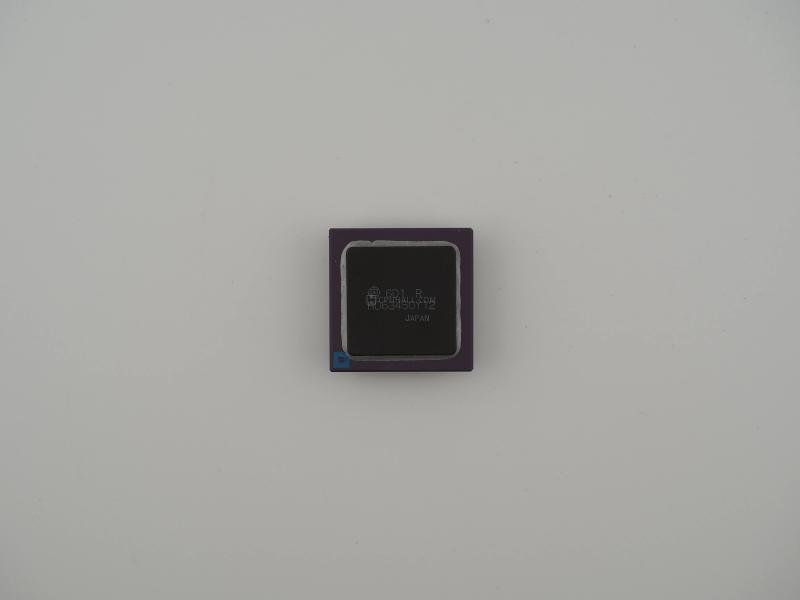

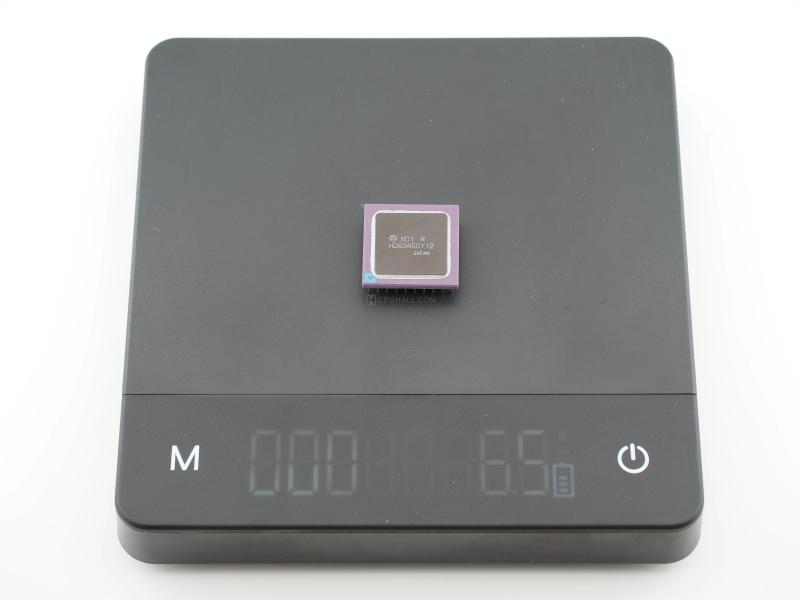
Holding this piece in the studio, the immediate standout feature is the incredibly striking purple ceramic substrate. It is a dense, high-quality ceramic that feels absolutely substantial in the hand. The top of the package is dominated by a dark, precisely brazed metal lid that acts as a heatspreader and environmental seal. Looking at the bottom, we have a beautiful 64-pin grid array featuring perfectly arranged gold-plated pins in a dual-row perimeter layout.
Under the macro lens, the laser etching on the dark metallic lid is crisp and utilitarian. The bottom left corner of the ceramic also features a distinct blue square marking, likely a factory orientation or QA stamp.
[Hitachi Logo] 6D1 R
HD63450Y12
JAPAN
The contrast between the bright gold pins, the deep purple ceramic, and the matte dark grey lid makes this a beautiful example of mid-1980s Japanese semiconductor manufacturing. There are no bent pins and the gold plating shows zero signs of insertion wear, making this a remarkably pristine artifact.
While it is easy to get distracted by the main processors of the era, the true heavy lifting in high-performance computing systems was often offloaded to specialized coprocessors. This artifact is a Direct Memory Access Controller, or DMAC. Specifically, it is Hitachi's high-performance CMOS implementation designed to interface seamlessly with the legendary Motorola 68000 bus architecture.
The engineering magic here lies in its ability to take control of the system bus. Instead of forcing the main CPU to waste precious clock cycles moving data byte-by-byte from a hard drive controller to RAM, this chip takes over. It manages massive data transfers independently across four completely separate channels.
Hitachi was famous for taking existing NMOS architectures from American designers and porting them to their highly advanced CMOS processes. The "63" in the part number indicates this CMOS lineage, which allowed the chip to run significantly cooler and draw far less power than Motorola's own NMOS equivalents. The 12 at the end of the part number denotes that this specific piece of silicon is rated to run at a blistering 12 MHz, which was top-tier speed for peripheral controllers in the mid-1980s.
The Motorola 68000 architecture powered the most iconic machines of the era. If you were using a classic Macintosh, an Amiga, an Atari ST, or a high-end Sun Microsystems Unix workstation, you were living in the 68k ecosystem. However, those machines achieved their legendary status largely because they employed clever coprocessor designs to keep the main CPU fed with data.
Hitachi played a massive, albeit quiet, role in this revolution. They were a licensed second-source manufacturer for Motorola, but they rarely settled for just making direct clones. They aggressively re-engineered the silicon. This created a fascinating dynamic in the market where hardware engineers often preferred Hitachi's "clone" peripherals over the original Motorola parts because the Japanese CMOS variants simply ran cooler and were incredibly reliable.
There is a running joke among vintage computer restoration experts that you can identify a truly premium 1980s logic board simply by counting the number of purple Hitachi ceramic packages scattered around the main processor.
Identifying this artifact is a straightforward process thanks to Hitachi's very logical part numbering system, though it requires knowing their specific era codes. I am highly confident in the identification based on the physical text and package format.
The HD prefix is standard for Hitachi Digital ICs. The 63 series is their CMOS implementation of the 68000 family, making 450 the identifier for the 4-channel DMA controller. The Y in the part number is Hitachi's internal code for a Pin Grid Array package, which perfectly matches the 64-pin configuration we see on the underside.
The 6D1 string is the manufacturing date code. In Hitachi's nomenclature for this era, the first digit represents the year of the decade, and the letter represents the month. This firmly places the fabrication of this specific DMAC in April of 1986. The R likely denotes a specific mask revision or stepping. Finding these chips in such pristine ceramic packages is a real treat, as later production runs heavily favored cheaper plastic packaging to cut costs.