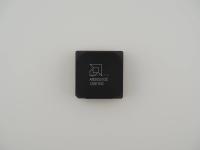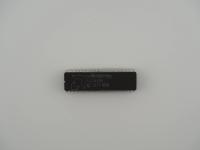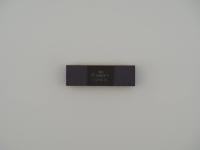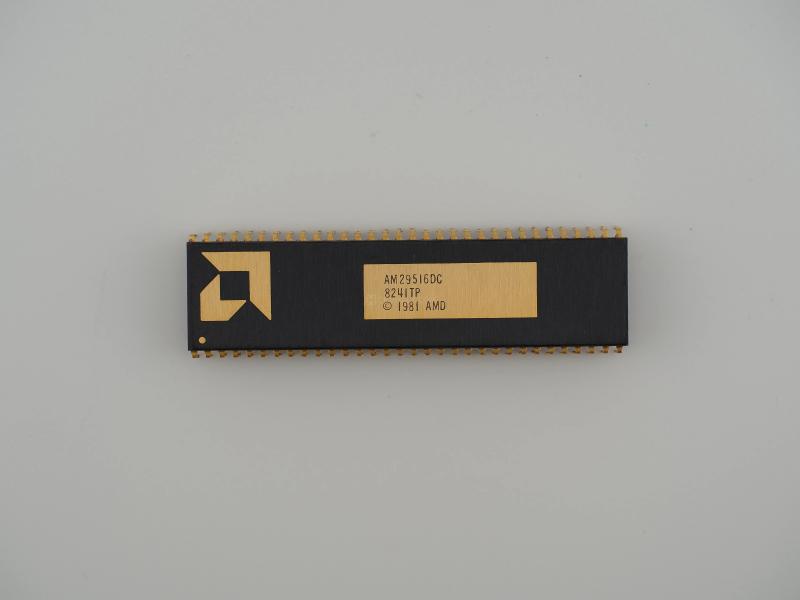

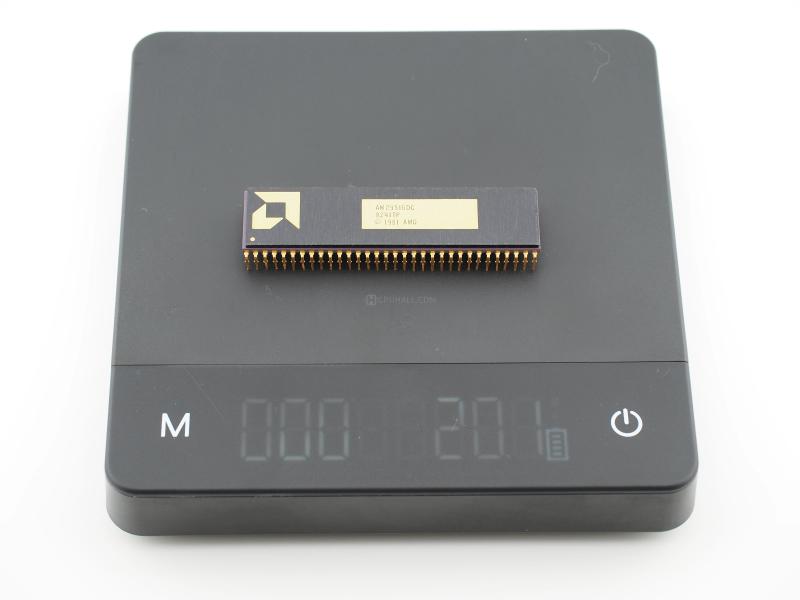
The dark, dense substrate gives the chip a serious, utilitarian weight. Looking at the top face, we have a bold, stylized AMD logo stamped directly onto the ceramic, positioned right next to a sizable gold-plated lid.
Here is the exact transcription of the top surface text:
AM29516DC
8241TP
© 1981 AMD
Flipping this artifact over reveals the underside of the brazed pins and a small gold square directly in the center. The lower right corner of the bottom ceramic features a simple, faint laser etching:
289
along with a small triangle pointing downwards to denote orientation. The 64 pins are straight and show the classic heavy brazing that was standard for high-reliability components of this era.
This is not a general-purpose processor. The AM29516 is a dedicated 16x16 parallel multiplier. Back in the early 1980s, asking a standard microprocessor to perform complex multiplication was a guaranteed way to bring your system to a grinding halt. To solve this bottleneck, engineers turned to dedicated hardware.
The broader Am2900 architecture is famously a bit-slice design. You built your computer by cascading these chips together to achieve the exact word length your application required. The 29516 was part of AMD's heavy push into digital signal processing. It features a highly optimized architecture that could crank out a 32-bit product from two 16-bit inputs in under 100 nanoseconds. The massive 64-pin package was an absolute electrical necessity. You needed separate 16-bit input buses for the X and Y operands, plus a full 32-bit output capability and various control lines, all operating in parallel without multiplexing bottlenecks.
The Am2900 family is absolute royalty in the history of high-performance computing. While monolithic microprocessors like the 8086 or 68000 were getting all the public glory in consumer electronics, bit-slice chips were doing the real heavy lifting behind closed doors. They were the computing heart of high-end minicomputers, advanced military avionics, specialized floating-point accelerators, and even legendary arcade machines.
A common myth among casual hardware historians is that AMD only existed as a second-source manufacturer for Intel in the early days. Chips like the Am2900 series completely shatter that narrative. This was AMD innovating and dominating a specific, highly lucrative niche with their own proprietary designs. The 29516 specifically represents the bridge between general-purpose bit-slice computing and the dedicated DSP revolution that would take off later in the decade.
The DC suffix in AM29516DC strictly dictates the packaging type as a side-brazed ceramic dual in-line package, which matches the visual evidence perfectly.
The date code 8241 places its manufacturing right at the 41st week of 1982. This aligns perfectly with the 1981 copyright date etched on the lid. The TP suffix likely denotes a specific fabrication plant or testing grade, which is very common in AMD's internal tracking for industrial and military parts. There is no real mystery here, just a remarkably well-preserved example of early, heavy-metal computing hardware.