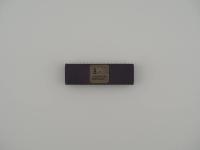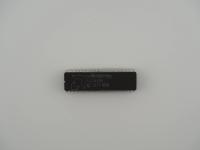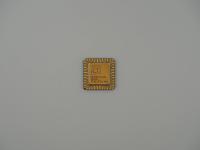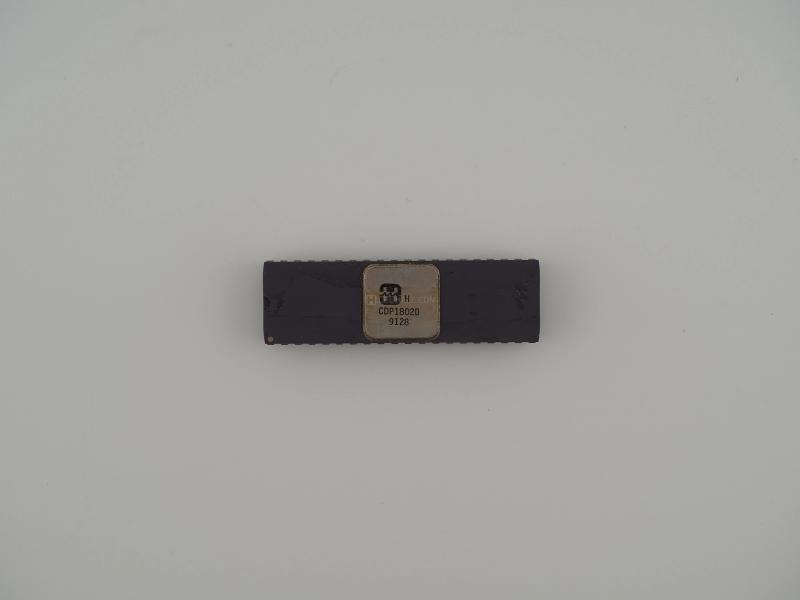

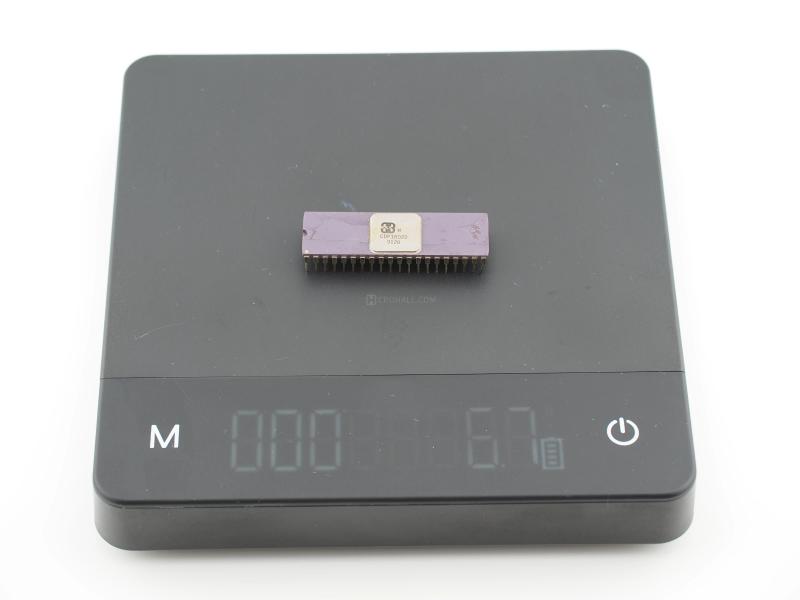
Holding this piece, I immediately noticed the weight and the distinct texture of the military-grade packaging. The deep purple ceramic substrate is a visual hallmark of high-reliability aerospace components from this era. When I set this artifact under the 45mm Elmarit macro lens to capture it for the museum archive, the micro-contrast really highlighted the intricate brazing on the side pins.
Front:[Harris Wave Logo] H
CDP1802D
9128
Rear:6FVTT
R6140/
The pins themselves show some localized oxidation and physical wear, particularly visible along the lower contact edges. The top lid is a brazed metal cap, lacking the bright gold flash seen on earlier RCA runs but still retaining an incredibly rugged, industrial aesthetic. The white painted nomenclature on the rear ceramic face is slightly worn but highly legible, adding a layer of bureaucratic mystery to the artifact.
The 1802 is an absolute masterclass in early CMOS (Complementary Metal-Oxide-Semiconductor) logic design. While most contemporary chips from Intel and Motorola were using power-hungry NMOS technology, the 1802 was designed from the ground up for minimal power consumption.
The architecture features an elegant, highly orthogonal 8-bit design utilizing a bank of sixteen 16-bit registers. However, the true engineering marvel of this silicon is its entirely static nature. Because it does not rely on dynamic capacitive storage for its internal state, you can completely halt the clock. The clockspeed can drop to 0 Hz, and the processor will simply freeze, retaining all register states indefinitely until the clock pulses again. This made it virtually immune to certain types of power fluctuations and allowed for incredible power scaling. The "D" suffix in the part number specifically denotes this heavy-duty, dual-inline ceramic package designed to withstand extreme thermal cycling.
If you talk to vintage hardware engineers, the RCA 1802 is spoken of with almost religious reverence. This is the chip that powered the Galileo spacecraft on its mission to Jupiter. It was chosen for spaceflight because its CMOS architecture could be easily adapted to a Silicon on Sapphire (SOS) manufacturing process, rendering it highly resistant to cosmic radiation and single-event upsets.
Down on Earth, it gained a cult following as the heart of the COSMAC ELF, an early single-board computer that taught a generation of hackers how to program in machine code using toggle switches. A persistent myth is that all 1802 chips are radiation-hardened. In reality, standard bulk CMOS parts like this one were incredibly resilient compared to their NMOS rivals, but only the specific SOS variants were officially rated for deep space exposure. Regardless, the fundamental bulletproof nature of the logic remains intact across all versions.
This specific unit tells a fascinating story of corporate acquisition and late-stage lifecycle production. While the architecture was famously designed by RCA in the 1970s, the markings on this chip clearly show the stylized wave logo of Harris Semiconductor.
Harris acquired RCA's solid-state division in 1988, taking over the production of their highly lucrative military and aerospace component lines. The date code 9128 perfectly aligns with this history, indicating this processor was fabricated in the 28th week of 1991. The fact that Harris was still rolling these out in heavy purple ceramic fifteen years after the architecture's introduction proves just how deeply entrenched the 1802 was in defense and industrial contracts. The white ink markings on the rear (6FVTT R6140/) are almost certainly internal lot codes or specific contractor tracking numbers, further cementing its identity as a specialized, high-reliability production unit rather than a commercial off-the-shelf part.