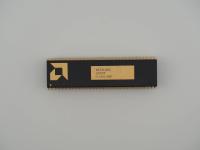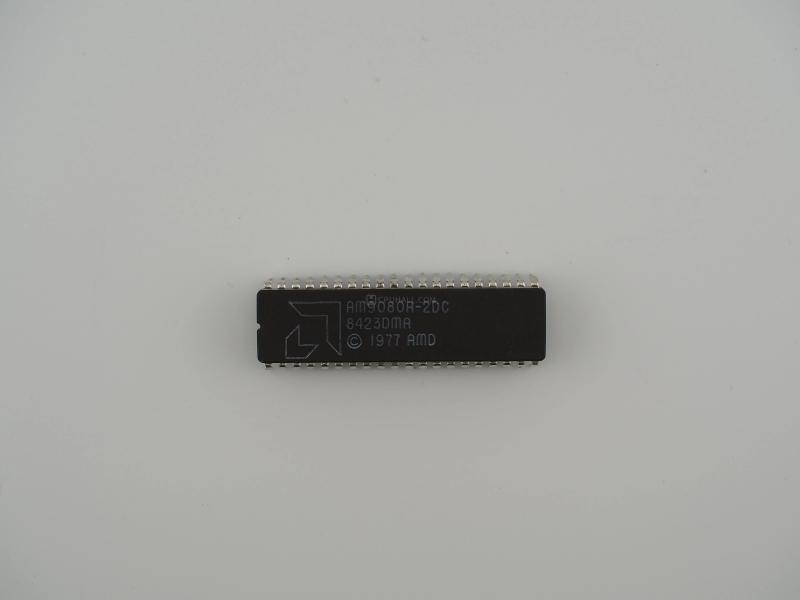

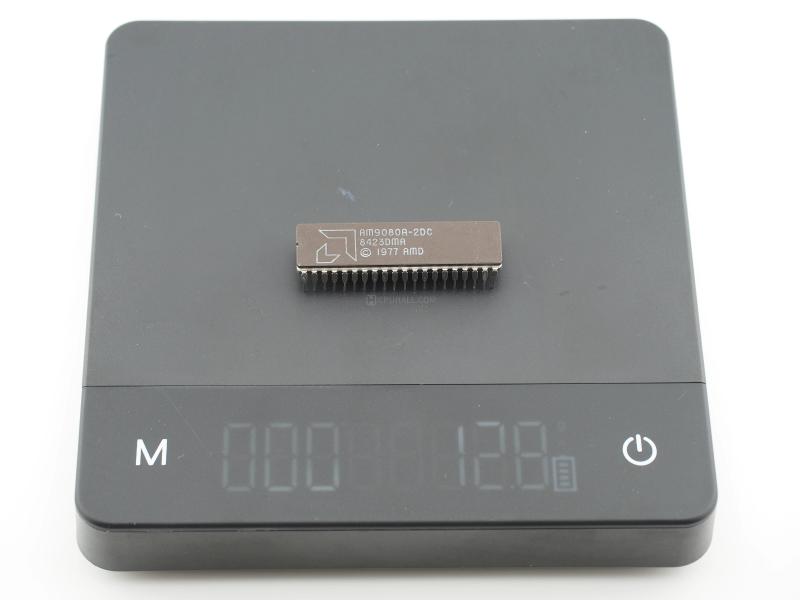
Let us take a close look at this beautiful slab of history. It has that unmistakable weight and thermal mass of late 1970s and early 1980s commercial silicon. The 40 pins appear to be tin-plated and show just a touch of expected oxidation from decades of storage, but they remain perfectly straight and structurally sound.
The surface etching is remarkably crisp against the dark substrate. We can clearly see the classic geometric AMD chevron logo. Here is the exact surface transcription:
AM9080A-2DC
8423DMA
(C) 1977 AMD
The high-contrast white text is perfectly preserved. It is a textbook example of a CDIP-40 package, devoid of the flashy gold caps found on military-grade components but carrying a rugged, utilitarian aesthetic.
Underneath that dark ceramic hood lies an exact, reverse-engineered replica of the legendary Intel 8080A microprocessor. The "A" designation indicates that this is the bug-fixed version of the original 8080 architecture. The "-2" suffix denotes a speed grade of 2.5 MHz, which was a respectable bump over the base 2.0 MHz specification.
This is an 8-bit microprocessor built on an NMOS fabrication process, packing roughly 6,000 transistors. One of the most fascinating engineering quirks of the 8080 architecture is its incredibly demanding power requirement. Unlike modern chips that run comfortably on a single low-voltage rail, this piece of silicon requires three distinct power supplies to function: positive five volts, negative five volts, and positive twelve volts. This architectural quirk made motherboard and power supply design an absolute nightmare for early computer engineers.
This exact model is essentially ground zero for the greatest rivalry in semiconductor history. When Intel released the 8080, it sparked the microcomputer revolution and served as the brains for iconic machines like the Altair 8800. AMD naturally wanted a piece of that explosive market. They took the bold step of reverse-engineering the 8080 and creating the AM9080 without Intel's explicit permission.
The AMD clone was so flawlessly executed that Intel was eventually forced to officially cross-license the technology to them. Major buyers like the military and massive industrial corporations strictly required a second manufacturing source to prevent supply chain bottlenecks. That forced handshake set a legal and historical precedent that would completely define the x86 ecosystem for decades to come.
The part number AM9080A is one of the most well-documented clone chips in all of computing history.
What makes this specific unit so fascinating to me is the date code: 8423. This indicates the chip rolled off the AMD manufacturing line in the 23rd week of 1984. By 1984, the desktop computing world had already moved on to the much more advanced Intel 8086 and 80286 processors. The fact that AMD was still churning out freshly minted 8080 clones in 1984 proves just how deeply embedded this architecture had become in industrial controllers, traffic lights, and specialized equipment. It is a flawless physical representation of an era when processors had manufacturing lifespans that lasted over a decade.