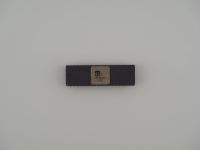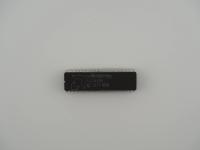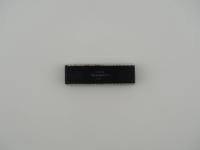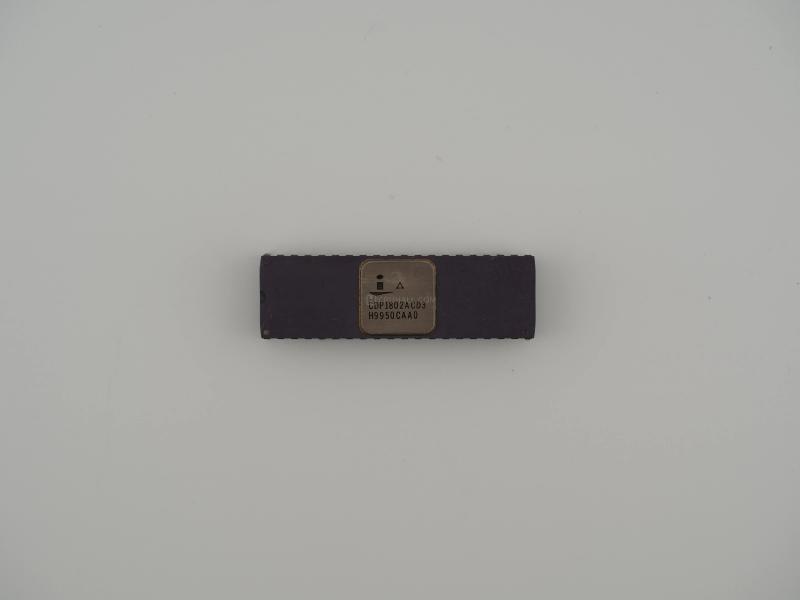

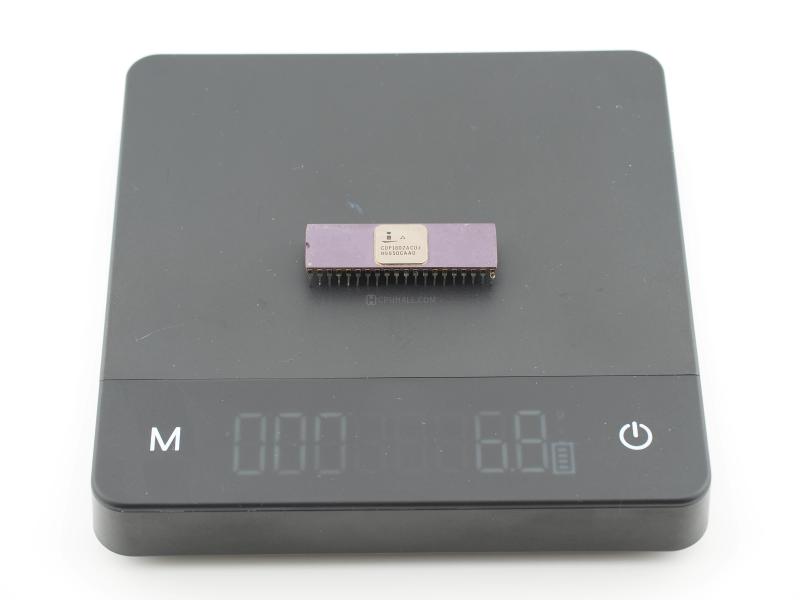
Dropping it on the scale, it registers a satisfying 6.8 grams. This specific unit is a breathtaking example of late 1990s high-reliability packaging. Looking closely, the deep purple ceramic substrate reveals a subtle, porous texture that contrasts brilliantly with the smooth, reflective gold cap brazed onto the top die cavity.
The side-brazed pins are thick, industrial, and completely unforgiving compared to modern consumer hardware. The surface markings are sharply laser-etched directly onto the gold lid.
Top Markings:[Intersil Logo] [Delta Symbol]
CDP1802ACD3
H9950CAA0
Bottom Markings:FX69 A
MALAY
The bottom of the ceramic package is completely bare aside from the stark white painted text indicating its Malaysian assembly origin. The sheer density and weight of the materials used here scream aerospace grade.
To understand the CDP1802A, you have to appreciate the absolute brilliance of early CMOS (Complementary Metal-Oxide-Semiconductor) engineering. Unlike the power-hungry NMOS processors of its era, the COSMAC (Complementary Symmetry Monolithic Array Computer) architecture was built for extreme efficiency.
One of the most fascinating engineering quirks of this processor is its completely static design. You can literally drop the clock speed down to zero Hertz, and the CPU will perfectly retain its internal state indefinitely. When you resume the clock signal, it picks up exactly where it left off. This made it wildly popular for embedded systems where power conservation was a matter of mission survival. The "A" revision of the 1802 typically supported higher clock speeds up to 3.2 MHz at 5 volts, though they could be pushed further if supplied with 10 volts. The DIP-40 package here utilizes side-brazed pins, a complex and expensive manufacturing process reserved almost entirely for high-stress, high-temperature, or high-radiation environments where standard plastic packages would simply melt or degrade.
This is the holy grail of spaceflight silicon. The RCA 1802 is universally revered as the processor that went to Jupiter. Because the chip could be manufactured using Silicon on Sapphire (SOS) technology, it could be naturally radiation-hardened. NASA selected this architecture to serve as the brain of the Galileo spacecraft. While desktop users were fighting over megahertz in the x86 wars, this architecture was quietly surviving the intense radiation belts of gas giants.
A common piece of hardware lore is that the 1802 was exclusively a military and space chip. In reality, it had a massive cult following among early hobbyists. It powered the COSMAC VIP and the legendary COSMAC ELF microcomputers. It was cheap, practically indestructible, and incredibly easy to interface with switches and LEDs for manual programming. It is a chip that simultaneously represents the pinnacle of multi-billion dollar space exploration and the grassroots foundation of homebrew computing.
Holding this piece, the most obvious mystery is the discrepancy between the architecture's origins and the logo stamped on the gold cap. The 1802 was designed by RCA Solid State in the 1970s. So why does this artifact bear an Intersil logo with a date code of 9950 (the 50th week of 1999)?
The answer lies in a complex trail of corporate acquisitions. RCA Solid State was acquired by GE in 1986. GE then sold the semiconductor division to Harris Corporation in 1988. Harris continued to manufacture the 1802 for aerospace clients because spacecraft designs move slowly and require decades of component support. In August 1999, Harris spun off its semiconductor business, reviving the classic Intersil brand name.
Because this chip was manufactured in late 1999, it represents one of the very first batches of the 1802 produced under the newly reborn Intersil name. The CDP prefix is a legacy RCA naming convention where "C" stands for CMOS and "D" stands for the ceramic dual in-line package. The ACD3 suffix indicates specific high-reliability testing and voltage grades demanded by military or industrial contractors. This isn't just a microprocessor. It is a 23-year-old architectural design that was still being actively manufactured in 1999 on a purple ceramic and gold package purely because the aerospace industry refused to let it die.