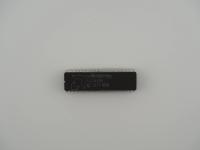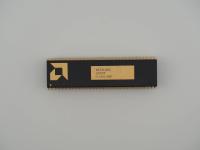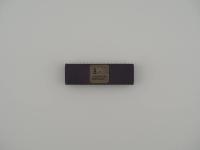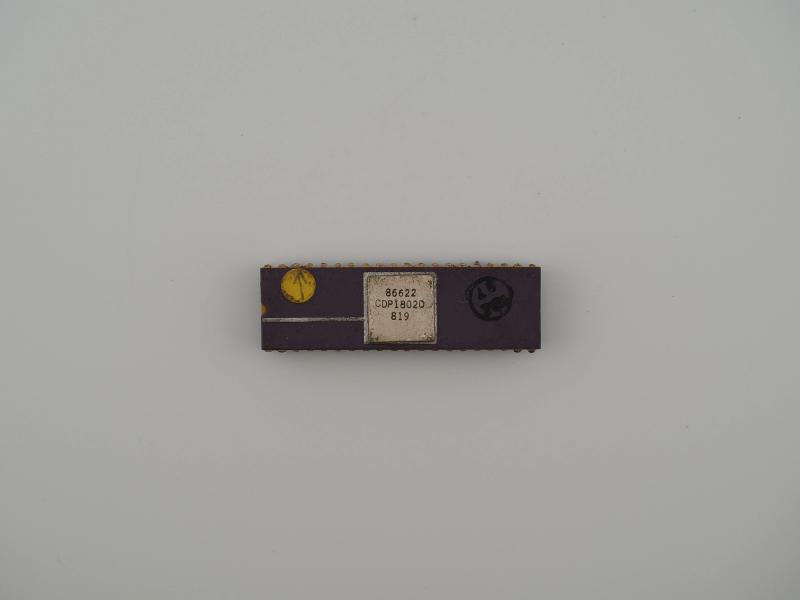

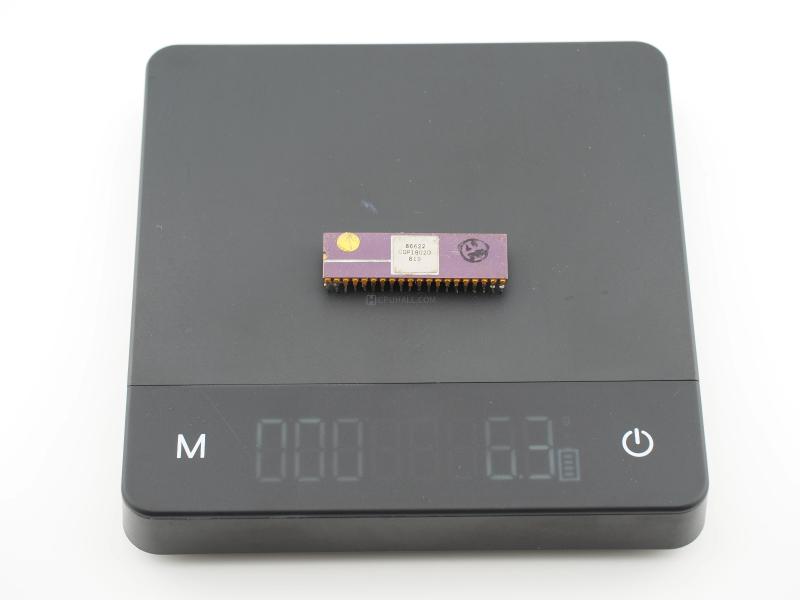
When I finally got this specific unit under the macro glass, the sheer physical beauty of 1970s fabrication really jumped out. The package is a classic side-brazed DIP-40 form factor, but it is the materials that make it special. The body is forged from a deep, rich purple ceramic, often referred to by collectors as aubergine.
Here is the exact surface text transcribed from the artifact:
Plaintext
Front Metal Cap:
86622
CDP1802D
H 819
Back Ceramic:
X WZED0000
Looking closely at the edges, you can see the gorgeous gold traces sandwiched between the ceramic layers, routing signals from the internal die to the heavily oxidized pins. The pins themselves show significant age and wear, indicating this chip was likely socketed and saw active duty or extensive testing. The die itself is protected by a hermetically sealed metal cap.
The surface of this artifact tells a story of rigorous quality assurance. On the left side of the ceramic face sits a faded yellow circular sticker with an arrow. On the right side, there is a partially smudged black circular inspection stamp. Capturing these faint details with high-fidelity glass reveals the exact porous texture of the ceramic substrate and the slightly uneven application of the factory markings.
Diving into the silicon, the CDP1802 is an absolute marvel of its era. Developed by RCA, this was one of the very first single-chip microprocessors to utilize CMOS (Complementary Metal-Oxide-Semiconductor) technology. At a time when competitors like the Intel 8080 and MOS 6502 were using power-hungry NMOS logic that generated significant heat, the 1802 was incredibly power efficient.
It is a fully static design. This means the clock speed could be dropped down to absolutely zero Hertz and the processor would perfectly hold its state without losing data. You could step through instructions one cycle at a time, which made debugging hardware almost completely foolproof.
Architecturally, it features an 8-bit data bus and a 16-bit address bus. Internally, it boasts a highly unusual and flexible 16 by 16-bit register file. A programmer could designate any of these registers as the program counter, data pointer, or standard working register. This made context switching incredibly fast and efficient for the time.
In the vintage hardware community, the RCA 1802 is almost universally known as the Space Chip.
Because it was built on a CMOS process (and later on Silicon-on-Sapphire for extreme environments), the 1802 was naturally resistant to cosmic radiation and extreme temperature fluctuations. If a stray cosmic ray flipped a bit, the chip was highly unlikely to experience a catastrophic latch-up and fry itself, a common failure mode for NMOS chips in space. This inherent toughness made it the processor of choice for the legendary Galileo spacecraft, as well as numerous orbital satellites and military applications.
Down on Earth, the 1802 gained a cult following among early microcomputer hobbyists. It was the brain behind the famous COSMAC ELF, a minimalist computer kit that enthusiasts could build from scratch. The ELF lacked a ROM and was programmed entirely by toggling hex codes into RAM via front-panel switches.
Identifying this exact piece requires reading the subtle clues left by the manufacturer. The CDP1802D part number is the primary key. The "D" suffix specifically denotes the hermetically sealed ceramic package, engineered for extended temperature ranges and high reliability compared to the commercial plastic "E" suffix versions.
The text H 819 on the cap is likely a date code. In the standard YYW or YWW formats used during this era, this points to a manufacturing date of late 1978 or possibly early 1981. The sequence 86622 is typically a government or military contract cage code, or a specific lot identifier used by RCA's solid-state division.
The visual evidence on this chip is overwhelming. The yellow alignment sticker and the black QA stamp are classic indicators of military or aerospace surplus. Chips destined for critical aerospace hardware went through extensive thermal cycling and functional testing. These stamps were applied at various stages of quality control. The faint white laser etching X WZED0000 on the rear ceramic further confirms its status as a tracked, high-reliability lot. Based on these physical traits, I am confident this specific artifact was pulled from a military or aerospace testing facility, surviving decades to end up preserved in the archive.