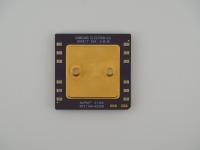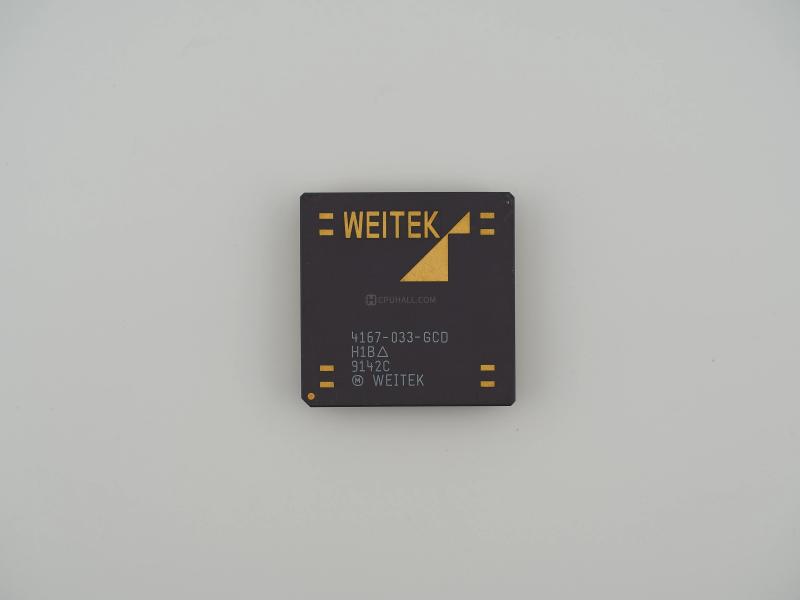

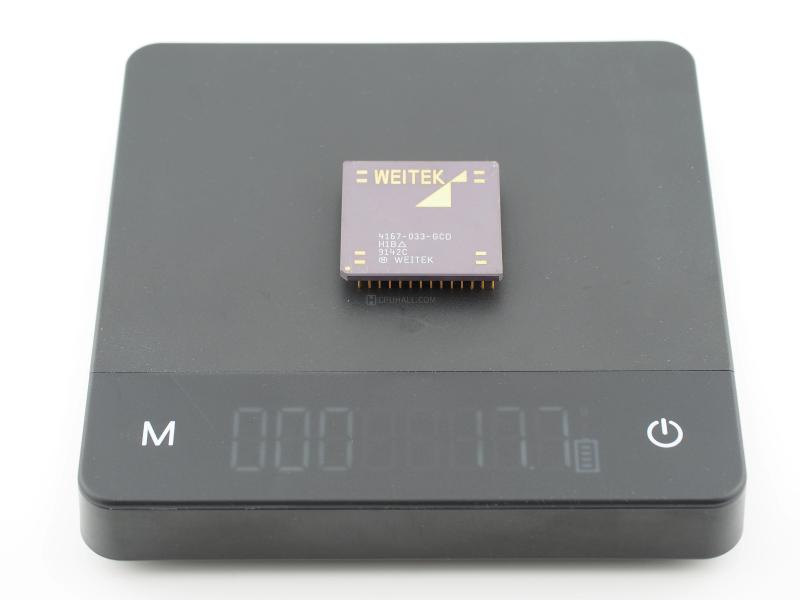
There is a distinct, heavy feel to late-80s and early-90s ceramic silicon. Holding this specific piece in my hand, dropping it on the scale at a solid 17.7 grams, you immediately respect the engineering. The dark grey ceramic substrate is immaculate. The top features a striking, stylized gold triangle alongside the company name, giving it a menacing, monolithic aesthetic.
I am incredibly fortunate to have not just one, but two of these pristine units in the museum collection. Spotting a matched pair in this condition is exceedingly rare. Most of these chips were brutalized by crude extraction tools or melted down for their precious metals.
A simple search on Ebay history using market research tools will reveal zero listings and zero market sales for about a decade. A single listed 4167 25 MHz can be found today (May of 2026) on a Chinese second-hand community platform (similar to Ebay for the west and Carousell for Singapore) for 20,000 RMB or about $3,000 USD.
The Weitek 4167-033 (33 MHz) in this gallery piece is significantly rarer than its 25 MHz counterpart due to a fatal timing mismatch with Intel's architectural shifts. While the earlier 25 MHz version enjoyed a brief window of commercial viability among early CAD adopters seeking to boost initial 486DX workstations, the 33 MHz variant was effectively dead on arrival by 1991. By the time it launched, Intel’s integrated FPU was widely accepted, software developers were abandoning Weitek's proprietary architecture for the standard x87 instruction set, and the impending release of clock-doubled chips like the DX2-66 made buying an expensive, proprietary coprocessor completely illogical, resulting in virtually non-existent production runs for the 33 MHz model.
Let us look at the exact surface text etched into this artifact:
Top Print:= WEITEK
4167-033-GCD
H1B (delta symbol)
9142C
(M) WEITEK
Bottom Cap:4167 - H1B
9142C
USA
Flipping the chip over reveals a massive gold-plated heat spreader sitting right in the center of the 142 gold pins. The reflection off the bottom cap is brilliant, and the brazing on the pins is a textbook example of high-end, low-yield workstation hardware fabrication. The date code 9142C puts the manufacturing of this specific unit at the 42nd week of 1991.
To understand the Weitek 4167, we have to talk about bottlenecks. By 1989, Intel was preparing to launch the i486, a revolutionary chip that integrated the x87 floating-point unit directly onto the main die. For standard users, this was plenty of math power. However, standard users do not buy $10,000 workstations to run AutoCAD.
The 4167 (often referred to as the Abacus) was a highly specialized, memory-mapped vector processing powerhouse. While the internal Intel 486 FPU was good, the Weitek architecture could execute complex floating-point instructions in fewer clock cycles. It bypassed the traditional x86 coprocessor interface entirely. Instead of waiting in line on the standard bus, the 4167 sat in a proprietary 142-pin socket (Socket 4167) and communicated with the CPU via memory-mapped I/O. The system literally wrote data to specific memory addresses, and the Weitek chip intercepted those writes to perform rapid-fire calculations.
This specific model is the 033 variant, meaning it was tuned perfectly to run synchronously with a 33 MHz i486DX. Generating immense calculations meant generating immense heat, which completely explains the massive gold heat spreader dominating the underside of the ceramic package.
The Weitek 4167 holds a hilarious and fascinating place in hardware history. It is effectively a coprocessor built for a processor that did not strictly need one. Intel had just killed the entire coprocessor market by integrating the FPU into the 486 die. Weitek looked at this and decided to build an even faster, completely proprietary math chip anyway.
It was an audacious move. The lore surrounding these chips in the vintage hardware community always centers on their price tag. These were astronomically expensive add-ons. If you were a 3D animator, a structural engineer, or a financial modeler in 1991, adding a Weitek 4167 to your motherboard could double your floating-point performance in optimized software. The catch was the software actually had to know the Weitek chip existed. Applications like AutoCAD and Mathematica included specific drivers to awaken this silicon beast. If a program lacked Weitek support, the chip just sat there idling in its expensive socket.
Eventually, the relentless march of Moore's Law caught up. When Intel released the Pentium architecture with its radically improved, pipelined internal FPU, the performance gap vanished. The dedicated math coprocessor market died overnight, making the 4167 the final, glorious swan song of the standalone consumer FPU.
Visual identification of this chip is completely unambiguous. The 4167-033-GCD nomenclature is perfectly documented in early 90s databooks. The 033 confirms the 33 MHz clock target. The GCD suffix relates to the specific PGA ceramic package and environmental grading.
The fact that this chip bears a 1991 date code is interesting because it represents the absolute peak of the 486 era, right before the DX2 clock-doubled chips started muddying the waters of synchronous bus speeds. Having two of these units in this flawless, un-scorched condition confirms they likely lived in well-cooled, high-end enterprise environments rather than cramped desktop towers. The physical evidence of the pristine pins shows they were extracted by a professional, saving them from the gold recycling bins that claimed so many of their siblings.