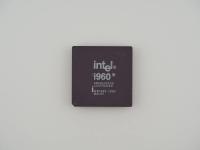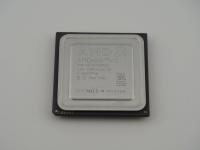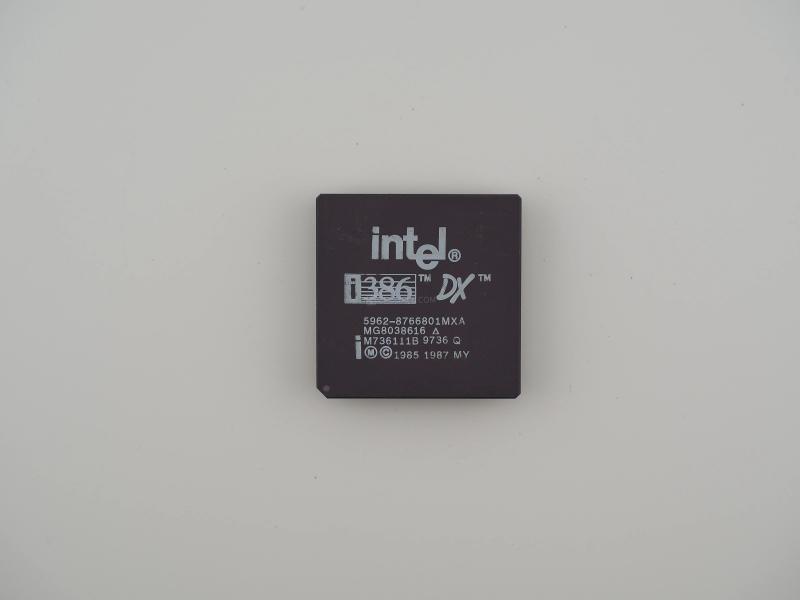

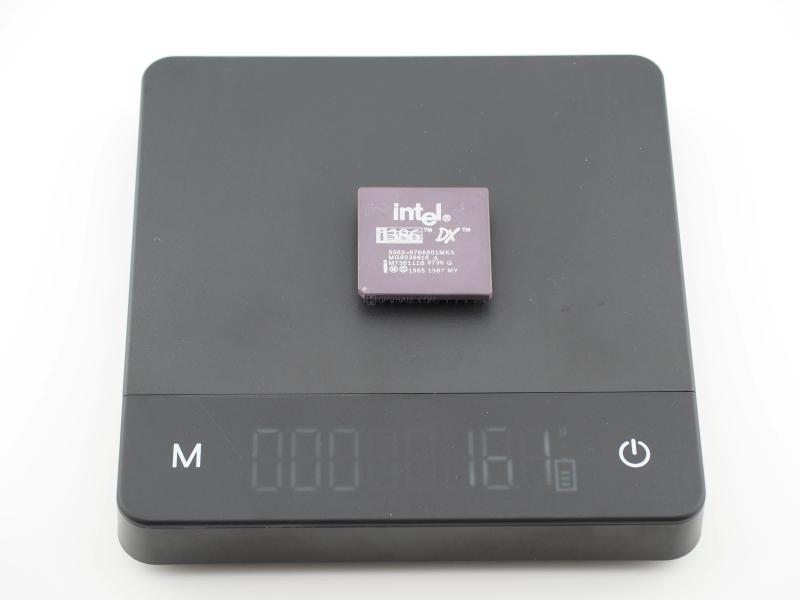
When I placed this specific unit on the scale, it weighed in at exactly 16.1 grams. Holding this piece in the light reveals a beautifully textured, slightly purple-grey ceramic substrate that feels incredibly dense. It is not just another desktop processor. This artifact is a military-specified piece of computing history. The top laser etching is brilliantly preserved and provides a massive amount of forensic data.
intel (R)
i386 (TM) DX (TM)
5962-8766801MXA
MG8038616 A
M736111B 9736 Q
(M) (C) 1985 1987 M.Y
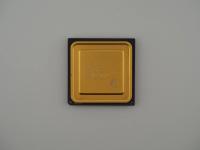
Flipping the chip over reveals a pristine array of 132 gold-plated pins framing a beautiful central gold heat spreader cap. The brazing on the pins is immaculate, which is typical for military-grade hardware designed to withstand extreme vibration. The gold cap itself is stamped with additional factory codes:
MALAY 736
8727689G7P
The physical wear on this unit is practically nonexistent. The pins are perfectly straight, and the ceramic corners remain sharp and unchipped. The stark contrast between the industrial grey ceramic and the bright gold cavity cap gives it a very distinct "Cold War tech" aesthetic that I absolutely love displaying in the collection.
To understand the i386 DX, you have to understand the monumental leap it represented for the x86 instruction set. This architecture transitioned the computing world from 16-bit to full 32-bit processing. Intel packed roughly 275,000 transistors into this die using a 1.5-micron CHMOS III process.
Because this is the military MG8038616 variant, it was manufactured to survive hellish environments. Standard desktop chips were rated for commercial temperatures, but this ceramic CPGA-132 package was designed to operate flawlessly between -55 degrees and +125 degrees Celsius. The engineering overhead required to guarantee stable 16 MHz clock cycles under those thermal extremes meant tossing out the standard fabrication playbook. The thick ceramic housing and the central gold cap were specifically engineered to manage thermal expansion and contraction during rapid temperature cycling in avionics or weapon systems.
The legacy of the i386 DX is arguably the most important in PC history. It was the chip that broke IBM's absolute stranglehold on the personal computer market. When Compaq released the first 386 computer before IBM did, it signaled that the PC standard now belonged to Intel and Microsoft. The 386 introduced the IA-32 instruction set, which is the foundational bedrock for almost every modern desktop and server processor running today.
The lore behind this specific military variant is even more fascinating. It is highly amusing to think that while the consumer market was obsessing over the Pentium II and 3D graphics in late 1997, highly classified government contractors were still placing bulk orders for 16 MHz 386 chips. Weapons platforms, radar arrays, and aerospace guidance systems require deterministic, deeply vetted, and radiation-hardened logic. They do not care about gigahertz. They care about a chip that will boot up in a frozen missile silo without a single floating-point error.
I am highly confident in the identification and provenance of this specific artifact based on the rich standard military markings present on the die.
The top line 5962-8766801MXA is the ultimate giveaway. This is a Defense Supply Center Columbus (DSCC) Standard Microcircuit Drawing (SMD) part number. It guarantees the chip was manufactured, tested, and documented strictly to MIL-STD-883 standards. The MG prefix in MG8038616 stands directly for Military Grade, and the 16 confirms its 16 MHz operational frequency.
The most revealing forensic clue is the date code 9736 stamped on both the front ceramic face and the rear gold cap (abbreviated as 736 on the rear). This tells us the chip was finalized in week 36 of the year 1997. The M.Y on the front and MALAY on the back confirm the final packaging occurred in Intel's Malaysian fabrication facilities. It is a brilliant example of the "long tail" of silicon manufacturing, proving that an architecture introduced in 1985 was still being actively stamped onto ceramic more than a decade later for specialized defense applications.