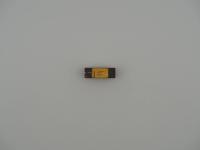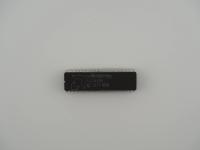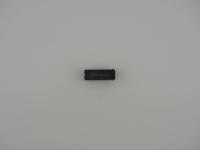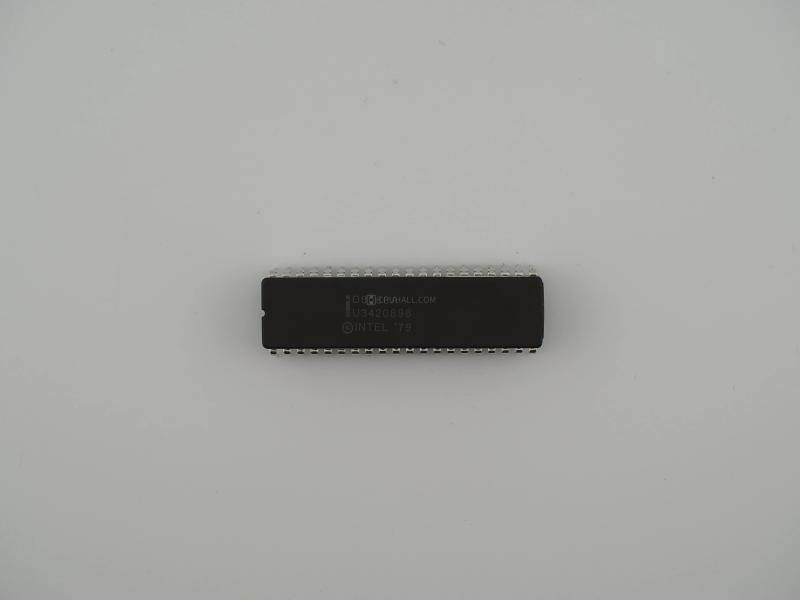

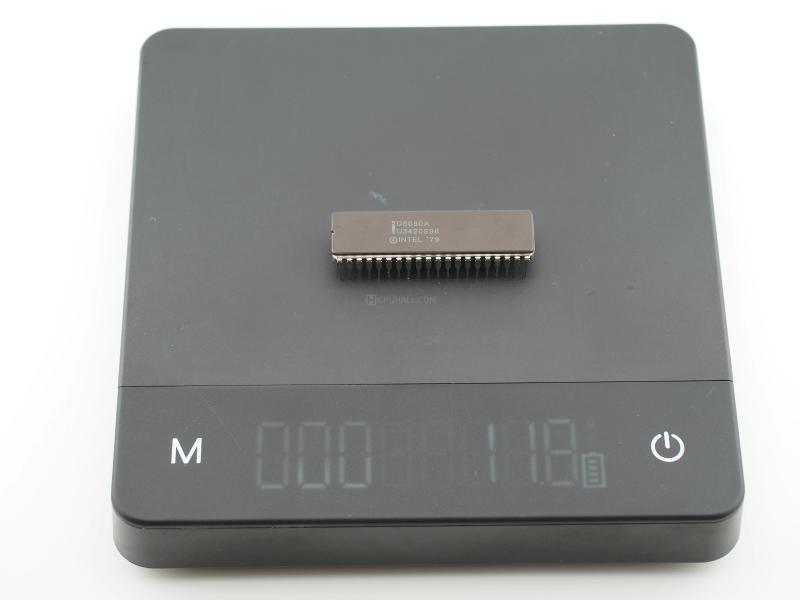
Dropping this specific unit onto the scale reveals a mass of exactly 11.8 grams. It is a substantial, dense piece of vintage silicon. Looking closely at the high-resolution macro shots, the texture of the dark grey ceramic packaging is beautifully rugged. This is a classic CERDIP (Ceramic Dual In-line Package), recognizable by the distinct visible seam where the top and bottom ceramic halves are bonded together with a glass frit seal.
The surface text is remarkably well-preserved. The crisp, white laser-etching on the dark ceramic provides excellent micro-contrast. Here is the exact transcription of the markings on this chip:
Top Face:i D8080A
U3420898
(C) INTEL '79
Bottom Face:F
PHILIPPINES 8342
EN
The tin-plated legs on this 40-pin package show a mild patina but remain perfectly straight and unoxidized, suggesting it was stored carefully or perhaps never socketed into a heavy-duty industrial board. The classic lowercase i Intel logo anchors the top left corner of the print, a vintage hallmark of 1970s and 1980s computing.
Diving into the silicon itself, the Intel 8080A is an absolute marvel of early NMOS (N-type metal-oxide-semiconductor) logic. Manufactured on a completely obsolete 6-micron fabrication node, this chip houses roughly 4,500 transistors. By modern standards, that is practically macroscopic, but in the mid-1970s, packing that much logic into a single DIP-40 package was a monumental feat of electrical engineering.
This artifact runs at a blistering 2 MHz clock speed. However, getting it to run at all was a notorious challenge for hardware engineers of the era. The 8080 architecture lacked on-chip clock generation and required a dedicated external clock driver chip (the Intel 8224). Even more frustrating for board designers was the power requirement. Unlike modern chips that run on a single low-voltage rail, the 8080A required three separate power supplies: +5V, -5V, and +12V. If a power supply failed and delivered the voltages in the wrong sequence, the chip would instantly and violently self-destruct.
Despite these quirks, the internal architecture was revolutionary. It featured a 16-bit address bus capable of addressing a staggering 64 Kilobytes of memory, paired with an 8-bit data bus. This allowed it to execute a robust instruction set that would ultimately lay the groundwork for the modern computing landscape.
You cannot talk about the history of computing without bowing at the altar of the Intel 8080. While it was technically a successor to the 8008, the 8080 was the chip that quite literally ignited the personal computer revolution.
When MITS released the Altair 8800 microcomputer in 1975, they chose the 8080 as its brain. That exact machine inspired a young Bill Gates and Paul Allen to write their first product: Altair BASIC. Every major software empire today traces its lineage back to the instruction set executed by the logic gates inside this ceramic package.
Legend has it that Federico Faggin, the brilliant architect behind this chip, worked tirelessly to push Intel to focus on microprocessors rather than just memory chips. He eventually left Intel to found Zilog, creating the legendary Z80 processor, a chip specifically designed to be backward compatible with the 8080 but vastly superior in implementation. The intense rivalry between Intel and Zilog during this era is the stuff of Silicon Valley mythology. Ultimately, Intel learned from the 8080 and its successors, leading directly to the 8086 and the ubiquitous x86 architecture that powers most of the world's servers and desktop computers today.
Analyzing the specific timestamps on this artifact reveals a fascinating timeline. The top of the ceramic package proudly displays a copyright date of 1979. However, examining the manufacturing codes on the bottom of the chip paints a different picture.
The code 8342 printed beneath the PHILIPPINES origin mark is a standard four-digit date code. This indicates that this specific unit was assembled in the 42nd week of 1983. This four-year gap between the copyright mask date and the physical assembly date is entirely common for highly successful industrial chips. The 8080A remained in massive demand well into the 1980s for embedded systems, military applications, and industrial controllers long after it was obsolete for desktop computers.
The D prefix in the part number D8080A is Intel's strict internal nomenclature for a Ceramic DIP package. The plastic equivalent would have been marked P8080A. The ceramic variant was significantly more expensive to produce but offered vastly superior thermal properties and environmental sealing, which explains why this piece has survived the decades in such impeccable physical condition.