
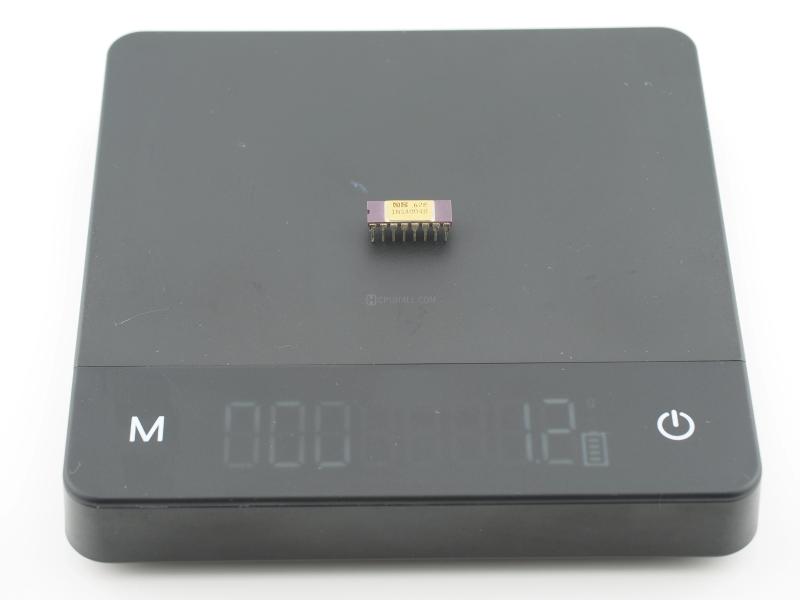
Holding this piece in the museum lab, the first thing that strikes me is just how tiny the genesis of modern computing truly is. Sitting on the scale, the entire package registers a mere 1.2 grams. But what it lacks in mass, it makes up for in breathtaking material presentation.
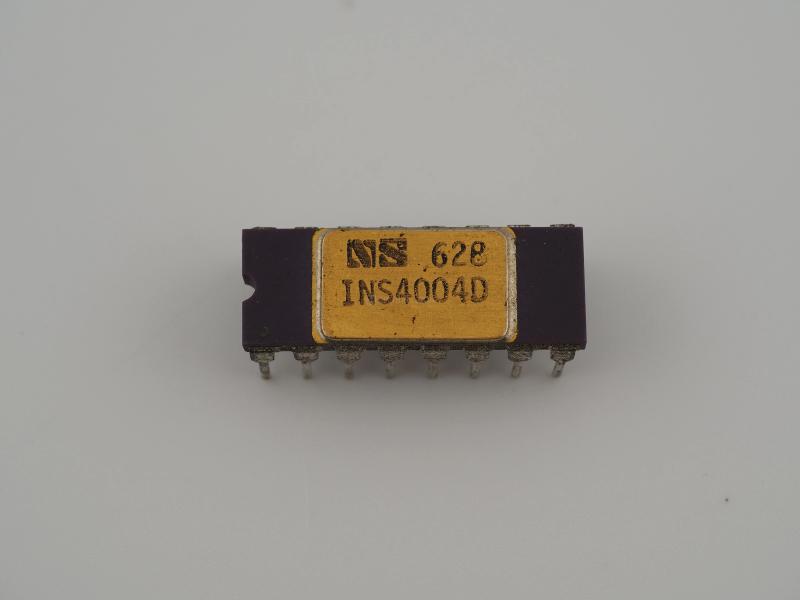
We are looking at a gorgeous 16-pin side-brazed ceramic DIP package. The ceramic substrate itself is a rich, dark purple. It is a signature look for high-reliability components of that era and it feels incredibly dense and cold to the touch. Set right into the center of that purple block is a brilliant, highly reflective gold cap covering the die cavity.
Looking closely at the surface printing on that gold cap, the markings are distinct and proudly stamped:
NS 628
INS4004D
The NS is the classic stylized National Semiconductor logo. The pins themselves show the passage of time. They have a dark, slightly crusty oxidation typical of silver or tin plating that has been exposed to the air for five decades, providing a stark, gritty contrast to the immaculate gold lid.
To understand the engineering of the INS4004, you have to look past the National Semiconductor branding and respect the Intel MCS-4 architecture housed within. This is a 4-bit central processing unit built on a 10-micrometer PMOS logic process. By modern standards, 10um is massive, but in the early 1970s, cramming 2,300 transistors onto a single piece of silicon was nothing short of black magic.
The chip operates at a maximum clock speed of just 740 kHz. The engineering bottleneck of the 4004 was never really the silicon itself but the physical package. Because it is crammed into a tiny DIP-16 form factor, the engineers were severely starved for I/O pins. To get around this physical limitation, they had to aggressively multiplex the pins. The 4-bit data bus had to do triple duty. It transmitted memory addresses, read data, and wrote data all on the exact same physical traces at different points in the machine cycle.
It is a masterpiece of constraint-driven engineering. They did not have the luxury of giant 1800-pin LGA sockets. They had sixteen rigid legs to talk to the rest of the world.
The lore of the 4004 is the foundational mythos of Silicon Valley. Intel originally designed this architecture not to revolutionize the world of computers, but simply to fulfill a contract for a Japanese company named Busicom. Busicom just wanted a customized chipset for a new line of high-end desktop calculators. Intel engineer Federico Faggin, alongside Ted Hoff and Masatoshi Shima, realized that instead of designing a dozen custom logic chips, they could build one general-purpose programmable processor. The microprocessor was born.
But why does this specific artifact say National Semiconductor? In the 1970s and 1980s, the hardware industry was terrified of single-source suppliers. If you were building a critical military system or a mass-market appliance, you could not rely on just one factory in California. If that factory caught fire, your entire product line was dead. Therefore, customers demanded "second sourcing." Intel had to license out their most precious blueprints to competitors like National Semiconductor to ensure a steady, redundant supply of chips.
There is a funny irony here. National Semiconductor built their reputation on analog wizardry, yet here they are pressing absolute masterclasses of digital history into some of the most beautiful purple ceramic ever fired.
The visual clues tell a very straightforward, albeit fascinating, story.
The INS4004D part number breaks down neatly. The INS prefix is National Semiconductor's identifier for their Intel second-source parts. The 4004 is obviously the architecture. The D suffix in vintage chip nomenclature almost universally denotes a ceramic DIP package, confirming exactly what we are holding.
The 628 printed above the part number is a standard date code. In the format of the era, the first digit represents the year of the decade, and the following two digits represent the week. This places the manufacturing of this specific piece squarely in the 28th week of 1976. This perfectly aligns with the timeline of when 4004 second-sourcing was in full swing before the 8-bit revolution completely obliterated the 4-bit market. It is a perfectly preserved time capsule from the bicentennial year.