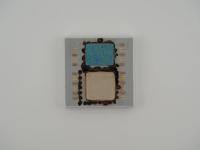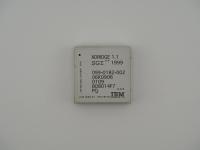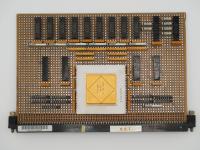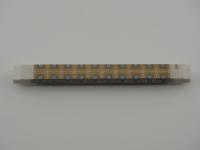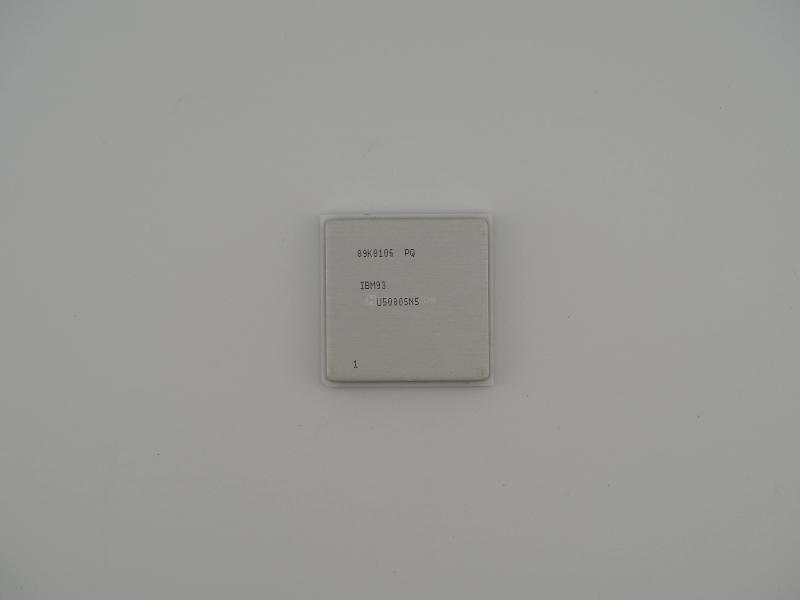

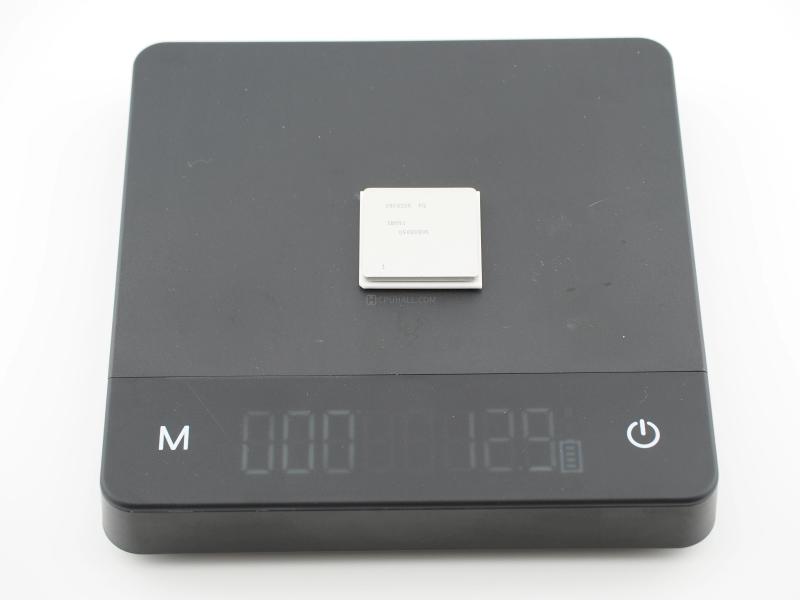
Holding this specific unit, I immediately notice its satisfying heft. Placing it on the scale reveals a solid 12.9 grams of pure 90s enterprise engineering. I captured these high-fidelity shots using my Olympus E-P7 with the 45mm Elmarit macro lens, and the micro-contrast really highlights the beautiful, industrial brushed texture on the thick metal heat spreader. The module itself measures precisely 31mm by 31mm.
The surface text is applied with a distinct dot-matrix style laser etching. It transcribes perfectly as:
09K0106 PQ
IBM93
U50005N5
1
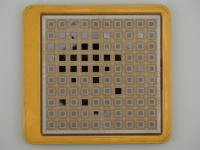
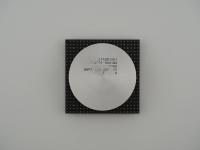
Flipping this artifact over reveals a pristine white ceramic substrate. The bottom interface is a beautifully dense array of solder spheres, perfectly preserved and uncrushed. The stark contrast between the heavy brushed metal cap and the bright white ceramic base is exactly the kind of material aesthetic that makes collecting vintage mainframe and server hardware so rewarding.
Let us dive deeply into the structural engineering. This form factor is a classic IBM CBGA. IBM essentially pioneered Ceramic Ball Grid Array packaging in the early 1990s to solve the massive thermal and pin-density challenges of their enterprise processors. Standard plastic packages simply warped under the intense thermal cycling of heavy server workloads. By moving to a rigid ceramic substrate, IBM was able to match the thermal expansion coefficient of the silicon die much closer. This prevented the microscopic flip-chip solder bumps inside the package from shearing off over years of continuous, hot operation.
The thick metal cap you see on top is a heavy-duty integrated heat spreader. It is likely brazed or bonded with high-grade thermal epoxy directly to the bare silicon die underneath. This design was necessary to rapidly pull heat away from the die and transfer it to the massive, highly torqued heatsinks found in rack-mounted server chassis.
The legacy of these mid-90s IBM chips is steeped in the fascinating transition era of Big Blue. This was the period when IBM was aggressively migrating their legendary AS/400 and RS/6000 lines over to the PowerPC and PowerPC AS architectures. They loved proprietary packaging and impenetrable part numbering schemes. It is always amusing to me how IBM would engineer some of the most advanced silicon on the planet, only to label it with a completely cryptic seven-character alphanumeric code that requires digging through ancient, dusty service manuals to fully decode. There is a running joke in the collector community that the true documentation for these FRUs is still locked in a lead-lined vault in Armonk.
When looking at the back of this board and the top markings, I am presented with a classic IBM mystery. Without a specific AS/400 or RS/6000 hardware manifest, I have to walk through the visual evidence like a forensic investigator.
The part number 09K0106 is the definitive IBM FRU. The IBM93 text points strongly to a 1993 copyright or original design tape-out year. The U50005N5 is undeniably a wafer lot or batch tracking code used by the fabricator. I know this is enterprise-grade server silicon, likely a custom logic controller, a memory controller, or perhaps a specialized coprocessor for a mid-range AS/400 system. The CBGA package with that specific heat spreader design was heavily utilized for PowerPC 601 and 604 variants, but IBM also used this exact packaging for the myriad of custom ASICs required to interface with those CPUs.
While I cannot definitively label this a central processor without finding the matching 1990s system manifest, all visual clues, material choices, and numbering conventions point squarely to a vital piece of IBM's formidable 1990s server architecture.