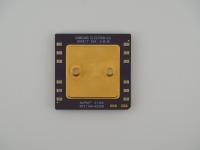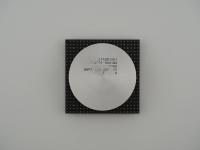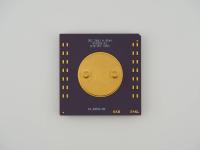

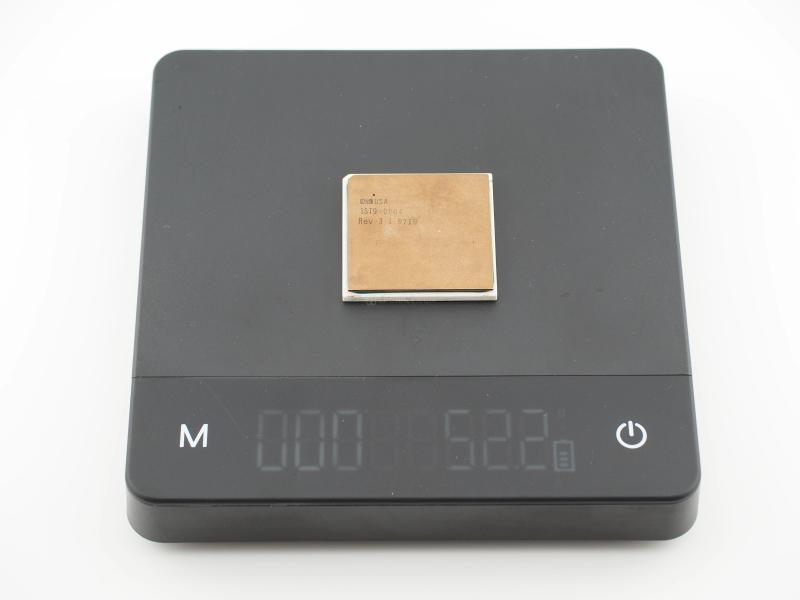
Holding this piece, the first thing I noticed was the sheer density of it. Tipping the scales at exactly 52.2 grams, this artifact feels less like a traditional computer component and more like a solid billet of industrial machinery. It is a stunning example of late-90s server silicon design.
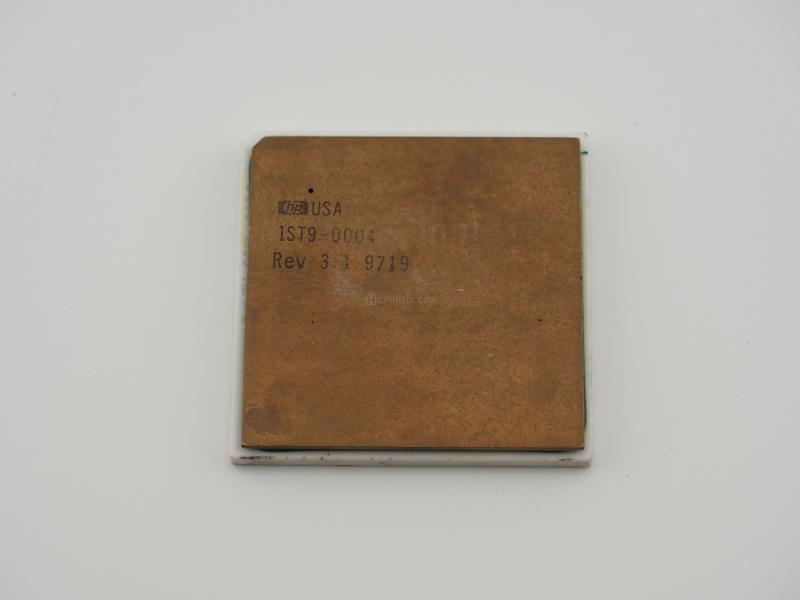
Etched directly into the massive, dark copper-toned heat spreader is the following text:
hp USA
1ST9-0004
Rev 3.1 9719
When looking at the top of this specific unit, the contrast between the thick white ceramic substrate and the tarnished metallic cap is striking. This is not a delicate desktop chip. Turning it over reveals an incredibly dense array of flat, gold-plated contacts. Unlike the fragile pins of a PGA package, these pads were designed to be clamped down under immense pressure into a specialized server socket. There is some visible smudging and residue in the center of the pad array, likely left over from thermal pads or compression materials used during its operational life, but the gold contacts themselves remain highly reflective and well-preserved.
Diving into the silicon beneath that heavy cap reveals a masterclass in 1990s microprocessor engineering. The PA-8200 (internally known as the PCX-U+) is a 64-bit powerhouse based on the PA-RISC 2.0 instruction set.
Manufactured on a 0.5-micron CMOS process, this die packs approximately 3.8 million transistors. While that number sounds tiny by modern standards, it was a massive achievement for 1997. HP engineered this processor to run at clock speeds between 200 MHz and 240 MHz. To keep the core fed with data, the PA-8200 relied on massive amounts of extremely fast, off-chip SRAM cache. It could support up to 2MB of instruction cache and 2MB of data cache physically located on the motherboard right next to the processor.
The thermal challenges of running 3.8 million transistors at 240 MHz in 1997 were significant. This explains the massive integrated heat spreader bonded to the ceramic. The package itself is a 1085-pad Land Grid Array (LGA). Intel did not popularize LGA for consumer desktops until the LGA-775 socket many years later, making HP's use of a 1085-pad LGA in 1997 a testament to their forward-thinking, enterprise-grade hardware design.
The PA-RISC family is the unsung hero of the dot-com boom. During the late 1990s, the server world was locked in a brutal arms race between Sun Microsystems with their UltraSPARC, IBM with their POWER architecture, and HP with PA-RISC.
The PA-8200 was the beating heart of the legendary HP 9000 series Unix servers and workstations. These machines ran enterprise databases, rendered early 3D CGI, and powered the backbone of the nascent internet. There is a deeply ironic historical myth that RISC was destined to lose to x86 simply because Intel had more money. In reality, architectures like PA-RISC were mathematically and architecturally superior in floating-point operations and branch prediction for years.
The tragic lore of the PA-RISC architecture is that HP effectively killed it themselves. They partnered with Intel to develop the ill-fated Itanium architecture, assuming it would replace both x86 and PA-RISC. As history showed, Itanium stumbled heavily, and these beautiful PA-RISC chips stand as monuments to a time when Unix workstations were the undisputed kings of computing.
Identifying this artifact requires looking closely at HP's internal part numbering schemes from the era. The 1ST9 designation is the primary giveaway.
In HP's taxonomy, the 1ST8 prefix was generally associated with the earlier PA-8000 processors. The shift to 1ST9 explicitly denotes the updated PA-8200 silicon. Furthermore, the date code 9719 translates directly to the 19th week of 1997. The PA-8200 was officially introduced to the market in mid-1997, aligning perfectly with the manufacturing window stamped on this heat spreader.
The "Rev 3.1" indicates this was a mature stepping of the silicon, likely featuring improved yields or minor errata fixes over the initial launch batch. The sheer size of the 1085-pad LGA package confirms it is a high-end PA-RISC 2.0 processor, leaving absolutely no doubt that this is a PA-8200 server processor.