
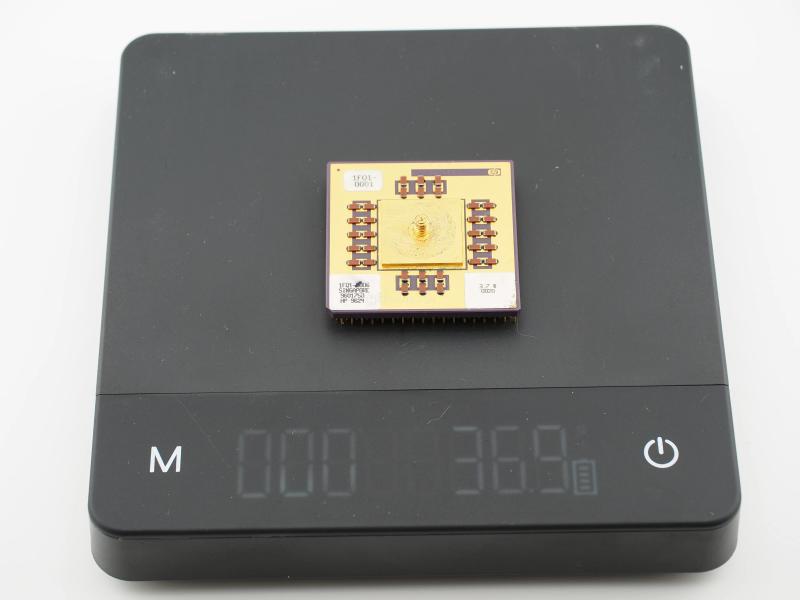
Holding this piece, the first thing that strikes me is the sheer, brutal density of the package. Placing it on the scale reveals a weight of 36.9 grams. For a processor of this physical footprint, that is an extraordinary amount of mass, speaking directly to the heavy-duty materials utilized in mid-90s enterprise silicon.
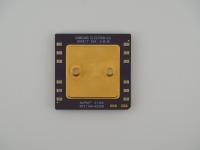
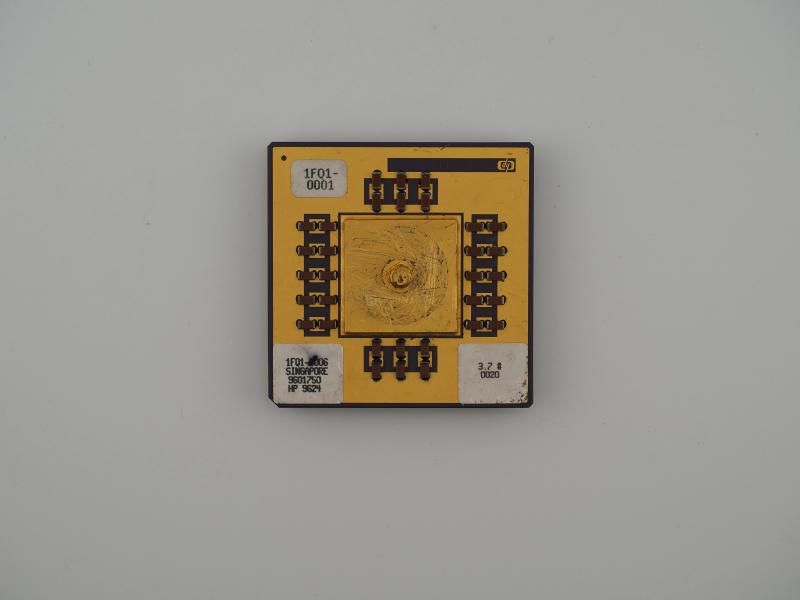
The top of this artifact is an absolute visual treat. We have a dark, multi-layer ceramic substrate housing a massive, gold-plated central heat slug. But the true star of the show is the threaded mounting stud brazed directly into the center of the die cap. This is not a chip that accepted a gentle, spring-loaded heatsink clip. This processor was designed to have a massive thermal block literally bolted and torqued down onto its surface.
Looking closely at the central gold plate, you can clearly see raw, radial machining marks surrounding the base of the threaded post. It is an industrial, almost violent texture that contrasts beautifully with the pristine array of fourteen surface-mounted decoupling capacitors flanking the central core.
In the top right corner, the classic lowercase hp logo is rendered directly in the gold trace layer. The surface bears three distinct paper identification stickers that have survived remarkably well:
Sticker 1 (Top Left):1FQ1-
0001
Sticker 2 (Bottom Left):1FQ1-0006
SINGAPORE
9601750
HP 9624
Sticker 3 (Bottom Right):3.7 #
0020
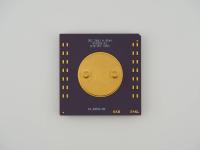
Flipping the artifact over, the bottom reveals a dense Pin Grid Array with bright, flawless gold pins. The center of the grid is left completely unpopulated, exposing the dark ceramic epoxy fill where the die sits on the opposite side. It is a stunning, industrial piece of high-end computing history.
This artifact represents the heavy metal era of UNIX workstations. To understand why this chip is built like a tank, we have to look at the architectural philosophy of Hewlett-Packard at the time. This specific unit operates on the PA-RISC architecture, a design that heavily prioritized floating-point performance and massive memory bandwidth over simple clock speed scaling.
Fabricated on a 0.55-micron CMOS process, the PA-7200 (internally known as PCX-T') was a superscalar beast. What makes the engineering of this specific package so fascinating is its approach to memory. Instead of cramming massive amounts of L1 cache onto the die, HP utilized a highly unique "assist cache" integrated directly onto the chip, which then managed a massive array of off-chip synchronous SRAM.
This required an incredible amount of I/O bandwidth, which explains the dense forest of gold pins on the bottom. Pushing that much data, alongside the high-performance logic gates of the era, generated serious heat. The threaded stud was not a gimmick. It was an engineering necessity to ensure perfect, high-pressure contact with a heavy extruded aluminum or copper heatsink to keep the silicon from melting down under enterprise workloads.
In the mid-1990s, the server room was a brutal battleground. Sun Microsystems had their SPARC architecture, IBM was pushing POWER, and HP was defending their turf with PA-RISC. Chips like this were the beating hearts of the legendary HP 9000 series workstations and servers, specifically the J-Class and K-Class machines.
There is a running joke among vintage hardware collectors that PA-RISC machines double as structural support for buildings. They were famously overbuilt. The lore surrounding these specific processors often involves system administrators running them in dusty, un-air-conditioned closets for a decade without a single crash. The threaded stud design actually birthed a minor myth that HP glued their heatsinks on; in reality, inexperienced technicians just did not realize they had to unbolt the heatsink from the chip itself.
This architecture eventually paved the way for the joint HP and Intel venture that became Itanium. While Itanium has its own tragic history, the pure PA-RISC chips remain beloved by UNIX purists for their flawless execution and bulletproof reliability.
Identifying exact variations of PA-RISC silicon can be slightly tricky because HP frequently used internal system part numbers rather than flashy marketing names on their production silicon. However, the visual evidence here paints a very clear picture.
The HP 9624 date code is the golden key. It tells us this chip was manufactured in Singapore during the 24th week of 1996. This perfectly aligns with the prime lifecycle of the PA-7200 processor. Furthermore, the physical layout of the fourteen capacitors and the central threaded stud is the exact footprint used for the PCX-T' generation.
The part numbers 1FQ1-0001 and 1FQ1-0006 are internal HP assembly and tracking codes. While some might confuse this package with the later PA-7300LC, the specific dual-sticker layout and the capacitor arrangement solidly point to it being a high-tier PA-7200. This artifact was almost certainly pulled from a decommissioned HP 9000 enterprise machine, surviving its server-room deployment to become a premier piece of this collection.