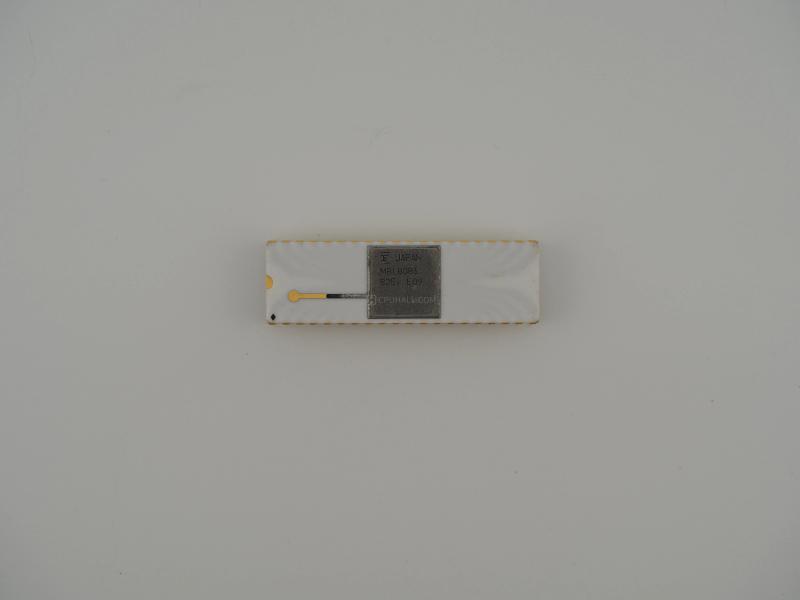

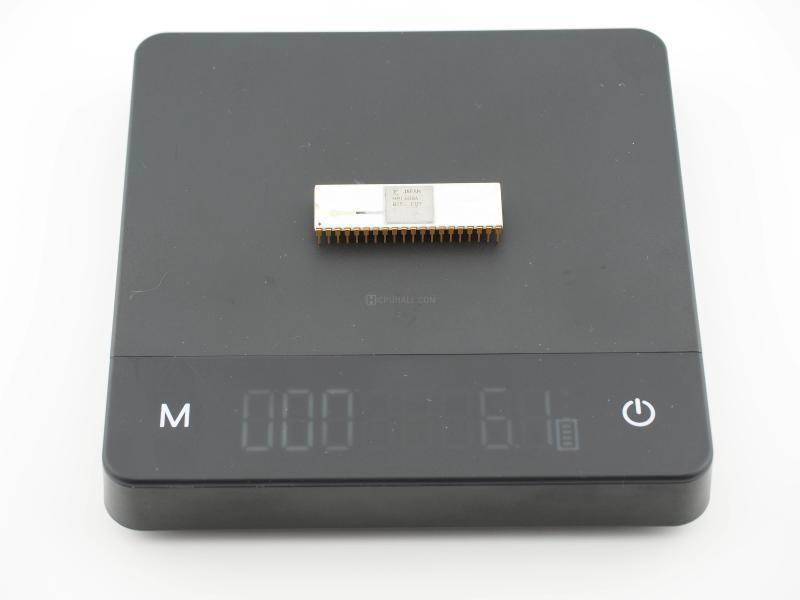
Holding this artifact, the sheer contrast of the materials immediately jumps out. We are looking at a striking white ceramic package capped with a grey metallic lid, accented by beautifully preserved gold-plated side-brazed pins. The top face features a very distinct grounding trace running from the left edge directly to the central metal cap. Examining the surface closely, we can clearly read the following markings:
[Fujitsu F Logo] JAPAN
MBL8086
8351 E09
The date code of 8351 places the manufacturing of this specific unit in the 51st week of 1983. The gold pins are in fantastic shape. When looking at the back of this board, the pristine, solid white ceramic substrate is completely uninterrupted, showcasing the level of quality Japanese fabricators brought to these early second-source agreements. The visual pop of the bright gold against the stark white ceramic makes this a fantastic display piece.
Underneath that protective metal cap sits the silicon that changed the world. This is a 16-bit microprocessor packing roughly 29,000 transistors built on a 3-micron depletion-load NMOS process. At its core, the x86 architecture utilizes a 16-bit external data bus and a 20-bit address bus. That 20-bit address bus is historically significant because it allowed the CPU to address a staggering 1 megabyte of memory, which was a massive leap for microcomputers at the time.
This specific Fujitsu MBL8086 operates at the baseline 5 MHz frequency. The choice of a 40-pin CDIP-40 (Ceramic Dual In-line Package) was entirely standard for the era. However, the white ceramic paired with the brazed metal cap provides superior thermal characteristics and environmental protection compared to standard plastic packages. The exposed trace on top grounds the cap to the substrate, effectively reducing electromagnetic interference and ensuring stable operation.
This chip represents the exact dawn of the x86 dynasty. While Intel designed the original 8086 in 1978, the semiconductor industry of the late 1970s and early 1980s operated on a strict second-source mandate. Major buyers, especially in military and industrial sectors, demanded that multiple manufacturers produce the exact same silicon to guarantee supply chain stability. Intel had to license the design out, and Fujitsu stepped up to the plate.
There is a common hardware myth that the 8086 powered the original IBM PC. In reality, IBM chose its cost-reduced sibling, the 8088, which had an 8-bit external data bus to save on motherboard trace complexity and support chip costs. However, the 8086 was the true flagship that laid the instruction set foundation we still build upon today. Every modern desktop processor owes its lineage directly to the architecture etched into this piece of silicon.
Identifying this piece is straightforward thanks to the immaculate printing on the top cap. The stylized "F" with the overline is the undeniable mark of Fujitsu. The MBL prefix was standard for Fujitsu's microprocessors and logic ICs of this era.
Given the late 1983 date code, this chip was fabricated right in the middle of the microcomputer revolution, just as the PC clone market was beginning to explode. The pristine condition of the white ceramic and the lack of severe socket insertion wear on the gold pins suggest it might have been new old stock or carefully pulled from a very clean industrial environment. I am highly confident in this classification as a standard 5 MHz Fujitsu 8086 licensed clone. It is a brilliant example of early 80s Japanese semiconductor manufacturing prowess.