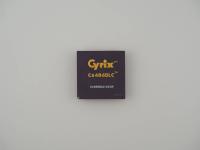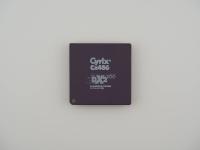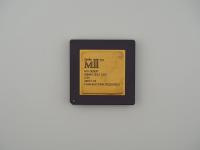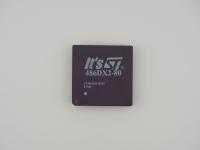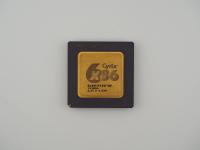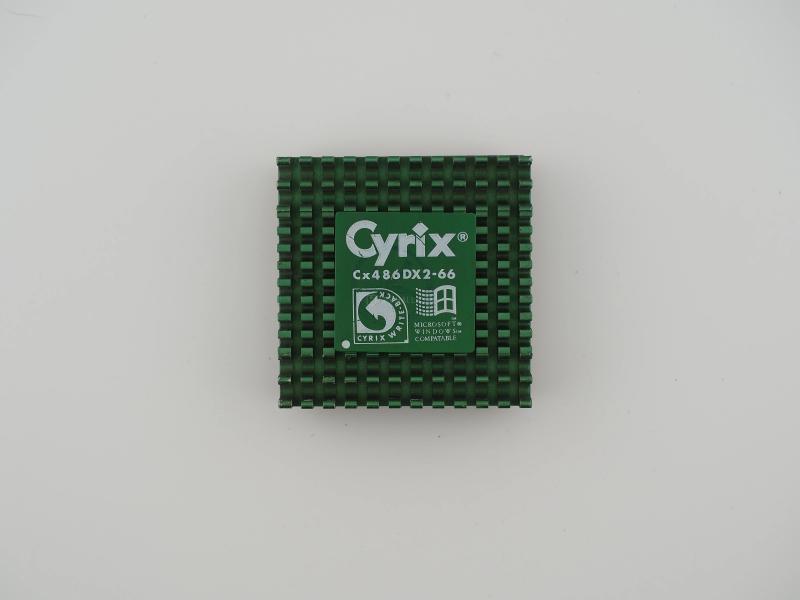

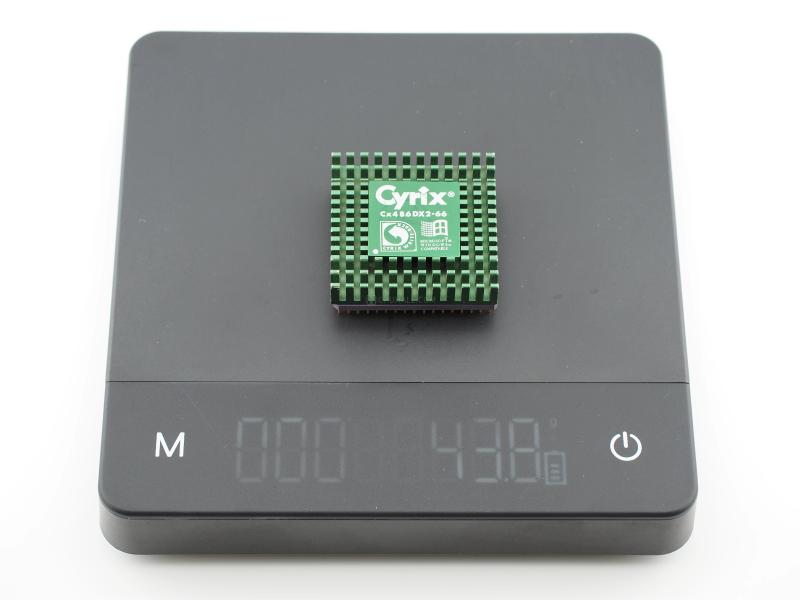
Examining this artifact, the first thing that hits you is that striking forest green anodized aluminum heatsink. It is permanently bonded to the chip, a signature Cyrix move that makes these units instantly recognizable in a sea of grey and black silicon. I've handled plenty of 486s, but the contrast between the deep purple ceramic substrate and the metallic green fins always feels uniquely "90s high-tech."
Looking at the underside, the gold-plated pins are in pristine condition, radiating that warm, high-purity glow. The center of the ceramic base features a black cap with crisp, silver-white laser etching.
Transcribed Markings:(C)(M) 1993 Cyrix USA
H1LP513H
Cx486DX2-66
CYRIX WRITE-BACK
MICROSOFT WINDOWS COMPATIBLE
The texture of the ceramic is smooth with that characteristic matte finish found on high-end chips of this era. There is no visible chipping on the corners of the substrate, which is rare for a chip that was likely pulled from a working Socket 3 board decades ago.
This specific unit is a clock-doubled beast. While the external bus screams along at 33 MHz, the internal core is hammered at 66 MHz. But the real engineering flex here is the Write-Back Cache. While many early 486 clones were stuck with slower write-through caches, Cyrix implemented a more sophisticated 8 KB unified write-back cache, which provided a significant boost in real-world application performance by reducing bus traffic.
Inside, we are looking at roughly 1.1 million transistors fabricated on a 0.65-micron process. It was a tight design. Cyrix didn’t just copy Intel’s homework; they clean-room engineered their own x86 implementation. This led to some fascinating architectural quirks, like their specialized hardware multiplier which made their integer performance punch way above its weight class. However, the trade-off was always the FPU (Floating Point Unit). While it was "FasMath" compatible, it often struggled to keep pace with Intel's DX2 in heavy 3D math or CAD workloads.
Cyrix was the ultimate underdog. They were the "heavy metal" alternative for builders who wanted to stick it to the Intel monopoly without sacrificing too much performance. In the mid-90s, owning a Cyrix was a statement. This Cx486DX2-66 was right at the heart of the "486 Wars."
The lore surrounding these chips usually involves their heat. That iconic green heatsink wasn't just for fashion; these chips ran hot. I remember rumors in the old hardware forums that Cyrix chips were "buggy," but most of that was just poor motherboard BIOS support for the advanced write-back features. Once configured correctly, these were stable, aggressive workhorses. Interestingly, the "Microsoft Windows Compatible" logo on the heatsink was a major marketing win for Cyrix, giving them the legitimacy they needed to compete in the pre-built OEM market.
The date code 93 and the part number H1LP513H firmly place this unit in the 1993-1994 production window. The inclusion of the "Write-Back" branding on the heatsink is a critical identifier. Earlier Cyrix 486s were often write-through or lacked the integrated heatsink entirely. The fact that this unit features the bonded green sink and the specific "Windows Compatible" badge confirms it was a retail or high-end OEM version meant to compete directly with the Intel i486DX2-66.