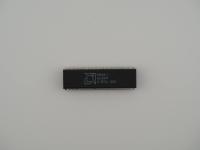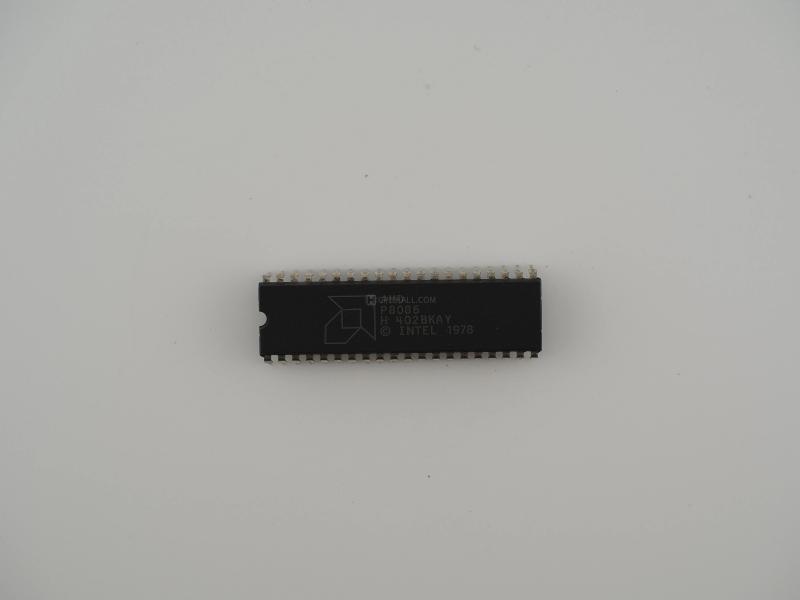

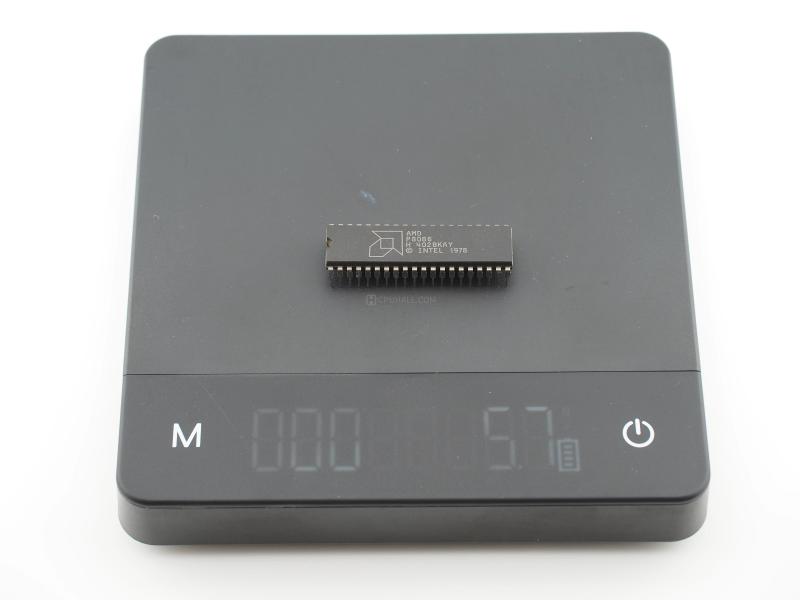
This is not a flagship thermal conduction module or some classified Soviet clone dripping in gold. It is pure, function-first plastic. Getting the lighting right to capture this piece for the archive requires bouncing the flash just perfectly to catch the micro-contrast of the laser etching against the matte black epoxy resin.
The surface markings are remarkably crisp:
AMD
P8086
H 402BKAY
© INTEL 1978
Flipping the board over, the bottom reveals standard injection molding artifacts, including a faint circle with "E2" and another with "9" embedded in the plastic. The 40 tinned pins show minor oxidation and wear, a testament to its age and its journey before finding a resting place here in the museum.
This piece of silicon is where the modern computing world was born. The 8086 is a 16-bit microprocessor built on a 3-micron HMOS process, packing roughly 29,000 transistors. The "P" in the AMD part number strictly designates the Plastic Dual In-line Package (PDIP), a packaging choice meant for cost-effective consumer and business machines rather than military or aerospace applications where ceramic was mandated.
Running at a base clock of 5 MHz, this specific chip features a 16-bit data bus and a 20-bit address bus. That 20-bit address bus famously allowed the processor to address up to 1 MB of memory. It is a chip that runs relatively cool by today's standards, pulling just a couple of watts, but it required careful motherboard layouts due to the sprawling, linear nature of the 40-pin interface.
The lore of this exact artifact is written right on its face. Seeing the old-school AMD logo stamped directly above a copyright claim for Intel perfectly encapsulates the most brutal corporate rivalry in semiconductor history.
When IBM was designing the original PC, they had a strict procurement policy. Any critical component must have a second-source manufacturer to prevent supply chain monopolies and bottlenecks. Intel was desperate to win the massive IBM contract and was forced into a technology exchange agreement with Advanced Micro Devices. This little plastic chip is the physical manifestation of that arrangement. AMD manufactured an exact, licensed clone of Intel's intellectual property. Intel effectively handed their greatest rival the keys to the kingdom, setting the stage for decades of fierce competition, relentless lawsuits, and the architectural leapfrogging that drove the PC revolution.
Researching the exact timeline of this AMD run involves decoding the 402BKAY string below the main part number. Typically, these date codes follow a strict format. The 40 is highly likely a representation of 1984 week 02, placing the fabrication of this chip right in the golden era of the IBM PC XT clones.
The lack of an -1 or -2 suffix on the P8086 designation confidently confirms this is the baseline 5 MHz part, not the faster 8 MHz or 10 MHz binned versions that came later. While it might not be the rarest piece of silicon in the collection, having this exact cross-branded artifact is absolutely essential. You simply cannot build a complete archive of CPU history without the chip that started the clone wars.