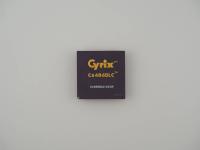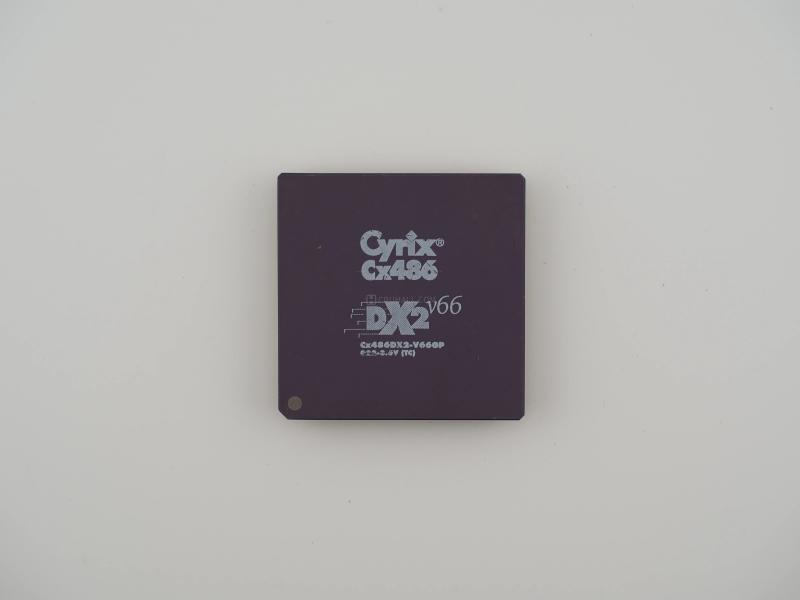

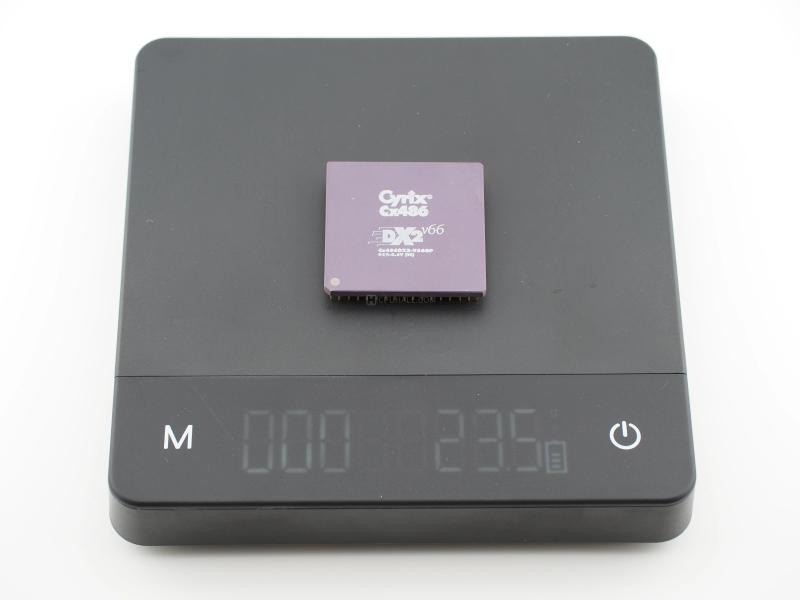
Looking at the main face, the silkscreening is wonderfully intact. We have the classic, slightly stylized Cyrix logo above the model designation, but it's the faint, laser-etched text below the main print that reveals the true engineering specifics:
Cyrix®
Cx486
DX2V66
Cx486DX2-V66GP
e3.3-3.6V (TC)
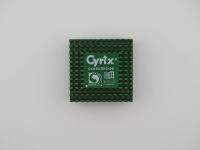
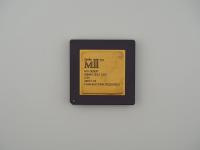
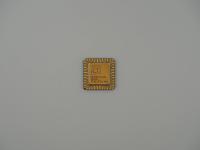
Flipping this chip over, we are greeted by a dense forest of 168 gold-plated pins. What I absolutely love about this specific unit are the vintage quality control and warranty stickers slapped right onto the central heat spreader. We have a classic grid sticker with 95 and 96 printed on it, with blue ink striking through the 10th month, a quintessential hallmark of independent PC shops from that era. Below that is an oval sticker with Chinese characters and "LX".
Peeking out from under these historical layers of commerce, the laser etching on the dark silicon cap reads:
© 1993 Cyrix USA
JAPAN
G1BN446E
This is a clock-doubled 486 processor, meaning it ran at a 33 MHz external bus speed while the internal core chewed through instructions at 66 MHz. This was the absolute sweet spot for gaming and desktop computing in the early-to-mid 1990s.
The V in the DX2-V66GP designation is crucial. Standard early 486 chips ran at a blistering (and thermally punishing) 5 Volts. As clock speeds scaled, heat became a massive bottleneck. The V designates this as a low-voltage part, corroborated by the e3.3-3.6V laser etching. By dropping the core voltage, Cyrix allowed system builders to run these chips with much smaller heatsinks (often just passive blocks of aluminum) compared to the active cooling solutions that were starting to become mandatory for 5V parts pushing past 50 MHz.
The "GP" suffix denotes the standard Ceramic Pin Grid Array (PGA-168) package, ensuring drop-in compatibility with the ubiquitous Socket 2 and Socket 3 motherboards of the day.
This chip is a frontline soldier from the Great Clone Wars of the 1990s. Cyrix didn't have Intel's massive fabrication plants, nor did they have the legal right to simply copy Intel's microcode. Instead, Cyrix engineers famously clean-room reverse-engineered the entire x86 instruction set. They built chips that were functionally identical to Intel's offerings but architecturally distinct under the hood.
The Cx486 series was a massive thorn in Intel's side. Cyrix leveraged their earlier expertise in high-performance math coprocessors (the legendary FasMath series) to build a 486 that could genuinely go toe-to-toe with the genuine article, often undercutting Intel on price while offering comparable, and sometimes superior integer performance.
A common myth is that all non-Intel 486s were inherently buggy or incompatible. While early clone motherboards certainly had chipset quirks, a well-configured Cyrix DX2-66 was a powerhouse. For a teenager wanting to play DOOM or Tie Fighter in 1994, this chip was the ultimate budget-friendly ticket to high frame rates.
The markings on this chip tell a fascinating story of global supply chains in the 90s. Cyrix was a fabless semiconductor company; they designed the architecture in Texas but had to contract out the actual manufacturing.
The prominent JAPAN stamp on the bottom spreader, combined with the 1993 copyright, strongly points to fabrication by either IBM Microelectronics (who had facilities in Japan) or potentially Seiko Epson, both of whom acted as foundry partners for Cyrix during this era.
The warranty stickers add the final layer to its provenance. The blue ink marking October 1995 or 1996 suggests this chip was sold, perhaps as a standalone upgrade or as part of a custom-built white-box PC, years after its initial 1993 design date. This makes perfect sense; as Intel pushed the original Pentium into the high-end market, clock-doubled 486 chips like this Cyrix became the absolute kings of the value sector, moving in massive volumes through local electronics districts and catalog retailers well into the late 90s.