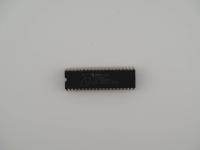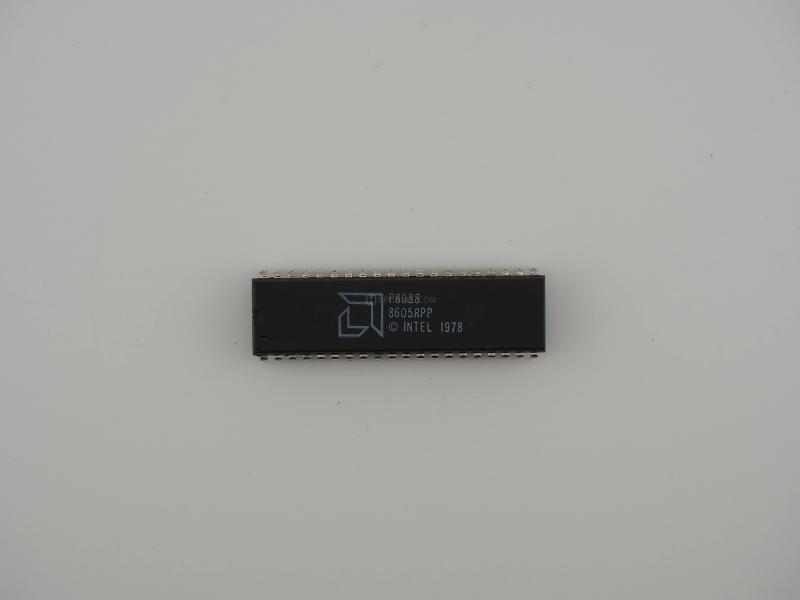

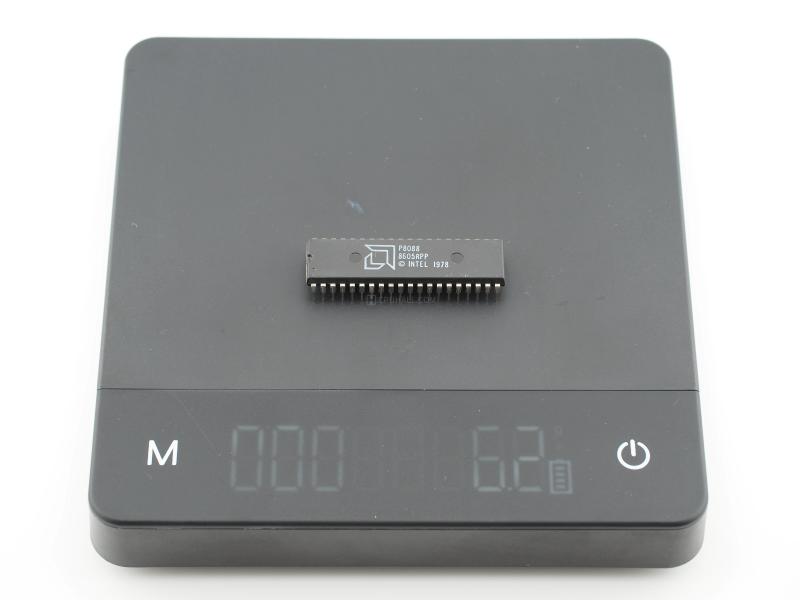
This artifact is housed in a standard black plastic Dual In-line Package. It lacks the heavy ceramic clink or the gold-plated luxury of the mainframe hardware in my collection, but its visual impact comes entirely from the stark, high-contrast laser etching on the top face.
[Large AMD Interlocking Squares Logo]
P8088
8605RPP
© INTEL 1978
The plastic surface has a slightly porous, matte finish typical of 1980s mass manufacturing. The pins are standard tin-plated copper and show minimal oxidation, indicating this specific unit was likely kept in favorable storage conditions or pulled carefully from a socket. Flipping it over to examine the underbelly, there are simple mold indentations marked BJ and 13, which are just internal tooling marks from the fabrication plant.
Beneath this unassuming plastic shell lies a piece of silicon that fundamentally changed the world. The 8088 is internally identical to the full 16-bit 8086 processor. It features the same execution unit and the same roughly 29,000 transistors built on a 3-micron HMOS process.
The brilliant engineering compromise of the 8088 lies in its external interface. While it processes data 16 bits at a time internally, it communicates with the rest of the motherboard over an 8-bit external data bus. This required the chip to execute two memory cycles to fetch a single 16-bit word. It sounds like a severe bottleneck, and in terms of raw performance, it absolutely was. However, this architectural quirk meant motherboard manufacturers could use cheaper, readily available 8-bit support chips and memory components. It kept system costs low and simplified board design significantly. It ran cool enough to never require a heatsink, radiating its nominal heat directly through the plastic package.
This is where the story of this specific chip gets truly heavy. Notice the branding. We have a massive AMD logo sitting directly above an Intel copyright. This single physical artifact represents the genesis of the most brutal and defining corporate rivalry in silicon history.
When IBM was developing the original IBM PC 5150, they selected the Intel 8088 to serve as the brains of the machine. But IBM had a strict corporate policy. They refused to rely on a single supplier for a critical component. If Intel had a manufacturing failure or a factory fire, IBM did not want their flagship PC assembly lines grinding to a halt. They demanded a second source.
To secure the IBM contract, Intel was forced to license their precious x86 architecture to other manufacturers. AMD was one of those chosen second sources. They were given the masks and the microcode to produce exact, mathematically identical clones of the Intel silicon. This arrangement made the IBM PC a massive global standard, but it also armed AMD with the x86 architecture. Years later, Intel would try to revoke these licensing agreements, sparking a decade of vicious legal warfare that ultimately resulted in AMD gaining the legal right to produce their own x86 designs. Every modern Ryzen and Core processor owes its lineage to the shotgun marriage represented by the ink on this very chip.
Identification of this artifact is entirely definitive. The surface printing leaves no room for ambiguity. The P prefix on the AMD model number denotes a Plastic package. The model is definitively the 8088.
The most interesting data point on this unit is the 8605RPP string. This is the date and batch code. The 8605 tells us exactly when this chip rolled off the assembly line: the 5th week of 1986. This is fascinating because the 8088 was introduced in 1979 and the IBM PC launched in 1981. By 1986, the Intel 80286 was already dominating the high-end market, and the legendary 386 was hitting the streets. Therefore, this specific unit was fabricated late in the 8088's lifecycle. It was almost certainly destined for an ultra-budget IBM XT clone system. It is a mass-produced workhorse, a perfect example of how the second-source agreements kept legacy silicon alive and affordable long after the bleeding edge had moved on.