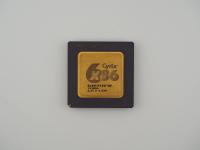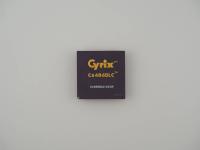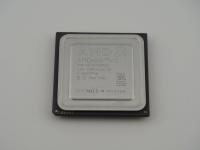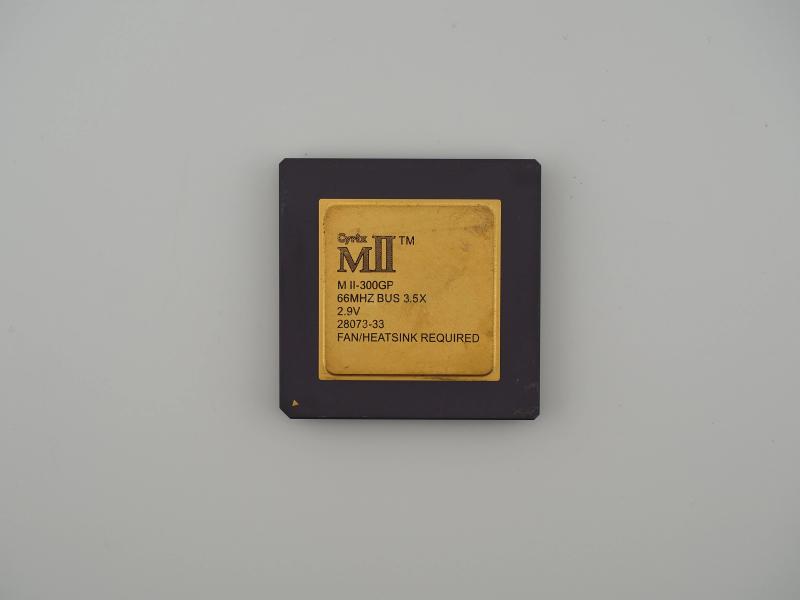

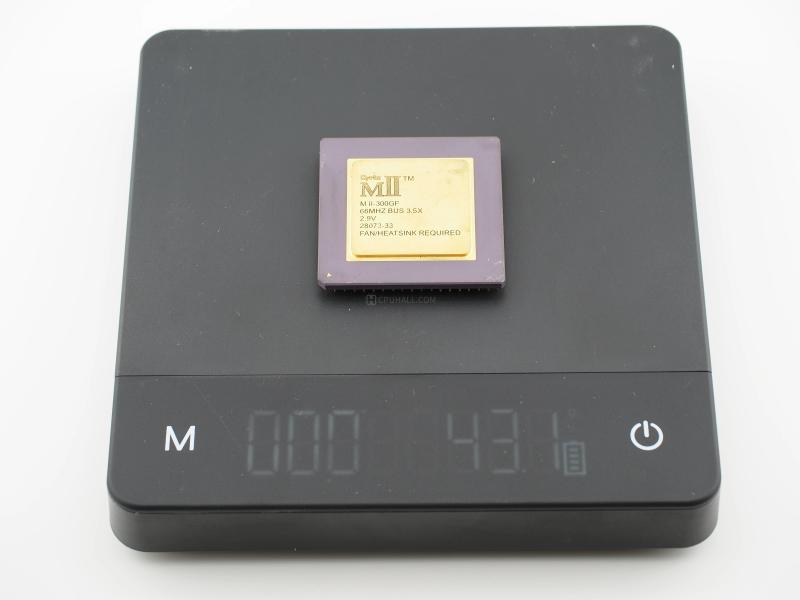
The gold cap is not just for show. It acts as a critical thermal interface for the die beneath, giving the entire package a dense, premium heft in the hand.
When observing the surface details, the typography is sharp and aggressive, perfectly matching the late 90s hardware attitude.
Front Heat Spreader:Cyrix MII™
M II-300GP
66MHZ BUS 3.5X
2.9V
28073-33
FAN/HEATSINK REQUIRED
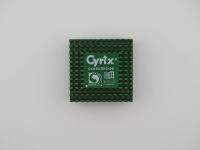
Back Ceramic Etching:Ⓜ © 1995-1998
CYRIX
V7SN7906DZ
Flipping this artifact over reveals the staggered gold pins of the classic Socket 7 layout. The pins are remarkably straight, and the gold plating still catches the light beautifully. Right in the center of the underside, there is a very faint laser etching on the dark silicon backing. I also noticed a paper aftermarket warranty sticker with the Chinese characters "撕毁无效" (void if torn) overlapping the silicon and the ceramic, a common sight on chips that circulated heavily through the grey markets of the era.
Underneath that heavy gold cap lies the 6x86MX core, which was rebranded here as the MII to directly combat Intel's Pentium II marketing machine. The numbers stamped on the heat spreader tell a fascinating, highly specific technical story of the era.
The "300GP" does not mean this chip runs at 300 MHz. Instead, Cyrix explicitly lists the true math right below it: 66MHZ BUS 3.5X. This means this processor physically operates at 233 MHz. The "300" is a Performance Rating (PR), a controversial marketing metric claiming this chip offered equivalent integer performance to an Intel Pentium II running at 300 MHz.
Operating at a core voltage of 2.9 Volts, this specific unit required a late generation Super Socket 7 motherboard equipped with split voltage regulators to feed the CPU core and the I/O interface separately. Cyrix chips from this generation ran notoriously hot due to their dense logic implementation, which is exactly why the engineers felt compelled to explicitly stamp FAN/HEATSINK REQUIRED directly into the gold plating. You could absolutely fry one of these in seconds if you booted it bare.
Cyrix was the ultimate scrappy underdog of the 1990s desktop market. They were a fabless semiconductor company, meaning they had to rely on heavy hitting partners like IBM and National Semiconductor to actually manufacture their silicon designs.
The MII was a masterclass in integer processing. If you were crunching spreadsheets, compiling code, or running basic Windows applications, this chip punched way out of its weight class and delivered incredible value. However, the architecture featured a weaker, less deeply pipelined Floating Point Unit (FPU) compared to Intel's offerings.
When id Software dropped Quake, a game that heavily relied on raw FPU calculations to render its 3D environment, the MII struggled to keep up. This created a legendary dichotomy in the vintage hardware community. The MII was a beast for office productivity but a known bottleneck for cutting edge 3D gaming. It remains a beautiful symbol of the "PR rating wars" where clock speed was completely decoupled from actual performance.
There is no mystery to the core identity of this specific unit given the bold, unashamed marketing printed directly on the gold cap. However, tracing its specific fabrication lineage is always a rewarding forensic exercise.
The 1998 copyright date and the MII branding place this piece right in the volatile era after National Semiconductor acquired Cyrix in late 1997. National Semiconductor ultimately wanted to push Cyrix IP into the low cost, highly integrated "system on a chip" market, marking the beginning of the end for Cyrix's high end desktop ambitions. The laser etched V7SN7906DZ on the ceramic belly is a lot code that confirms its late 90s production run.
Based on the paper distributor sticker on the back, I can confidently deduce this chip had a long, working life in the Asian domestic aftermarket before being retired and finding a permanent home in my collection. It survived the heat, the overclocking attempts, and the relentless march of Moore's Law.