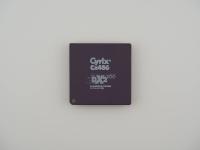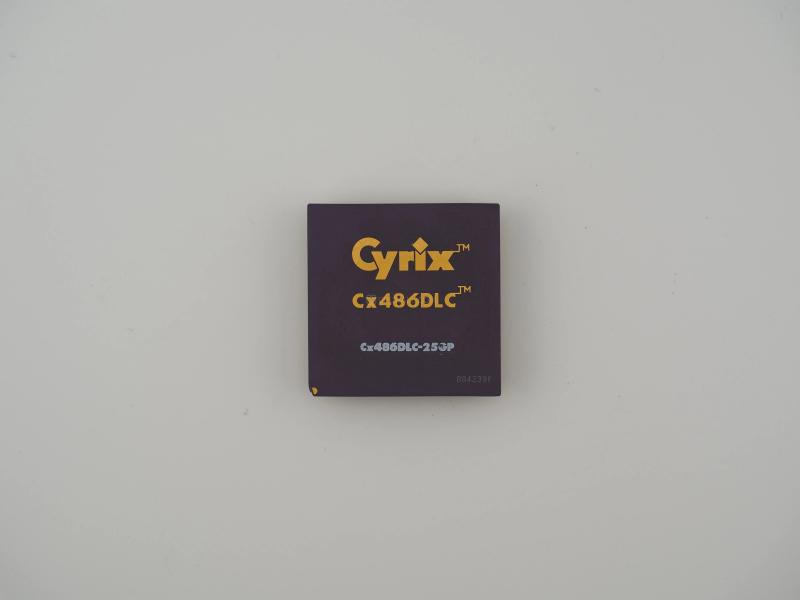

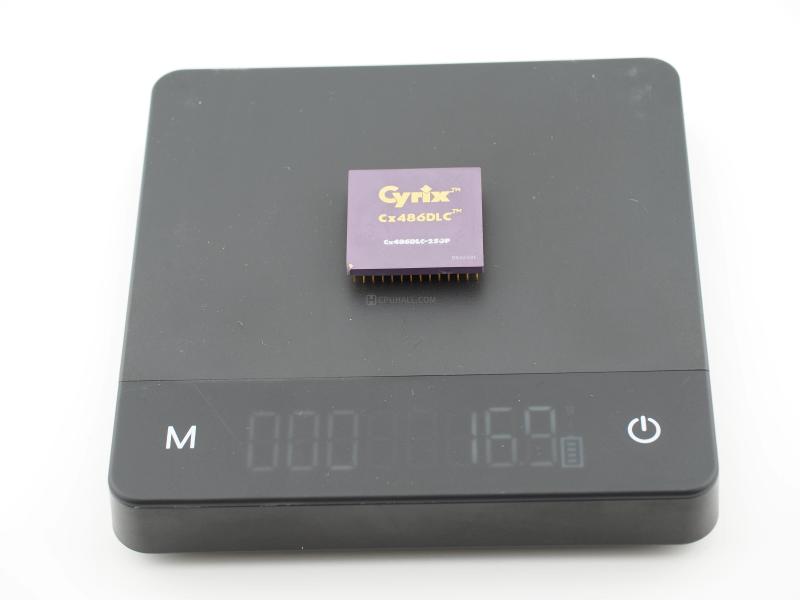
Holding this piece in the light reveals a beautifully subtle, deep purple hue to the ceramic substrate. This is a hallmark of classic early 1990s chip fabrication. The top surface features the striking, yellow-gold Cyrix logo alongside crisp, silver-white stamping for the model number. Down in the bottom right corner, a much fainter manufacturing batch code is barely visible against the dark ceramic.
Front Markings:Cyrix™
Cx486DLC™
Cx486DLC-25GP
BB4239F
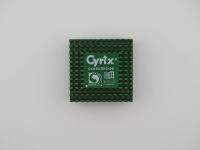
Rear Markings:©℗ 1992 Cyrix USA
JAPAN
Flipping this artifact over, the 132 gold-plated pins are perfectly aligned and brazed directly into the ceramic base. They frame a dark, raised central cap where the silicon die resides. The laser etching on this rear cap clearly denotes the 1992 copyright and the "JAPAN" origin. The high-contrast aesthetic between the bright gold pins and the dark ceramic is exactly why I love collecting and photographing this specific era of hardware.
This chip is a fascinating architectural hybrid. It fundamentally crams a 486-class execution engine into a physical package designed strictly for a 386DX motherboard socket. The interface is a standard 132-pin PGA, allowing it to act as a drop-in upgrade. It runs at 25 MHz and features 1KB of integrated L1 cache.
That 1KB of cache was a massive deal for performance, but it caused significant engineering headaches. Motherboards designed for the older 386 architecture simply did not expect the CPU to have its own internal cache. This led to severe cache coherency issues with DMA controllers, meaning background hardware tasks could overwrite memory the CPU thought it still had cached. To fix this, you had to run a specific software enabler utility in your AUTOEXEC.BAT file to turn the L1 cache on safely. Furthermore, this specific silicon lacks an integrated floating-point unit. If you were doing heavy mathematical workloads or early 3D rendering, you still had to pair this chip with a separate 387 or 487 math coprocessor on the motherboard.
The Cyrix Cx486DLC was the ultimate budget hot-rod part for the computing masses. In 1992, a true Intel 486 system required an entirely new, incredibly expensive motherboard. Cyrix realized they could sell a massive performance boost directly to people who were stuck on older 386 platforms. They famously reverse-engineered the x86 instruction set completely from scratch in a "clean room" environment to avoid Intel's patents. This naturally led to years of bitter, industry-defining lawsuits.
The DLC was a massive thorn in Intel's side because it aggressively cannibalized lower-end 486SX sales. A funny historical quirk of these upgrade chips is how they absolutely broke older PC games. Software from the 1980s often tied game speed directly to the CPU clock cycle. Dropping a highly efficient 486 core into a 386 board made everything run at ludicrous, unplayable speeds. You had to rely heavily on the "Turbo" button on the front of your PC case just to slow the system down enough to play a game of Pac-Man.
I am highly confident in the identification of this artifact. The "25GP" suffix on the surface text definitively indicates the 25 MHz operating frequency and the grid array packaging. The 1992 copyright aligns perfectly with the historical release window of the DLC line.
The "JAPAN" marking on the rear cap is an interesting logistical footnote. Cyrix was a fabless semiconductor company based in the United States. They famously partnered with larger foundries like Texas Instruments and SGS-Thomson to actually manufacture their silicon. The Japan stamp suggests this specific batch was packaged or perhaps entirely fabricated in an overseas partner facility. This physical detail points directly to the sprawling, complex global supply chains that Cyrix utilized to keep costs low enough to aggressively undercut Intel in the retail market.