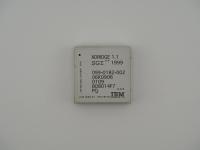

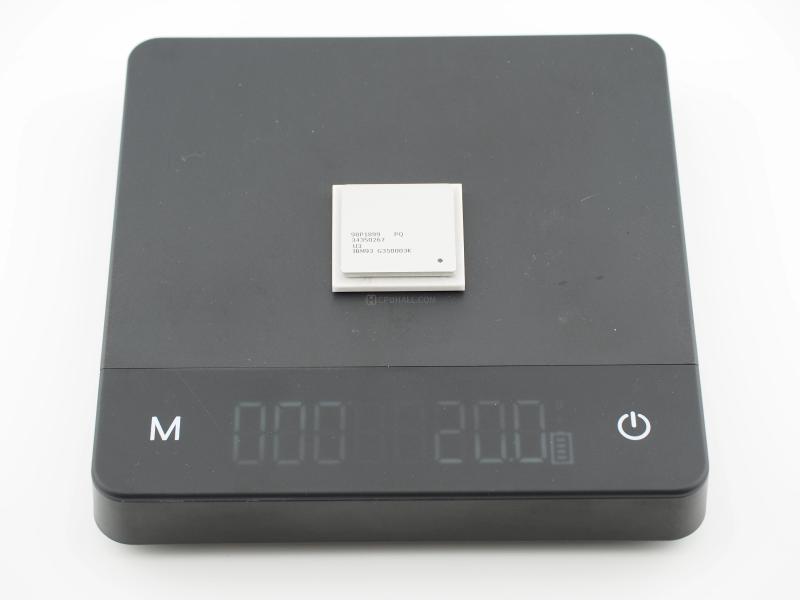
Holding this specific unit in my hands, the first thing that strikes me is the sheer density. As seen on the scale, it weighs in at exactly 20.0 grams. For a bare component without a heatsink, that is a remarkably hefty chunk of materials.
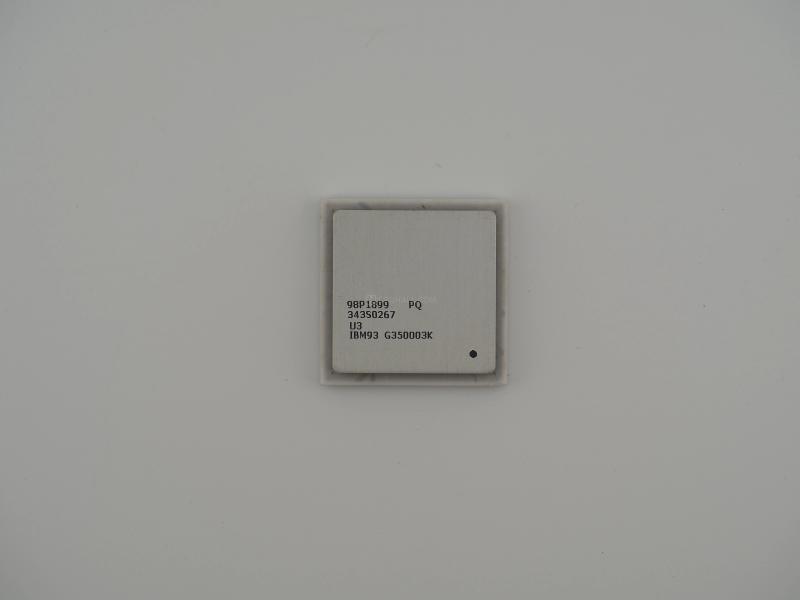
The aesthetic is aggressively industrial. The top features a brushed metallic heatspreader with a stark black orientation dot in the lower right corner. The text is laser-etched with incredible precision, reading exactly as follows:
98P1899   PQ
343S0267
U3
IBM93 G350003K
Flipping this artifact over reveals a mesmerizing Ceramic Ball Grid Array (CBGA). The substrate is a brilliant, opaque white ceramic, which feels exceptionally cold and rigid to the touch. The solder balls are heavy, distinct, and arranged in a complex pattern with a voided center and missing corners to optimize power delivery and signal routing. The pristine condition of the brazing and the absolute uniformity of the metallic spheres indicate this was either perfectly reballed or, more likely, never mounted to a production board.
The U3 is not a central processing unit, but rather the System Controller, commonly known as the Northbridge, for the PowerPC 970 (G5) architecture. In the early 2000s, IBM engineered the G5 processor to be a computational monster, but all that power was useless without a massive pipeline to feed it data. That is exactly what this slab of ceramic and silicon was designed to do.
The U3 chip acted as the Grand Central Station of the Power Mac G5 logic board. It managed the ultra-high-speed point-to-point processor bus (which ran at up to half the clock speed of the CPU itself), handled the dual-channel DDR RAM controller, and provided the AGP 8X graphics interface. Funneling gigabytes of data per second across these interfaces generated an immense thermal load. The dense white ceramic packaging was specifically chosen by IBM for its thermal stability, allowing the immense heat from the die to transfer through the lid and into the massive aluminum heatsinks Apple had to design specifically for this controller.
This chip represents the chaotic twilight of the PowerPC era. When Steve Jobs introduced the Power Mac G5 in 2003, he touted the Apple and IBM partnership as an unstoppable force. The G5 was a genuine supercomputer architecture scaled down for the desktop.
However, the U3 Northbridge holds a very dark legacy among vintage hardware collectors and repair technicians. Because it ran incredibly hot, it was subject to extreme thermal cycling. You turn the machine on, the U3 heats up rapidly; you turn it off, it cools down. Over time, the differing thermal expansion rates between the rigid ceramic substrate of the U3 and the fiberglass logic board caused the BGA solder balls underneath to crack and break contact.
When a connection severed, the G5 would fail to POST. Instead, the system would default to running all internal cooling fans at maximum speed. This terrifying roar is known in the community as the "G5 jet engine" syndrome. Thousands of beautiful aluminum Macintoshes ended up in landfills strictly because of micro-fractures beneath this exact piece of hardware.
Identifying this piece requires looking past the surface simplicity. The laser etching tells the entire story without ambiguity. The 343S0267 string is a proprietary Apple part numbering format, immediately placing this within the Macintosh ecosystem. The 98P1899 and IBM93 markings confirm IBM as the primary fabricator and engineering partner.
The definitive identifier, however, is simply the U3 stamped right in the middle. In Apple logic board schematics from 2003 to 2005, the U3 is universally the designation for the G5 System Controller. Visual confirmation of the thick white ceramic substrate perfectly matches known teardowns of single and dual-processor Power Mac G5 logic boards. I am absolutely certain of this identification. It is a vital, albeit deeply flawed, masterpiece of early millennium silicon design.