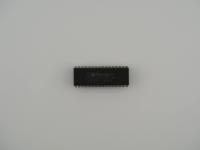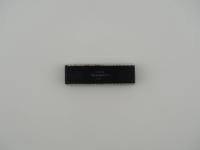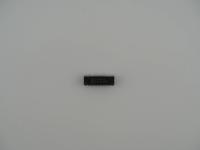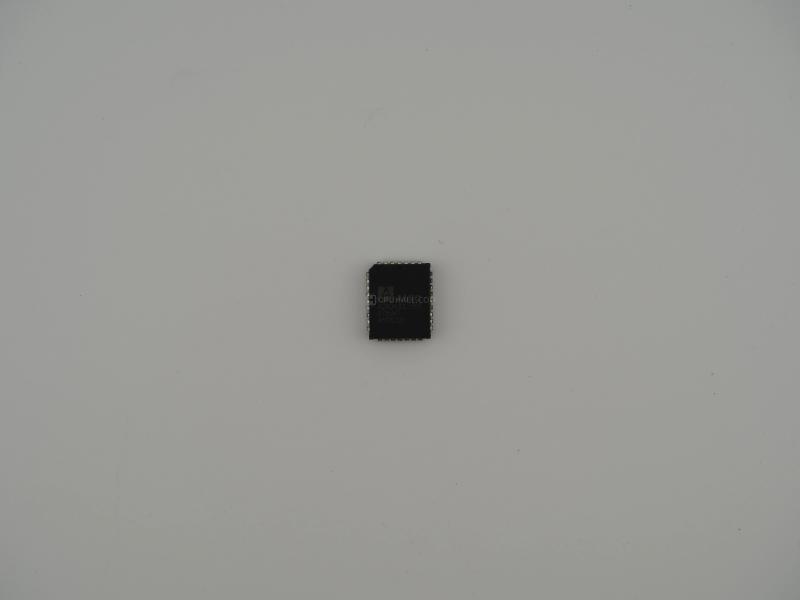

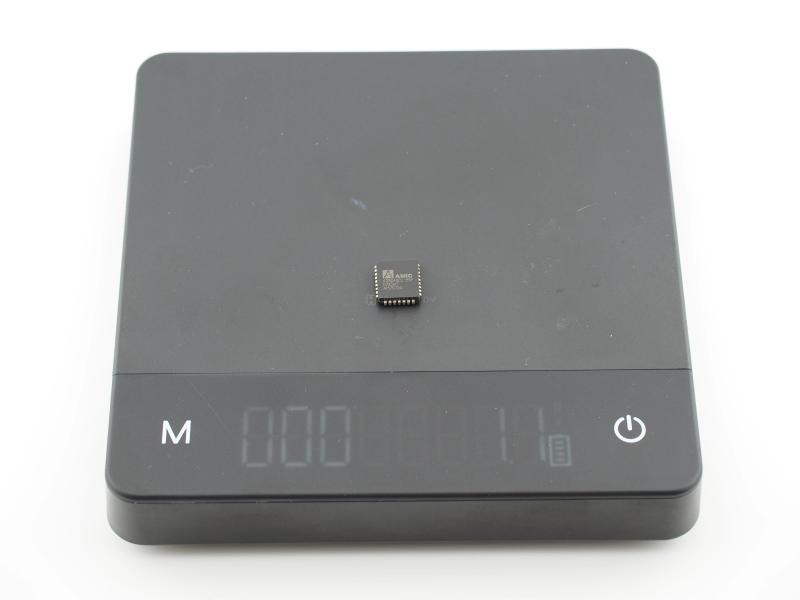
Holding this specific unit under the lighting rig, there is no exotic gold brazing or heavy purple ceramic to admire. Instead, we have the quintessential black plastic workhorse of the mid-2000s computing era. The encapsulation is a standard, slightly textured epoxy resin. The J-leads curling under the package show minor oxidation, typical for a component of its age that has likely been pulled from a socket rather than remaining factory sealed.
Leveraging the macro lens, the laser etching on the surface is highly legible against the dark substrate. The prominent stylized "A" logo sits clearly next to the manufacturer name:
A AMIC
A29040CL-55F
0735WT
AM76720
The date code 0735 indicates this piece of silicon was baked in the 35th week of 2007. The packaging is a classic PLCC-32 format. These chips were designed to be socketed directly onto motherboards, allowing for easy replacement if a user managed to brick their system during an ill-advised firmware update.
While it lacks the massive transistor count or thermal footprint of a mainframe processor, the engineering inside the A29040CL-55F is purely practical. This is a 4 Megabit 5-volt only CMOS flash memory chip, organized as 512K by 8 bits.
The 55F suffix denotes a 55-nanosecond access time. For a BIOS or firmware storage chip, 55ns is plenty fast enough to feed initial boot instructions to a CPU before system memory takes over the heavy lifting. The architecture utilizes a sector erase mechanism, which was a massive quality of life improvement over older EEPROM chips that required bulk erasing. AMIC rated these chips for 100,000 program and erase cycles with a 20-year data retention lifespan. It operated strictly on a standard 5.0V power supply for both read and write operations, eliminating the need for the specialized 12V programming voltages required by older generation ROMs.
In a museum dedicated to massive thermal conduction modules and prototype supercomputer silicon, a generic Taiwanese flash chip might seem out of place. Yet, these little plastic squares are the unsung heroes of computing history. AMIC Technology spun out of United Microelectronics Corporation (UMC) in the late 1990s and flooded the market with highly reliable, cheap memory ICs.
You would find the A29040 series acting as the BIOS chip in countless late-era Pentium III, Pentium 4, and early Athlon motherboards. It also lived inside network routers, embedded industrial controllers, and set-top boxes. There is no glorious lore of engineers bleeding over the design of this chip. It was a pure commodity. However, without these reliable boot ROMs holding the crucial initial code, the most expensive and exotic processors of the era were absolutely useless blocks of sand.
The identity of this artifact is entirely straightforward. The laser etching is unambiguous and perfectly matches AMIC's standard nomenclature for their 4M-bit CMOS flash memory line.
The L in the part number typically denotes a specific low-power standby mode or temperature rating within AMIC's internal tracking, while the WT suffix often points to the physical packaging tape and reel format or a specific fabrication plant code. Because this chip was manufactured in 2007, it represents the tail end of the PLCC BIOS era. Shortly after this period, the industry aggressively shifted towards 8-pin SPI flash chips in SOIC packages to save motherboard real estate and reduce routing complexity. This makes our PLCC-32 example a late-stage artifact of parallel interface boot ROMs.