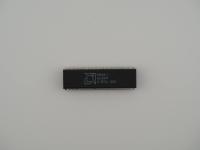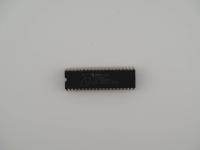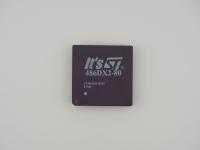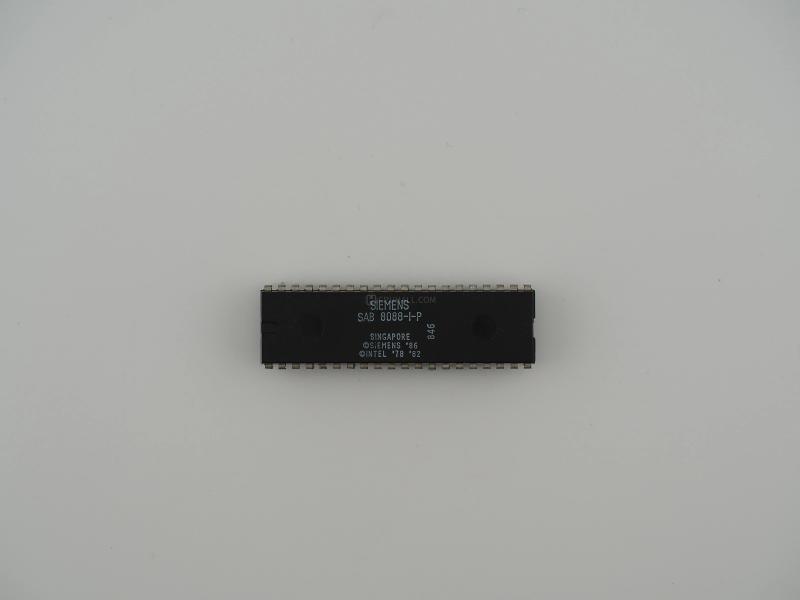

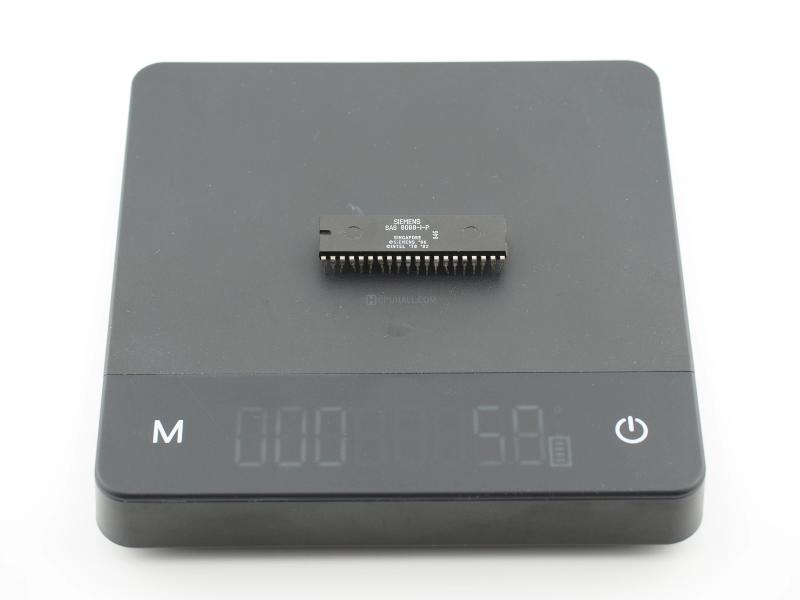
Holding this piece, I am immediately grounded in the utilitarian reality of the mid-1980s personal computer boom. This is not some exotic, gold-capped ceramic mainframe module. It is a standard, mass-produced plastic slab weighing exactly 5.8 grams. It measures out to the classic 40-pin Dual In-line Package dimensions, built to be slammed into inexpensive consumer motherboards with zero fanfare.
When looking at the top surface, the laser etching is crisp against the matte black plastic resin. The micro-contrast is excellent, revealing the dual-copyright lineage of second-source manufacturing.
SIEMENS
SAB 8088-1-P
846
SINGAPORE
©SIEMENS '86
©INTEL '78 '82
The pins are standard tin-plated copper, showing just a hint of oxidation and slight bending on the left flank from past extraction. The "P" in the part number explicitly denotes this plastic packaging. The 846 is almost certainly a batch identifier or a date code pointing to the 46th week of 1988. It is a humble artifact aesthetically, but functionally, it is the foundation of the modern computing world.
Diving into the silicon, the SAB 8088 is a masterclass in pragmatic compromise. Internally, this is a fully 16-bit processor. It features 16-bit registers and can process 16-bit data operations internally just like its older brother, the 8086. However, the external data bus is intentionally crippled down to 8 bits.
This specific unit carries the -1 suffix. In Intel and second-source nomenclature of the era, the standard 8088 ran at 5 MHz. The 8088-2 ran at 8 MHz. This -1 variant represents the absolute performance ceiling for this specific architecture, clocking in at a blistering 10 MHz.
To pull this off, the fabrication required a highly refined 3-micron HMOS process containing roughly 29,000 transistors. Operating at 5 volts, this chip did not require active cooling. It just sat in its socket, crunching through the x86 instruction set and addressing a maximum of 1 megabyte of memory using its segmented memory architecture. The engineering brilliance here was not raw power. It was economic viability. By bottlenecking the external bus to 8 bits, hardware manufacturers could use vastly cheaper 8-bit support chips, memory modules, and board designs.
You cannot talk about CPU history without bowing to the 8088. When IBM decided to build the PC 5150, they bypassed the superior processors of the era like the Motorola 68000. They wanted something cheap, something that used existing and inexpensive 8-bit support infrastructure. The 8088 was chosen, and that single corporate decision cemented the x86 architecture as the dominant standard for the next four decades.
The lore of second-sourcing is written right on the top of this chip. IBM demanded that any vital component have multiple manufacturing sources to guarantee supply chain stability. Intel was forced to license their golden goose to companies like AMD, Fujitsu, Harris, and in this case, Siemens.
There is a common misconception that the 8088 was just a "fake" 16-bit processor. People often confuse bus width with architectural width. Inside the die, this chip is executing identical microcode to the 8086. It just took twice as many clock cycles to fetch a 16-bit word from memory since it had to pull it across the bus in two 8-bit chunks. It is a brilliant hack that birthed an empire.
Identifying this artifact is highly straightforward thanks to the immaculate legibility of the markings. Siemens was a major European semiconductor fabricator and a massive producer of licensed Intel silicon during the 1980s.
The dual copyright dates explicitly outline the legal and developmental history. The INTEL '78 '82 refers to the original architecture design and subsequent microcode revisions. The SIEMENS '86 copyright marks the year Siemens updated their specific mask or fabrication process for this high-speed 10 MHz variant. The SINGAPORE mark indicates the final assembly and packaging facility. During this era, wafer fabrication often happened in Europe or the US, while the delicate wire-bonding and plastic encapsulation was outsourced to Southeast Asian facilities to keep costs aggressively low.
I am completely confident in this classification. It is a pristine example of late-stage 8088 production, built right at the moment when the 80286 and 80386 were beginning to take over the high end, relegating these 10 MHz 8088s to budget "Turbo XT" clones.