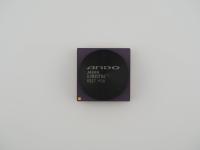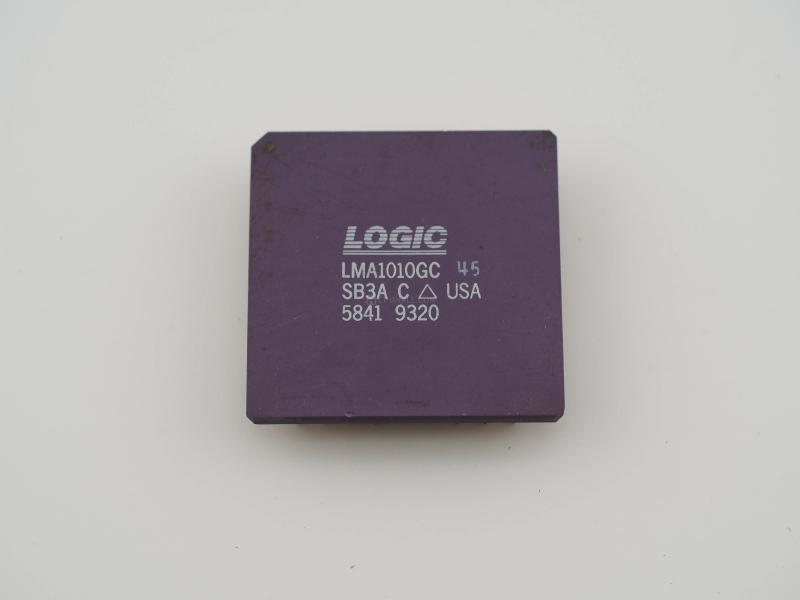

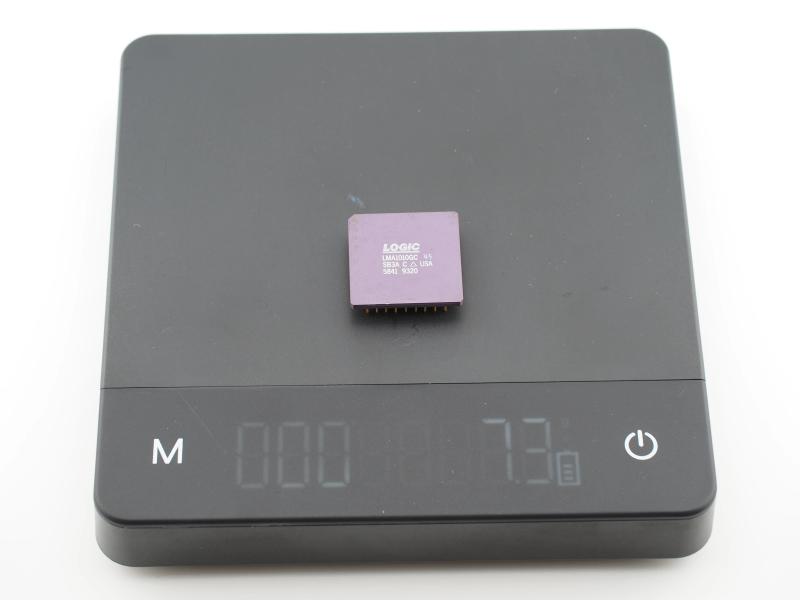
Looking closely at this specific unit under my 45mm macro lens reveals a stunning example of late-twentieth-century industrial silicon. The absolute standout feature here is the deep purple ceramic package. It has a beautiful, almost chalky matte texture that contrasts perfectly with the highly reflective gold-plated pins. Placing the artifact on the scale yields a precise weight of 7.3 grams. The bottom of the chip features a dark, sealed ceramic cap covering the die, surrounded by a 68-pin grid that leaves the center completely empty.
The top surface features crisp white etched text, crowned by the classic lined logo of Logic Devices. Here is the exact surface transcription:
LOGIC
LMA1010GC 45
SB3A C △ USA
5841 9320
This is not a general-purpose processor. The LMA1010 is a dedicated 16x16-bit Multiplier-Accumulator, frequently abbreviated as a MAC. Before modern superscalar architectures could chew through complex math in a single clock cycle, engineers had to route heavy mathematical workloads to dedicated coprocessors like this one.
The 45 in the part number indicates a 45-nanosecond multiply-accumulate cycle time. If you do the math, that translates to roughly 22 MHz. While that sounds slow by modern standards, executing a massive mathematical accumulation in a single 45ns hardware cycle was blazing fast for digital signal processing in the early 1990s. The 68-pin CPGA package utilizes only its outer rings to route power, ground, and data to the die, which helped mitigate some of the thermal density issues common in high-speed math chips of this era.
Logic Devices made an absolute killing second-sourcing and improving upon famous military and industrial chips. This specific artifact is essentially a drop-in, lower-power CMOS replacement for the legendary TRW TDC1010. TRW basically invented the single-chip MAC market for radar and digital signal processing.
A common misconception is that dedicated math chips died out when the Intel 486 integrated a floating-point unit. The reality is quite different. By the time this specific artifact was fabricated in 1993, general-purpose desktop CPUs were certainly getting faster. However, dedicated MACs were still strictly required for real-time signal processing in military hardware, medical imaging equipment, and high-end professional audio gear. They did one thing, and they did it with absolute deterministic perfection.
Identifying this chip was completely straightforward thanks to the pristine ceramic top and clear manufacturer markings. The GC suffix in the Logic Devices nomenclature explicitly designates a Ceramic Pin Grid Array package.
The date code 9320 places its manufacture precisely in the 20th week of 1993. The small triangle or delta symbol next to USA is a common fabrication mark indicating the plant of origin. I noticed this specific piece lacks the full MIL-STD-883 markings. This strongly suggests it was destined for high-end commercial or industrial applications rather than a classified missile guidance system. It is a gorgeous, heavy-metal piece of computing history that represents the bridge between analog signal processing and the fully integrated digital era.