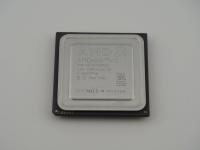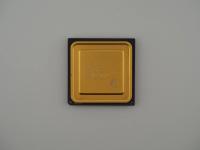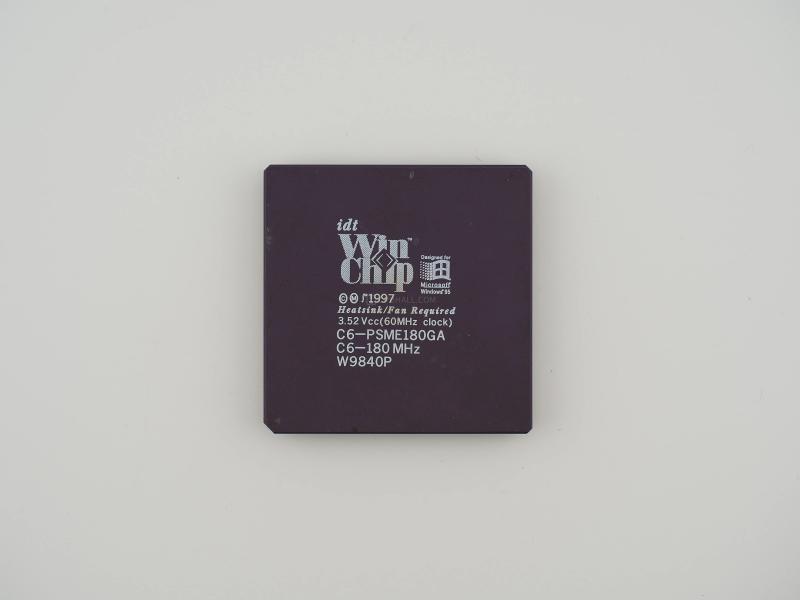

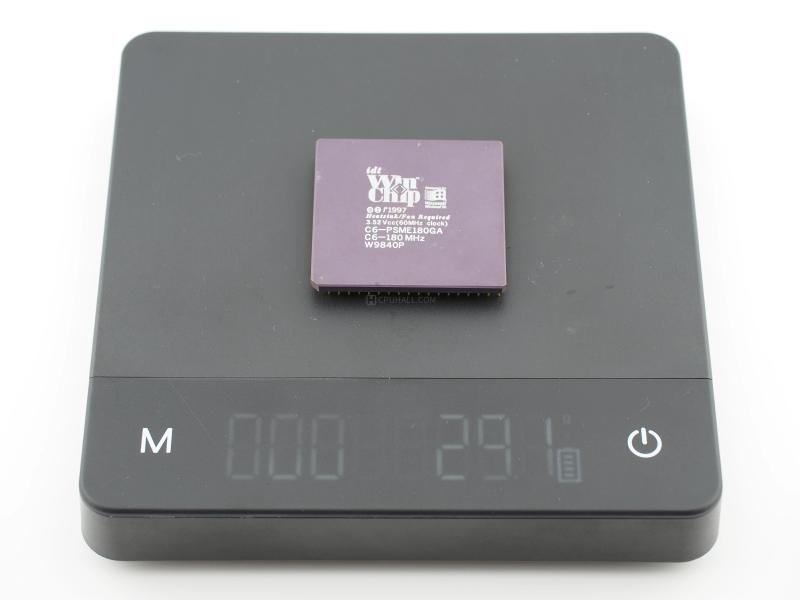
Holding this piece under the studio lights, the first thing that strikes me is the striking plum colored ceramic substrate. It is a stark departure from the standard grey or brown packages that dominated the late 1990s. When I place this artifact on the scale, it registers a satisfying 29.1 grams, a hefty weight owing largely to the thick ceramic and the generous gold plated heat spreader on the underside.
The top side features crisp white silkscreening that heavily promotes its intended operating system environment. Here is the exact surface transcription:
idt
WinChip(TM)
Designed for Microsoft Windows 95
(C)(M) 1997
Heatsink/Fan Required
3.52 Vcc(60MHz clock)
C6-PSME180GA
C6-180 MHz
W9840P
Flipping the chip over reveals a gorgeous array of staggered gold pins. Through the 45mm Elmarit macro lens on my Olympus camera, the precision brazing of each pin to the ceramic substrate is exceptionally clear. The central gold cap is stamped with MALAY HP, and just above that, I can make out a faint, heavily obscured laser etching that appears to read 7210Z8.
What gives this specific unit immense character are the two vintage paper warranty stickers slapped directly onto the gold slug. They feature traditional Chinese characters ("高智" and "全新", translating roughly to "High Intellect" and "Brand New") with punch holes indicating warranty dates spanning 1999 and 2000. These stickers tell a vivid story of this chip moving through the bustling Asian grey market.
The internal architecture of the IDT WinChip is a masterclass in aggressive minimalism. While Intel and AMD were locked in an arms race of complex superscalar architectures and out of order execution, Centaur Technology took a radically different path. Glenn Henry and his small team designed the C6 to be as small and cheap to manufacture as physically possible.
Instead of superscalar complexity, the WinChip relies on a streamlined, single issue, in order execution pipeline. In many ways, it operates like a massively overclocked 486 processor. To compensate for this simplified pipeline and the complete lack of L2 cache on the die, IDT equipped the WinChip with a relatively massive 64KB L1 cache, split evenly between 32KB for instructions and 32KB for data.
This specific C6 model runs on a 60MHz front side bus with a 3.0x internal multiplier to achieve its 180 MHz clockspeed. It requires a thirsty 3.52 Volts to remain stable. Because the die size was so small (around 88 square millimeters on a 0.35 micron process), the manufacturing yields were incredibly high. This allowed IDT to undercut the competition severely on price.
The late 1990s Socket 7 ecosystem was the absolute wild west of hardware. You had Intel trying to force everyone onto Slot 1, while AMD, Cyrix, and IDT fought viciously for the remaining budget desktop market. IDT was primarily a manufacturer of SRAM memory, but they saw an opportunity to utilize their fabrication plants to make high margin x86 processors by acquiring Centaur Technology.
The WinChip was heavily marketed toward business machines and basic home PCs. For Microsoft Windows 95 office applications, it performed admirably. The massive L1 cache kept it snappy in Word and Excel. However, the lore of the WinChip is forever tied to its abysmal floating point performance. If you attempted to play Quake on an IDT WinChip, the frame rates would crater. The FPU was heavily compromised to save die space, making this chip the bane of budget conscious PC gamers at the time.
Despite its gaming shortcomings, the WinChip remains a legendary piece of silicon. It proved that a tiny, focused team could build a functional x86 processor from scratch and successfully bring it to market against the monolithic giants of the industry.
Based on the physical evidence and the W9840P date code, I can authoritatively date the fabrication of this specific silicon to the 40th week of 1998. The MALAY HP stamp confirms the final packaging and testing occurred in a Malaysian facility.
The most fascinating aspect of this artifact's provenance is the pair of warranty stickers. The red sticker is punched for the year '99, and the blue sticker is punched for the year '2000. This indicates the chip was likely sold in a retail environment in 1999 and perhaps serviced or resold in 2000. The presence of Chinese characters strongly points to the bustling electronics markets of Taiwan or mainland China, where cheap Socket 7 upgrade paths remained highly relevant long after the West had moved on to the Pentium II.
It is incredibly rare to find these paper stickers surviving in such good condition on a chip that requires a heatsink, suggesting this processor may have spent a significant portion of its life in a low stress environment or was pulled and stored shortly after its warranty period expired.