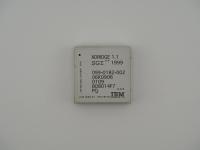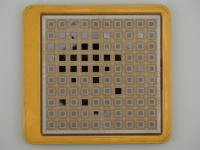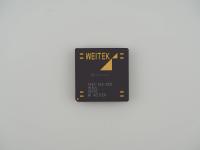

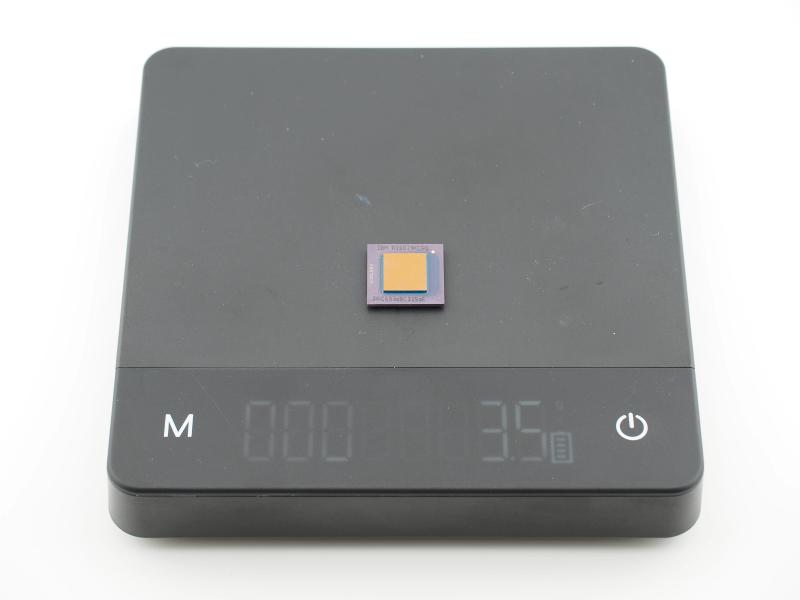
Holding this piece, I immediately noticed how incredibly dense it feels for its size. Dropping it on the scale confirms it weighs exactly 3.5 grams. That heft comes from the beautiful, dark purple ceramic substrate that IBM was so fond of during this era.
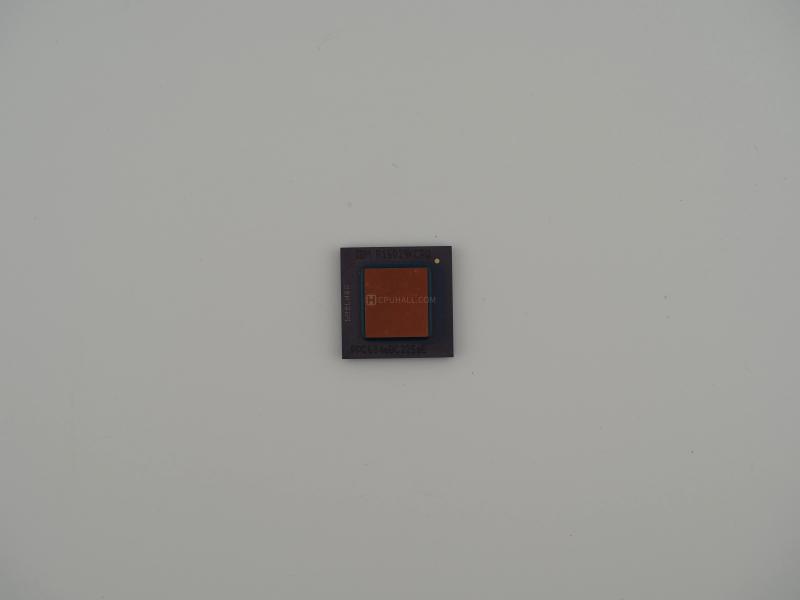
When you look closely at the top, you see a masterclass in mid-90s packaging. The bare, copper-toned silicon die sits directly on top of the substrate. The micro-contrast of the laser etching is faint but completely legible under good lighting. I actually had to rely on my 45mm macro lens to properly resolve the tiny dot-matrix text hiding on the left edge of the ceramic.
Here is the exact surface text transcribed from the artifact:
Top Primary: IBM R16029KCPQ
Left Edge (Dot Matrix): 68H1004
Bottom Primary: PPC604eBC225aE
Flipping it over reveals a pristine 255-ball grid array. The solder balls are perfectly spherical and untouched, catching the light like a tiny grid of liquid silver. It is a stunning example of flip-chip ceramic ball grid array technology before everything moved to organic substrates and pins.
The PowerPC 604e was an absolute beast when it launched. It was the necessary die-shrink and architectural refinement of the original 604 core. IBM and Motorola fabricated these on a 350-nanometer CMOS process, cramming approximately 5.1 million transistors onto that small piece of silicon you see exposed on the top.
This specific chip runs at 225 MHz. To feed a chip this fast in 1996, the architecture featured a doubled L1 cache setup compared to its predecessor, sporting 32KB for instructions and 32KB for data. It also included a heavily optimized dynamic branch prediction unit.
The physical packaging tells a story about thermal management. Because the 604e ran hot, the flip-chip design was crucial. By mounting the die face-down onto the ceramic substrate, the backside of the silicon is exposed directly to the air. This allowed system builders to slap a heatsink straight onto the die for maximum thermal transfer.
This little ceramic square represents one of the most ambitious corporate team-ups in computing history: the AIM Alliance. Apple, IBM, and Motorola joined forces to build a RISC architecture capable of destroying Intel's x86 monopoly.
The 604e was the high-end desktop champion of this dream. If you were doing serious video editing, 3D rendering, or graphic design in the late 90s, you wanted a machine with one of these inside. This silicon powered legendary machines like the Apple Power Macintosh 8600 and 9600, as well as high-end Mac clones from companies like Power Computing and UMAX.
The lore of this era is defined by the RISC versus CISC holy war. The PowerPC camp genuinely believed their elegant, streamlined instruction set would ultimately crush the messy, legacy-burdened Intel Pentium Pro. For a brief, glorious window, chips exactly like this one actually held the performance crown.
I am highly confident in the identification of this artifact. The surface markings leave zero room for ambiguity.
The bottom text string PPC604eBC225aE is a standard Motorola/IBM part number structure for the era. PPC designates the PowerPC architecture. 604e is the specific core design. The 225 explicitly denotes the 225 MHz clockspeed rating.
Finding these in a bare CBGA package in this condition is always a treat. Most end-users only ever saw these chips permanently soldered onto upgradeable daughtercards inside their Macintoshes. Having the bare processor allows us to really appreciate the ceramic work and the BGA interface that made the high-speed signaling possible.