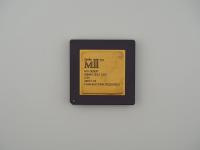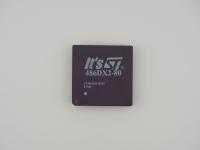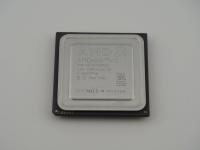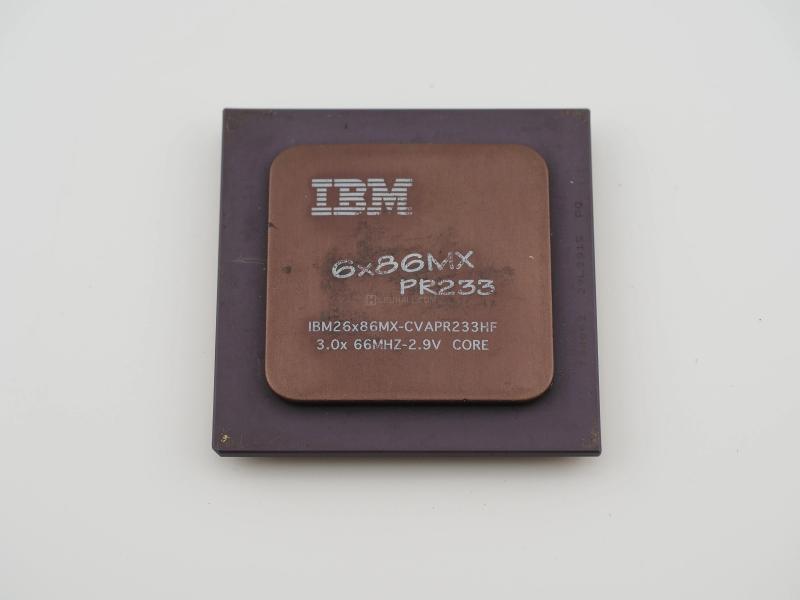

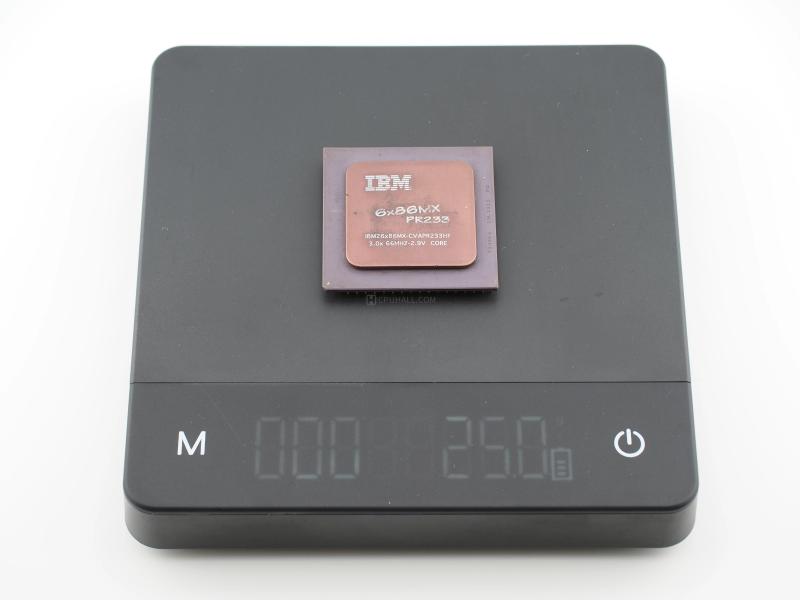
Holding this piece immediately transports me back to the chaotic, highly competitive Socket 7 motherboard era. Placing it on the scale, it registers a satisfying 25.0 grams of late-90s silicon and metal. The top heat spreader is a beautifully oxidized, copper-toned cap bearing the iconic ribbed IBM logo. It is a fantastic contrast against the dark, purplish-brown ceramic substrate.
Inspecting the surface under macro lighting, the laser-etched text remains crisp and highly legible:
6x86MX
PR233
IBM26x86MX-CVAPR233HF
3.0x 66MHZ-2.9V CORE
Edge Text: T34062 29L3915 PQ
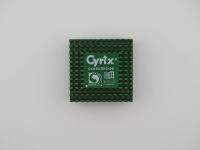
Back Text: COPR. CYRIX 1995-1998 USA
Flipping the artifact over reveals a stunning array of staggered, gold-plated pins characteristic of the CPGA-296 package. Carved directly into the ceramic belly is the Cyrix copyright, a physical testament to the fascinating manufacturing alliance between two industry heavyweights. I absolutely love the intact paper warranty and vendor stickers on the underside. They are tiny time capsules pointing to a system builder from the late 90s, complete with faded red ink marking the date grids.
To understand the silicon beneath that copper-colored cap, we have to look at the architectural arms race of 1997. This chip is powered by the Cyrix "M2" core. It was a massive evolution over the original 6x86 architecture. Cyrix engineers quadrupled the L1 cache to a generous 64KB, enhanced the branch prediction logic, and finally added support for Intel's proprietary MMX instruction set.
The laser etching provides a direct look into the electrical requirements of the era. The 3.0x 66MHZ line tells us exactly how this chip operates. It takes a standard 66 MHz front-side bus and multiplies it by three, resulting in a true internal clock speed of 200 MHz. The 2.9V CORE designation is crucial. Unlike earlier Socket 7 chips that ran at a unified 3.3V, this processor required a dual-plane or "split voltage" motherboard layout. Providing 3.3V for the I/O and 2.9V directly to the core was necessary to keep the 0.35-micron manufacturing process from melting down. Even with the reduced voltage, these IBM-fabricated units ran notoriously hot and demanded serious aftermarket cooling solutions.
This processor is a prime example of the Performance Rating or "PR" wars. Cyrix designed their integer pipeline to be significantly more efficient per clock cycle than the Intel Pentium. Because their 200 MHz chip could match or beat a 233 MHz Pentium in standard Windows desktop applications, they stamped PR233 right on the heat spreader. It was a brilliant, highly controversial marketing move that forced consumers to look past raw megahertz.
However, the architecture had an Achilles' heel. The floating-point unit was notoriously weak compared to Intel's FPU. If you were running Microsoft Word or Excel, this IBM 6x86MX was a lightning-fast bargain. If you tried to boot up Quake, which heavily relied on floating-point math for 3D rendering, the performance cratered. It cemented a long-standing myth that non-Intel processors were simply bad for gaming, a stigma that took years for the industry to shake off.
The existence of an IBM logo on a Cyrix design is its own fantastic piece of lore. Cyrix was a fabless semiconductor company. They had the engineering talent but lacked the multi-billion dollar factories required to print the silicon. They struck a deal with IBM Microelectronics. IBM would manufacture the chips for Cyrix in their cutting-edge facilities, and in return, IBM gained the right to manufacture and sell their own branded versions of the processors. This artifact is the direct physical result of that handshake.
There is absolutely zero ambiguity regarding the identification of this artifact. The physical markings are perfectly preserved and tell the entire story without the need for guesswork.
The IBM26x86MX part number confirms it was manufactured and packaged by IBM rather than SGS-Thomson, which was Cyrix's other fabrication partner. The precise CVAPR233HF string breaks down exactly what we are holding. The C indicates a 0.35-micron process. The V specifies the 2.9V core voltage requirement. The A denotes the specific package type, and PR233 is the performance rating. The high-fidelity text on the front perfectly aligns with the Cyrix copyright embossed into the ceramic on the back, confirming the dual-lineage of the processor without a shadow of a doubt.