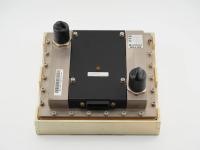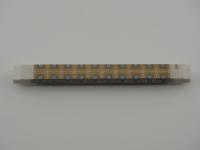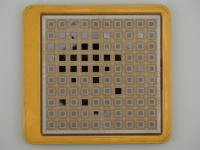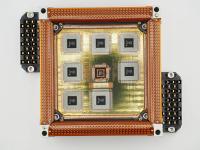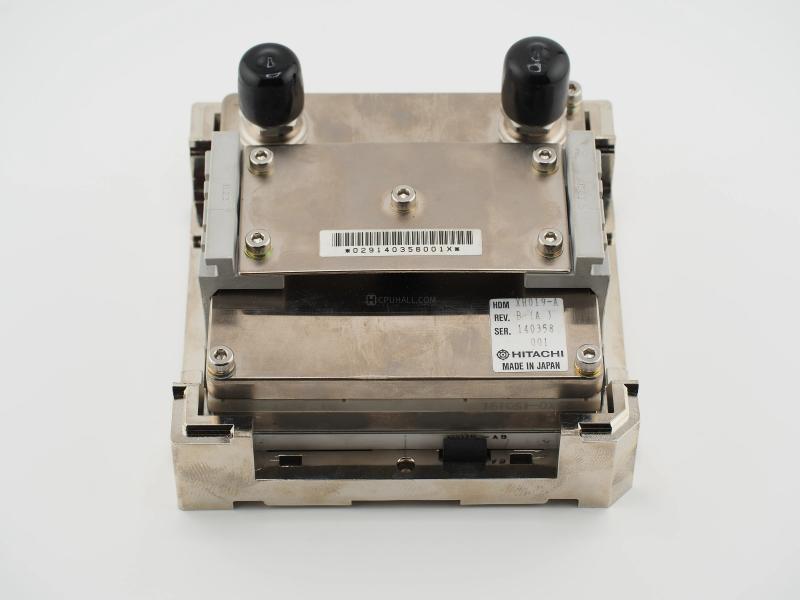

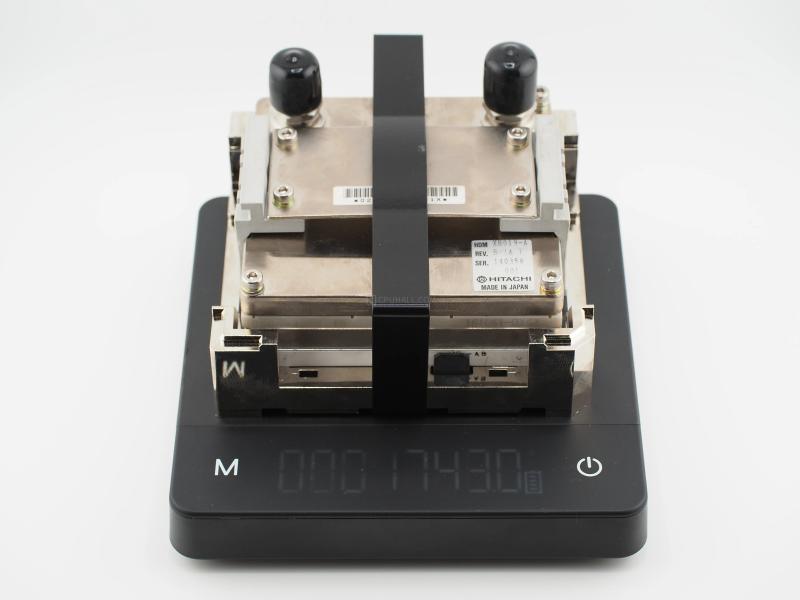
Getting this massive 1.7-kilogram beast to sit perfectly on the scale was an exercise in patience. This is not just a processor. This is a slab of computing history that could easily double as a blunt-force weapon. It weighs exactly 1743.0 grams. The bulk of that weight comes from the massive machined metal cooling block bolted to the top of the ceramic substrate.
We are looking at a heavily engineered liquid-cooled Multi-Chip Module. The two prominent black caps on top protect the quick-disconnect nozzles where chilled water or fluorocarbon coolant would cycle through the internal channels.
Let us look at the transcriptions from the various labels and the ceramic itself.
Main Label:HDM XH019-A
REV. B ( A )
SER. 140358
001
HITACHI
MADE IN JAPAN
Barcode Label:*029140358001X*
Transport Box Label:HDM Box-A
Mfg No 03203
(Dwg No 5744503-1)
特許申請中 (Patent Pending)
Ceramic Edge Etchings:XH019 - AB
25X0-150191
Gold Stamped Ceramic Serial:140358001
Pin Grid Corner Marks:25X-0
440
E01-0
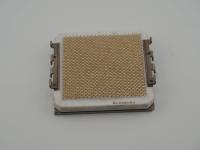
The physical textures here are incredible. The metal heat spreader has a beautiful raw, brushed industrial finish secured by heavy hex screws. Flipping it over reveals an absolute sea of gold. These are not standard pins. They are thick, flat-headed gold pillars individually brazed directly onto the white ceramic substrate. In the macro shots, you can clearly see the solder pool at the base of each pin. The fact that Hitachi actually stamped the serial number 140358001 in raised gold lettering directly onto the ceramic is an aesthetic flex that modern silicon fabricators could learn a lot from.
You do not build a 1.7-kilogram processor module for a desktop computer. This Hitachi Dense Module was designed for the absolute upper echelon of enterprise computing.
To understand the engineering here, we have to look past the gold and focus on the thermal dynamics. During the late 1980s and early 1990s, high-end mainframes utilized Emitter-Coupled Logic gate arrays. These chips were blisteringly fast for their time, but they leaked heat like an open furnace. Putting dozens of these bare silicon dies onto a single ceramic substrate created a thermal density nightmare.
Hitachi solved this by sealing the dies beneath that massive metal hat and pumping liquid directly through the module. The precision machining required to ensure the coolant never leaked onto the microscopic logic gates below is astounding. The white ceramic substrate itself is a marvel. It is not a single piece of material. It is composed of dozens of micro-thin layers of co-fired ceramic, containing miles of microscopic wiring that route signals between the logic chips and the thousands of gold pins on the bottom.
Those flat-headed pins are another engineering tell. This module does not drop gently into a Zero Insertion Force socket. It requires a mechanically actuated connector block to clamp down onto those flat heads with immense physical force to ensure a flawless electrical connection.
There is a distinct "Cold War" vibe to Japanese mainframe hardware from this era. During the 1980s and 1990s, the battle for datacenter supremacy was vicious. IBM was the undisputed king with their System/370 and ESA/390 architectures, but Japanese titans like Hitachi, Fujitsu, and NEC built massive "plug-compatible" mainframes that were often faster and more heavily engineered than the IBM originals.
Hitachi's M-series mainframes were legendary for their bulletproof reliability. This exact type of module would have been the beating heart of an enterprise handling national banking transactions, airline reservations, or massive corporate databases.
The tragic lore surrounding these modules is what makes them so rare today. Not only are they made in low numbers, but because they contain an exorbitant amount of physical gold in the pins and internal wiring, and because they weigh nearly two kilograms, almost all of them were targeted by scrap metal refiners. When these mainframes were decommissioned, the modules were violently ripped out, crushed, and thrown into chemical baths to recover the precious metals. Seeing one survive fully intact with its original transport box is practically a miracle.
Without an internal Hitachi engineering datasheet, pinpointing the exact mainframe model for the HDM XH019-A requires some forensic deduction.
The presence of the original anti-static transport case marked HDM Box-A with the Japanese text for "Patent Pending" is a massive clue to its field life. This was a Field Replaceable Unit. If a module failed in a datacenter in Tokyo or Frankfurt, a Hitachi engineer would arrive with this exact grey box, unlatch the heavy metal clasps, pull out the replacement module, and securely pack the dead one to be shipped back to the fabricator in Japan.
Based on the liquid cooling design, the pin density, and the HDM taxonomy, I strongly suspect this belongs to the Hitachi M-880 processor complex or a very closely related high-end system from the very early 1990s. The M-880 was famous for utilizing high-density boards packed with these liquid-cooled modules to achieve its massive instruction throughput.
Compressing the high-fidelity macro images of these brazed pins for the mobile-first version of the museum site feels a bit tragic because the micro-contrast on the ceramic surface tells such a rich story. But documenting every faint laser etching and gold stamp is exactly why I preserve these pieces.