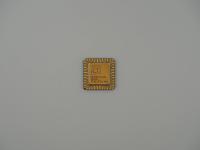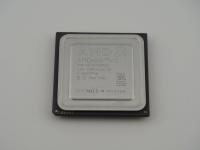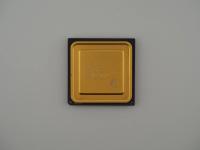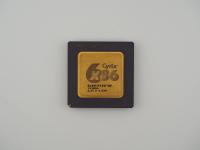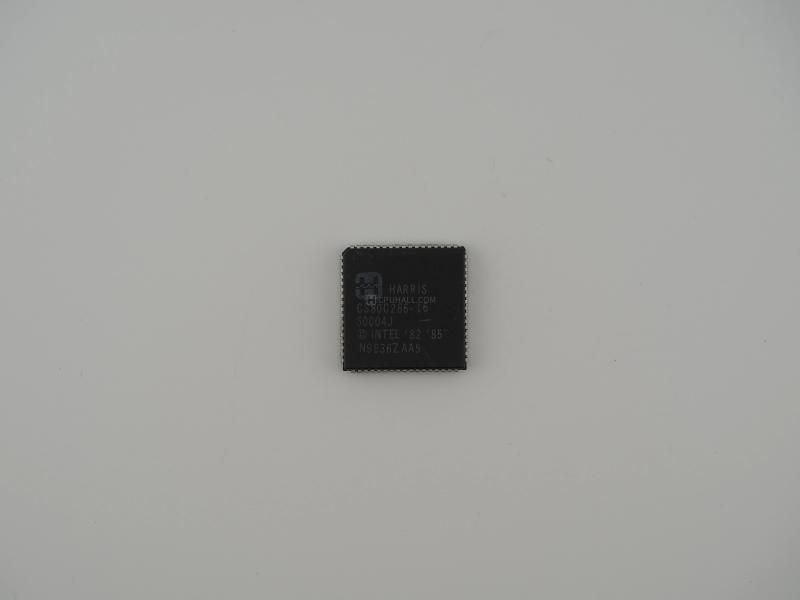

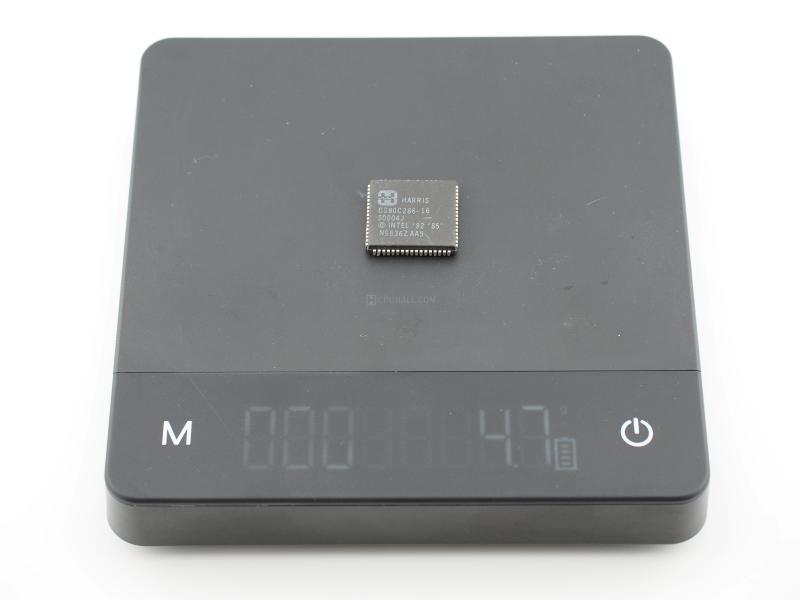
Holding this piece, I immediately noticed the utilitarian nature of the PLCC (Plastic Leaded Chip Carrier) package. It lacks the cold heft of the ceramic modules in the collection, but it tells a completely different story of mass production and cost optimization.
Under tight macro inspection, the micro-contrast of the laser etching on the dark epoxy surface is crisp and highly legible despite some minor surface scuffs and dust common to plastic packages of this vintage. The J-leads wrapping under the body show a slightly oxidized but solid metal finish.
Here is the exact surface text transcribed from the front and back of this artifact:
[FRONT](Harris Wave Logo) HARRIS
CS80C286-16
50004J
© INTEL '82 '85
N9836Z AA5
[BACK]14175
CZ62A
The prominent CS80C286-16 identifies the core specifications, while the dual copyright years © INTEL '82 '85 highlight the licensing agreement. Looking closely at the N9836Z AA5 line, the 9836 portion suggests a manufacturing date code of the 36th week of 1998. This is remarkably late for a 286 processor, indicating this specific chip was likely destined for a long-lifecycle embedded system or industrial controller rather than a consumer desktop.
The standard Intel 80286 was built on a 1.5-micron NMOS (N-type Metal-Oxide-Semiconductor) process. It was a massive leap over the 8086, pushing 134,000 transistors and introducing protected mode with a 16 MB memory address space. However, NMOS runs incredibly hot as clock speeds increase. Intel struggled to push their NMOS 286 past 12.5 MHz without encountering serious thermal walls.
This is where the engineering of this specific Harris chip becomes fascinating. Harris Semiconductor held a cross-licensing agreement with Intel and redesigned the silicon using a static CMOS (Complementary Metal-Oxide-Semiconductor) process. CMOS inherently draws far less power and generates significantly less heat than NMOS. By porting the 286 architecture to CMOS, Harris eliminated the thermal bottleneck.
This specific unit runs at 16 MHz, which was a serious performance tier at the time, providing a massive throughput advantage over standard 8 MHz or 10 MHz IBM AT clones. Because it is static CMOS, the clock can theoretically be stopped completely without the processor losing its internal state, a crucial feature for low-power embedded applications. The PLCC-68 package itself was a step toward cheaper, denser motherboards compared to the older, massive DIP-68 or expensive PGA packages.
The 286 architecture has a somewhat infamous legacy. Bill Gates notoriously called it a "brain-dead" chip. The major architectural quirk was that while it introduced protected mode, it lacked a dedicated hardware instruction to switch back to real mode. To return to real mode, the operating system literally had to reset the processor, a clumsy and slow workaround that frustrated software developers trying to write backward-compatible multitasking operating systems.
Despite this, the Harris 286 holds a legendary status among hardware enthusiasts of the late 80s and early 90s. While Intel was trying to push everyone toward the more expensive 386 architecture, companies like Harris and AMD kept pushing the 286 faster and faster. A Harris 16 MHz or 20 MHz 286 could actually outperform an entry-level 16 MHz 386SX in raw DOS applications because the 286 could execute many instructions in fewer clock cycles. It created a bizarre market dynamic where the "outdated" second-source chip was the smarter, faster buy for gamers and budget power users.
Identification of this artifact is definitive based on the clear CS80C286-16 marking. The C designates the CMOS process, and the -16 confirms the 16 MHz clock speed.
The interesting part of this specific chip's history is its late manufacturing date. While the desktop market had moved on to Pentium IIs and K6s by 1998, the 80286 architecture remained incredibly popular in embedded applications. Things like point-of-sale terminals, industrial automation hardware, and telecommunications equipment relied heavily on the reliable, low-power, and well-documented 286 CMOS chips. Harris continued to print money by fulfilling these industrial contracts long after the 286 vanished from consumer magazines. This artifact is a perfect physical representation of the long, hidden tail of successful microprocessor architectures.