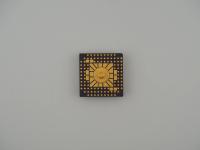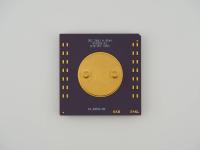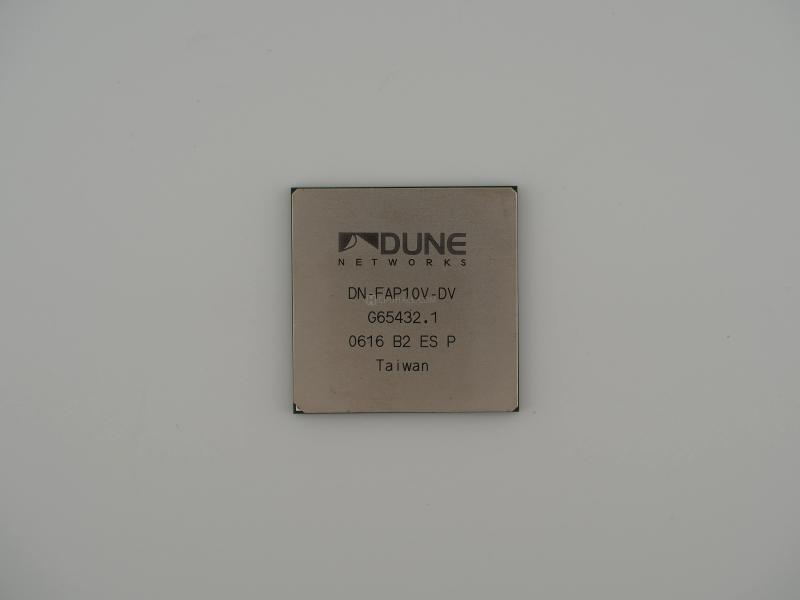

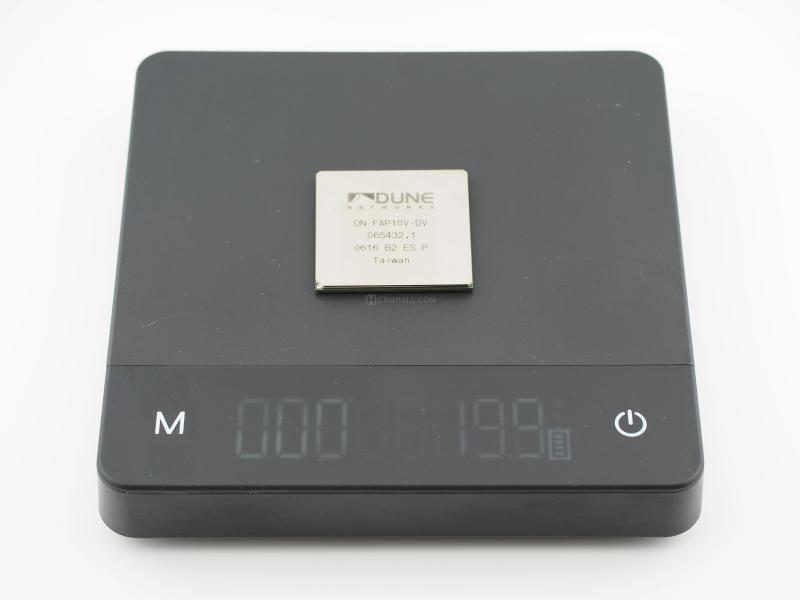
This is a 40mm by 40mm slab of networking history, capped with a brushed metal Integrated Heat Spreader. It lacks the exotic gold plating or ceramic heft of a mainframe module, but it possesses the cold, calculated precision of enterprise telecom hardware.
The laser etching on the lid is exceptionally crisp, and a close inspection reveals the following:
DUNE
NETWORKS
DN-FAP10V-DV
G65432.1
0616 B2 ES P
Taiwan
Flipping this piece over reveals a dense Ball Grid Array. The layout of the solder balls is fascinating. Rather than a solid grid, there is a distinct, multi-tiered square void in the center. This specific routing pattern is a hallmark of massive I/O silicon, leaving the center clear to manage thermal density directly under the die while routing high-speed differential pairs out to the edges of the organic substrate. The fact that the etching explicitly denotes this as an ES or Engineering Sample makes it a particularly prized oddity in the collection.
This is not a traditional computational processor. The DN-FAP10V is a Fabric Access Processor. In the high-stakes realm of data center chassis switches, you cannot simply connect every port to every other port. You need a switch fabric.
Dune Networks specialized in this exact topology. The FAP sits on the line card of a massive network switch. When a data packet arrives at a network port, the FAP is responsible for traffic management, queuing, and chopping that packet into fixed-size cells. It then blasts those cells across the backplane to a central switching element. By buffering traffic at the ingress point rather than the egress point, this silicon prevents the entire switch from locking up during bursts of heavy traffic. The massive BGA footprint we see on the underside is strictly dedicated to feeding dozens of multi-gigabit serial links directly into the backplane. This chip was designed to run hot, push terabits, and never drop a single packet.
Dune Networks is one of those legendary ghost companies in the semiconductor world. Founded in Israel in 2000, they essentially solved the scaling problem for massive internet routers. Before their SAND architecture, building a router that could handle terabits per second without internal bottlenecks was a nightmare of proprietary ASICs.
Dune standardized the concept of off-the-shelf, deeply buffered merchant silicon for switch fabrics. Their technology was so brutally effective that Broadcom outright bought the company in 2012. The DNA of this exact prototype chip lives on today. Broadcom absorbed the Dune architecture and rebranded it as the StrataDNX line. If you are routing data through the backbone of the internet today, there is a very high probability your packets are being sliced and queued by the direct descendants of the silicon resting on this table.
Identifying the exact stepping and history of an engineering sample is always a forensic exercise. The date code 0616 is our anchor. This confirms the chip was packaged in the 16th week of 2006, right around mid-April. This aligns perfectly with the maturation of the FAP10/FAP20 series before they hit full enterprise deployment in core routers.
The B2 indicates a mature stepping for a prototype, suggesting that the initial silicon bugs had been ironed out, and this unit was likely being validated by an equipment manufacturer like Arista or Juniper to build a new line card. The Taiwan mark indicates the fab origin, which was almost certainly TSMC handling the fabrication before packaging. Finding bare Dune silicon is already difficult because these chips lived their entire lives buried under massive heatsinks inside telecom racks. Finding an engineering sample from their independent days before the Broadcom acquisition is a genuine treat.