
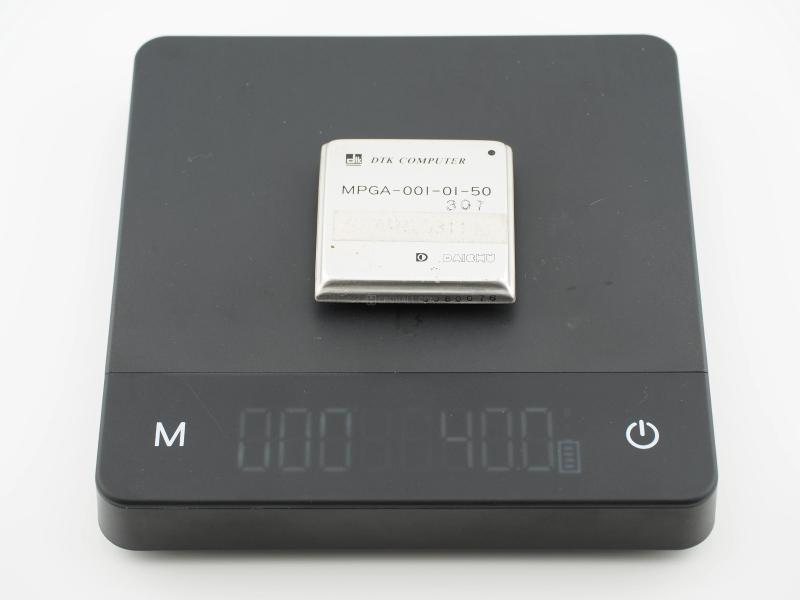
The sheer industrial heft is deceptive. What initially masquerades as a heavy-duty motherboard chipset is actually a full-fledged workstation CPU hidden beneath tank-like armor. Holding this piece reveals a remarkably dense component, entirely dominated by a thick aluminum heat spreader acting as the top cover.
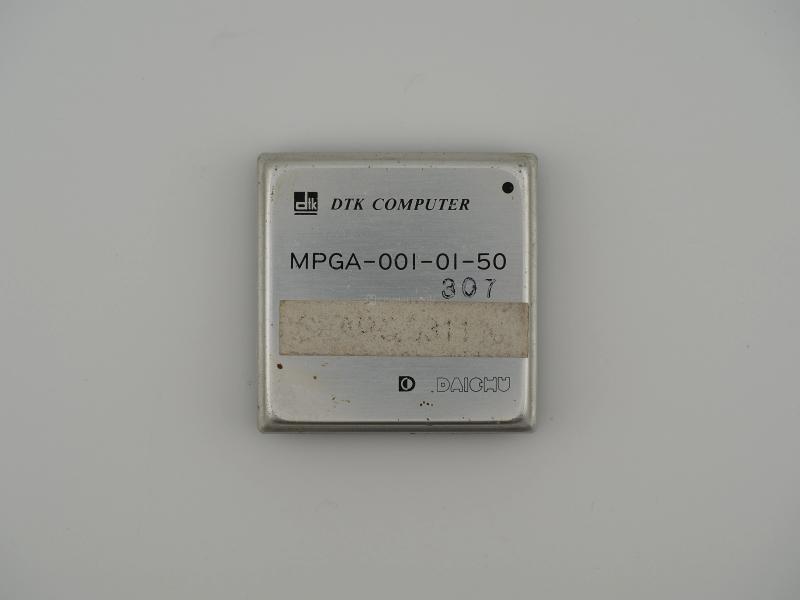
The laser etching on the surface is beautifully preserved. Under the light, the micro-contrast reveals:
dtk DTK COMPUTER
MPGA-001-01-50
307
[QC Sticker]: C 400311 (Faded)
[Logo] .DAICHU
Looking at the side profile, stamped directly into the rim of the metal cap, is the sequence 9200805.
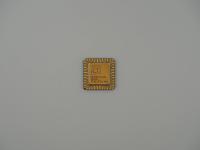
Flipping it over exposes a gorgeous cavity-down package design. The substrate is a deep, glossy black high-temperature material, framing a central void. The gold-plated pins are brazed in a stepped square ring pattern. The contrast between the cold silver aluminum cap and the dense forest of gold pins gives it an uncompromising, military-grade aesthetic.
The true engineering marvel here is the packaging. Inside this custom Daichu enclosure lies a Texas Instruments TMS390S10, the silicon for Sun Microsystems' microSPARC I processor.
Standard microSPARC CPUs of this era were typically implemented in fragile, notoriously hot TCP (Tape Carrier Packages) or plastic QFPs that were soldered directly to the motherboard. To mitigate thermal issues and allow for socketed motherboard designs, DTK Computer commissioned the Japanese packaging specialist Daichu to encapsulate the TI microSPARC silicon into this massive Metal Pin Grid Array (MPGA). The thick aluminum cap acts as an integrated heat spreader, drawing thermal energy directly away from the cavity-down die.
While DTK Computer was globally renowned for its IBM PC clones, their foray into the SPARC workstation market is an incredibly obscure and fascinating chapter of early 1990s computing. Sun Microsystems actively encouraged the cloning of their architecture to establish SPARC as an industry standard against x86 and MIPS.
DTK capitalized on this by building SPARCstation clones, which were particularly popular in Japan and distributed by companies like JCC (Japan Computer Corp). The lore of the MPGA-001-01-50 is brilliant: by rebranding the microSPARC processor and sealing it in a proprietary package, DTK disguised standard Sun/TI architecture as their own custom hardware. When these machines boot up, the OpenBoot PROM strips away the physical disguise and simply reports the processor as a TI TMS390S10.
Identifying this disguised CPU requires digging into vintage Japanese workstation archives. The 50 in the part number explicitly denotes the 50 MHz clock speed of the microSPARC I.
The 307 marking acts as the date code, indicating this CPU was packaged in the 7th week of 1993, aligning perfectly with the era of DTK's SPARCstation-compatible motherboards. The faded paper sticker reading C 400311 is a factory Quality Control pass ticket. Surviving examples of this exact chip have been documented inside rare JCClassic, JCCStation, JS10 and JS20 machines (SPARCstation 10/Classic clones). It stands as a remarkable physical record of 1990s global hardware manufacturing: Sun architecture, Texas Instruments silicon, Taiwanese motherboard integration, and heavy-duty Japanese packaging.