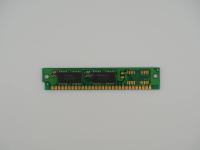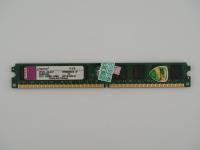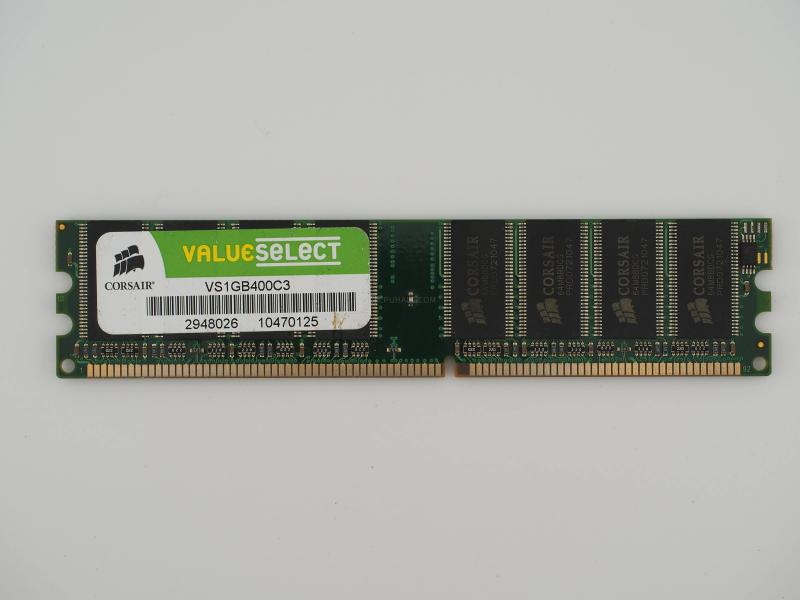

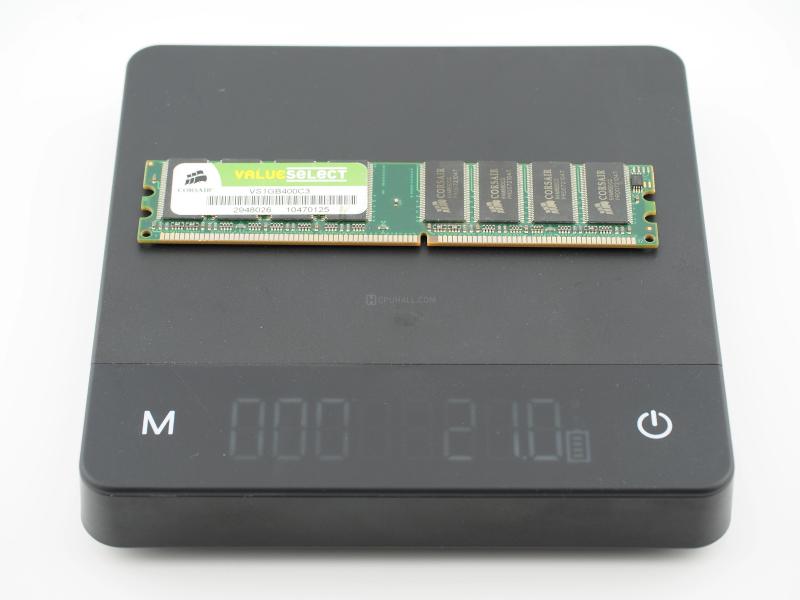
Holding this piece, I am immediately struck by how standard, how unapologetically "consumer grade" it feels. We spend a lot of time in this museum looking at gold-plated military ceramics and bespoke supercomputer logic blocks. This Corsair stick is the absolute opposite. It is the working-class hero of early 2000s desktop computing. Weighing in at exactly 21.0 grams on my digital scale, it is a dual-sided 184-pin unbuffered DIMM populated with sixteen identical memory ICs.
Looking closely at the surface of the green PCB and the black resin chips, I transcribed the following identifying markings:
[Module Label]
CORSAIR
VALUESELECT
VS1GB400C3
2948026  10470125

[Memory IC Silkscreen]
CORSAIR
64M8BDCG
PRD0721047

[SPD EEPROM]
C1HS
05077
The physical textures are classic early 2000s manufacturing. The memory ICs are housed in TSOP-II (Thin Small Outline Package) format, with those delicate gull-wing pins soldered directly to the surface of the board. The gold contacts on the edge connector show minimal wear, suggesting it was slotted in and mostly left alone. On the reverse side, there is a small blue holographic QC (Quality Control) sticker with Chinese characters indicating it passed inspection. The Corsair logo is physically etched or silk-screened over the black epoxy of the chips, entirely obscuring the original silicon fabricator.
Diving into the technical specifications, the VS1GB400C3 part number tells us exactly what we are dealing with. This is a 1 Gigabyte module rated for DDR-400 speeds (also known as PC-3200), meaning it runs at a 200 MHz base clock but transfers data twice per clock cycle. The C3 at the end denotes a CAS Latency of 3, which is relatively loose for the era. Enthusiast memory at this time would push for tight CL2 or CL2.5 timings.
To achieve 1GB of capacity on a single stick in the DDR1 era, Corsair had to use very dense memory chips. The part number 64M8BDCG reveals the internal organization. There are sixteen chips total (eight on each side). Each chip is a 64M x 8-bit component, yielding 512 Megabits per IC. Multiply that by 16 chips, and you get 8192 Megabits, which perfectly translates to 1024 Megabytes (1 GB) of total capacity.
Operating at a standard 2.5 Volts, this memory ran cool enough that Corsair did not bother slapping on their signature aluminum XMS heat spreaders. The small 8-pin IC located near the edge connector is the Serial Presence Detect (SPD) EEPROM. This tiny chip holds the timing tables and JEDEC specifications, communicating directly with the motherboard BIOS upon boot to negotiate the correct voltage and clock speeds.
The mid-2000s was a bloodbath of competition in the PC hardware space. We were watching the intense rivalry between the AMD Athlon 64 and the Intel Pentium 4. High-end system builders were obsessing over memory bandwidth and extremely tight timings, chasing legendary memory chips like the Winbond BH-5 which scaled beautifully with insane amounts of voltage.
Corsair recognized that not everyone wanted to overvolt their motherboard and risk a fiery death just to gain two frames per second in Half-Life 2. Thus, the ValueSelect line was born. The lore behind ValueSelect is simple: it was the great equalizer. It allowed gamers on a budget to max out their system memory capacity without paying the exorbitant "enthusiast tax" for the premium XMS Pro lines with their flashy LED activity lights.
A persistent hardware myth from this era was that RAM heat spreaders were mandatory for high performance. The truth is that TSOP memory chips dissipated heat exceptionally well on their own. Unless you were pushing massive overvolts for competitive overclocking, bare sticks like this ValueSelect module would happily run at their rated speeds for a decade without breaking a sweat. The heat spreaders were largely cosmetic armor.
Identifying the true origin of the silicon on this module requires a bit of forensic guesswork. Corsair does not fabricate their own memory dies. They bin, test, and package chips manufactured by giants like Samsung, Hynix, Micron, Nanya, or Promos. The fact that the ICs are laser-etched with "CORSAIR" means they bought entire wafers or unbranded chips in massive bulk and applied their own branding.
Based on my experience with the ValueSelect line from this era, Corsair heavily relied on Promos or Nanya for their budget DDR400 ICs. The PRD0721047 batch code gives us a very fascinating chronological clue. The 0721 almost certainly indicates a manufacturing date code of the 21st week of 2007.
This date is fascinating because DDR2 memory had already completely taken over the mainstream market by 2007, riding alongside the massive success of the Intel Core 2 Duo. The existence of a newly manufactured 1GB DDR1 stick in late 2007 proves that there was still a massive, lucrative aftermarket for upgrading legacy systems. People were holding onto their old Socket 939 and Socket 478 motherboards, desperately maxing them out with 2GB or 4GB of RAM to keep them alive for just a few more years. This module is a time capsule of that specific upgrade cycle.