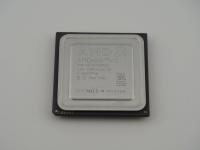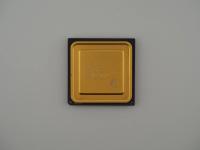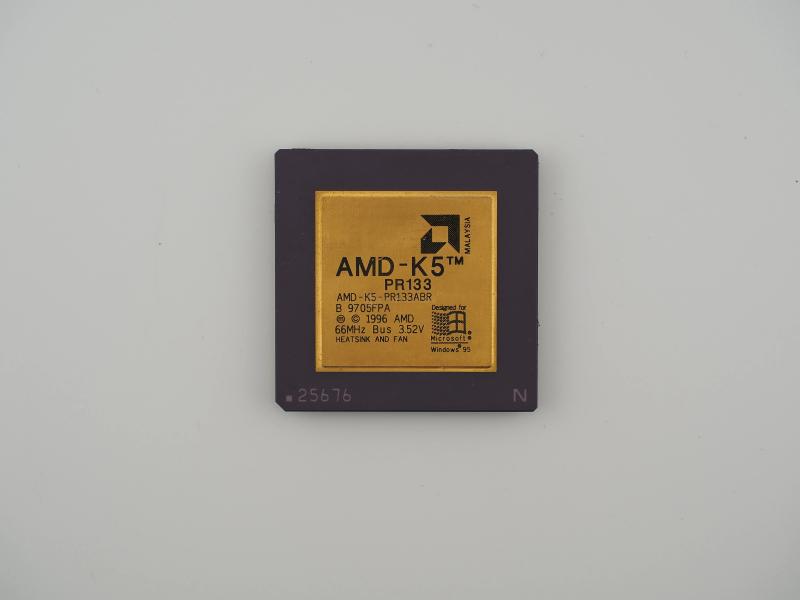

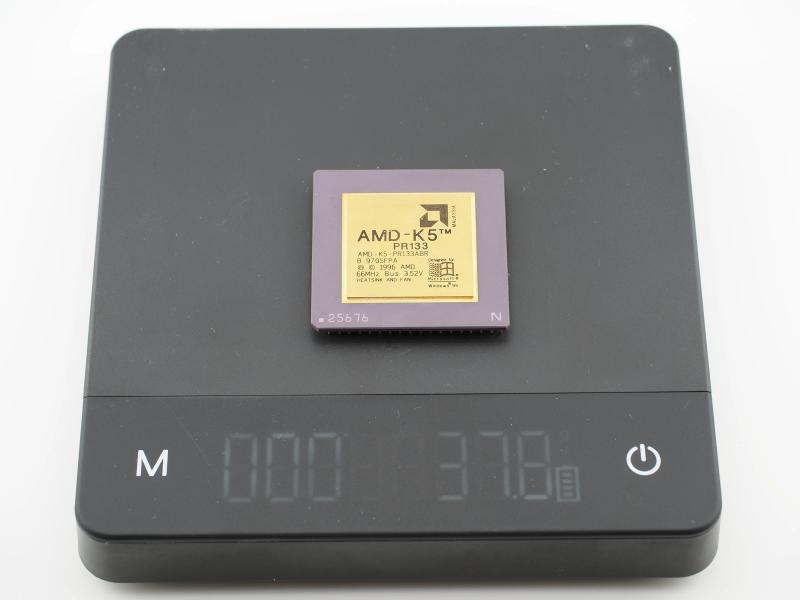
Holding this piece, the first thing we can notice is the sheer weight and density of the CPGA-296 package. The ceramic substrate has that distinct aubergine hue typical of 1990s AMD and Cyrix processors. The top face features a prominent metal heatspreader. The gold plating on this cap is functional and standard for the era, showing a realistic matte finish rather than an artificial gleam.
Flipping this specific unit over reveals a fantastic piece of retail history. Stuck directly to the central gold pad is a paper warranty sticker bearing Chinese characters and grid dates marking the years 96, 97, and 98, frozen in time from whoever originally sold or installed this chip.
The engravings read:AMD-K5™
PR133
AMD-K5-PR133ABR
B 9705FPA
(M) (C) 1996 AMD
66MHz Bus 3.52V
HEATSINK AND FAN
This artifact represents a highly ambitious era of microprocessor design. Underneath the cap sits a die fabricated on a 0.35 micrometer process, containing roughly 4.3 million transistors. The K5 architecture, internally known as SSA/5, was radically different from Intel's Pentium. Instead of a traditional x86 execution core, AMD engineers leveraged their experience with the Am29000 RISC architecture. The K5 translates complex x86 instructions into simpler, faster RISC micro-instructions on the fly.
The PR133 designation is the most fascinating engineering quirk of this artifact. This chip does not run at 133 MHz. It operates at exactly 100 MHz, utilizing a 66 MHz front side bus paired with a 1.5x multiplier. AMD engineered the integer pipeline to be so efficient that they claimed a 100 MHz K5 could match the performance of a 133 MHz Intel Pentium. Pushing this architecture required power, clearly evidenced by the 3.52V operating voltage etched right onto the heatspreader.
The legacy of the K5 is a story of brilliant engineering hampered by devastating delays. AMD needed a processor to fight the original Pentium, but the K5 project missed its launch windows by a wide margin. To bridge the gap, AMD was forced to aggressively market the 486-based Am5x86.
When the K5 finally arrived, it was a mixed bag. Its integer performance was phenomenal, often beating Intel clock-for-clock in business applications. However, its floating point unit was notably weaker, making it a poor choice for the emerging 3D gaming market. Furthermore, the complex internal architecture meant AMD struggled to scale the clock speeds up. Because they could not reach 133 MHz or 166 MHz physically, they doubled down on the Performance Rating system. This chip essentially forced consumers to learn that Megahertz did not always equal performance, a marketing battle AMD would continue fighting for the next decade.
There is no ambiguity regarding the identity of this processor. The surface markings provide a perfect forensic map. The AMD-K5-PR133ABR string is the definitive OPN (Ordering Part Number). The A signifies the CPGA package, the B confirms the 3.52V operating voltage, and the R denotes a maximum case temperature of 70 degrees Celsius.
The date code 9705FPA tells me this exact piece of silicon was packaged in the 5th week of 1997. The vertical MALAYSIA stamp located directly beside the vintage AMD logo confirms the specific assembly facility. It is a perfectly preserved, flawlessly documented example of a transitional moment in semiconductor history.