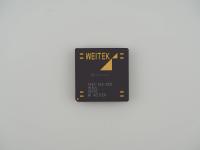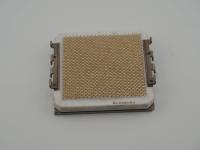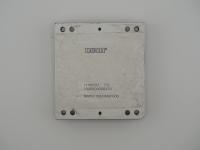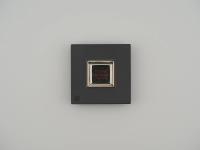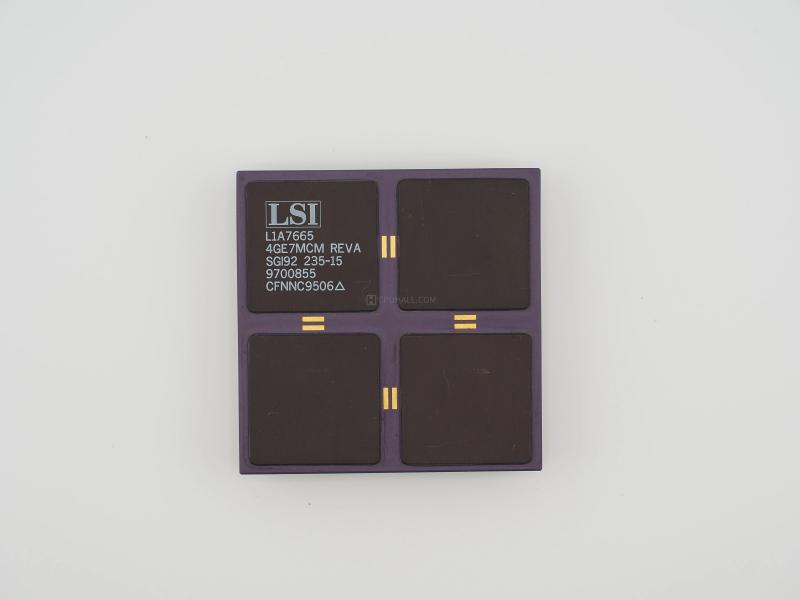

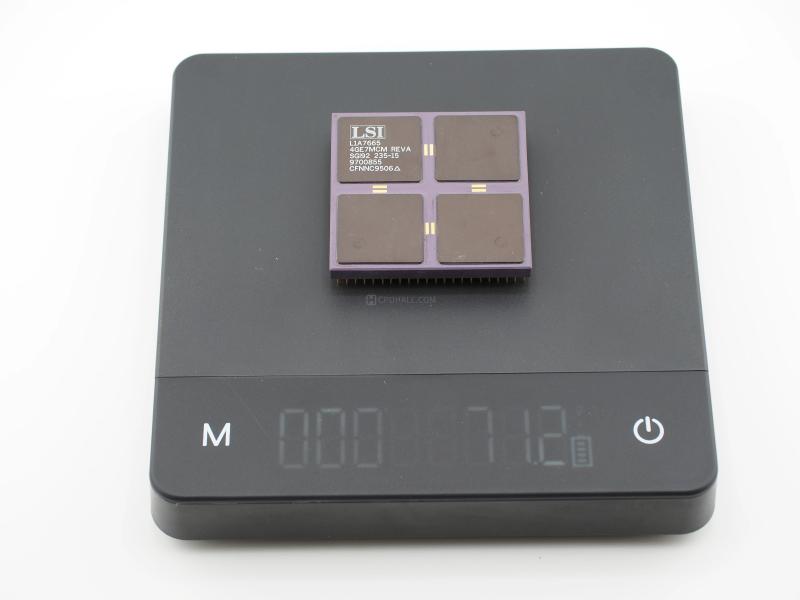
The substrate is a heavy, dark purple ceramic, a stark departure from the standard brown or white ceramics usually seen in IBM or early Intel silicon of the era.
The surface textures are distinctly utilitarian. Instead of bare dies, we have four identical, matte-black ceramic caps protecting the individual silicon logic blocks beneath. Between these caps, there are small, unpopulated gold alignment traces embedded directly into the purple substrate.
Fabricator Logo: LSI
Part Number: L1A7665
Description: 4GE7MCM REVA
Copyright/Design: SGI92 235-15
Batch/Serial: 9700855
Date Code: CFNNC9506A
Flipping the module over reveals a dense PGA layout with a large, square void in the center where the mounting pressure would be focused. It is a rugged package designed to be clamped securely into a massive supercomputing board.
To answer the immediate question: this artifact is neither a traditional Central Processing Unit (CPU) nor a modern Graphics Processing Unit (GPU). It exists as the missing evolutionary link between the two.
The 4GE7MCM marking explicitly identifies this as a Quad Geometry Engine 7 Multi-Chip Module.
In the early 1990s, rendering 3D graphics required physically distinct pipelines. A traditional CPU (like the MIPS processors in SGI machines) handled the operating system and game logic, but it simply couldn't crunch floating-point math fast enough to draw complex 3D scenes. Conversely, there were "Raster Managers" that handled the actual drawing of pixels on the screen, but they didn't know how to calculate 3D space.
This Geometry Engine sat right in the middle. Before a pixel could be colored in, this MCM calculated the heavy 3D math: vertex transformations (moving objects in 3D space), lighting calculations, and clipping (figuring out what is hidden behind other objects). Modern GPUs integrate both vertex math (Transform and Lighting) and pixel rasterization onto a single die. This SGI artifact is essentially the first half of a modern GPU, physically separated and built as a dedicated math annihilator. Each of the four custom LSI Logic ASICs under those black caps operated in parallel to forcefully crunch that floating-point geometry data.
In the halls of vintage computing lore, the SGI RealityEngine and its successor, RealityEngine2, are foundational legends. This is the exact architectural lineage of hardware that dominated 1990s visual effects. SGI Onyx machines equipped with these geometry pipelines rendered the dinosaurs in Jurassic Park, powered highly classified military flight simulators, and served as the primary development platform for the Nintendo 64 (Project Reality).
There is a common misconception that early 3D graphics were bottlenecked purely by pixel fill-rate or VRAM. In reality, calculating the geometry for complex 3D polygons was just as punishing on the hardware. Silicon Graphics' brute-force solution was to throw massive, parallel arrays of these Geometry Engine MCMs at the problem, creating rendering pipelines that consumer desktops wouldn't catch up to for nearly a decade.
There is very little mystery surrounding the identity of this module; the surface markings are highly definitive. The SGI92 points to the base design year of the RealityEngine architecture, while the CFNNC9506A string points to a fabrication date code around the 6th week of 1995. This places its actual manufacturing squarely in the RealityEngine2 era.
Acquiring intact SGI MCMs from this specific generation is becoming increasingly difficult. Many of these supercomputers were mercilessly scrapped, crushed, and recycled for the precious metals in their pins and traces in the early 2000s once their computing power was eclipsed by cheap, single-chip desktop GPUs like the Nvidia GeForce 256.