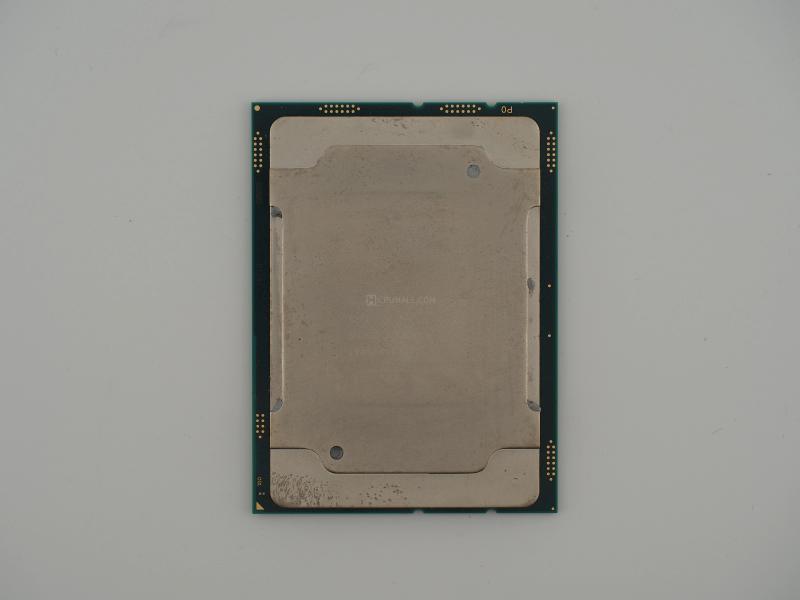

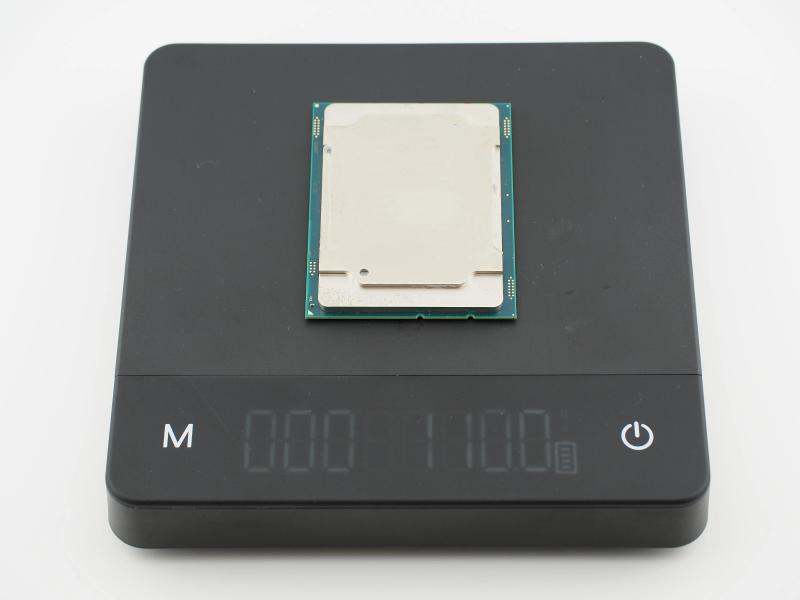
Handling this artifact, the sheer mass of it is the first thing that strikes you. Tipping the scale at exactly 110.0 grams, it feels more like a small structural brick than a delicate piece of electronics. The top of the processor is dominated by a massive, rectangular nickel-plated copper Integrated Heat Spreader.
Looking closely at the massive heatspreader, I can easily pull the faint laser etching from the micro-contrast of the metal surface:
INTEL(R) XEON(R) GOLD
5118
SR3GF 2.30GHZ
L945F491 (e4)
Flipping the silicon over reveals the sprawling, dense grid of the LGA-3647 form factor. The gold pads are split into two distinct arrays, flanking a central cavity packed with tiny surface-mounted capacitors. Right in the middle of these SMDs sits a blue and white paper sticker with Chinese characters reading "撕毁无效" which translates directly to "Void if torn", alongside a date of "2025 11 12". The edges of the green fiberglass substrate show very minor handling wear, which is entirely expected for a used datacenter part.
The engineering inside this piece represents a massive architectural shift for Intel's server division. This is a Skylake-SP processor built on the 14nm fabrication node. For years, Intel relied on a ring bus topology to connect cores and cache. However, as core counts climbed, the ring bus became a latency bottleneck. With this generation, Intel introduced a 2D mesh architecture to allow cores, cache, and memory controllers to communicate more efficiently across the die.
The Xeon Gold 5118 packs 12 cores and 24 threads. It features a base clock of 2.3 GHz and can boost up to 3.2 GHz, operating within a relatively tame Thermal Design Power of 105 Watts. This chip required the massive LGA-3647 interface, officially known as Socket P. The socket was so large and the mounting pressure requirements so high that Intel mandated the use of specialized plastic carrier brackets just to properly align the CPU with the heatsink before screwing it down to the motherboard. This platform also introduced six-channel DDR4 memory support and brought the heavy-hitting AVX-512 instruction set to mainstream enterprise racks.
The legacy of the Scalable Processor line is heavily tied to marketing shifts and intense industry rivalries. With this generation, Intel completely abandoned their universally recognized E3, E5, and E7 naming conventions. Instead, they adopted a precious metals hierarchy. The Bronze and Silver tiers were relegated to entry-level tasks, while Gold and Platinum dominated the high-margin enterprise space. The Xeon Gold 5118 sat squarely in the middle of this new stack.
Historically, this chip launched at a pivotal moment. The third quarter of 2017 was the exact moment AMD woke up the industry with their first-generation EPYC Naples processors. For the better part of a decade prior, Intel enjoyed a virtual monopoly in the server room. The Xeon Gold 5000 and 6000 series chips were Intel's frontline soldiers in what would become the modern datacenter core wars.
Identifying this specific unit leaves absolutely no room for mystery. The markings on the IHS are pristine and tell the complete story. The S-Spec SR3GF confirms with absolute certainty that this is a retail production unit and not an Engineering Sample or Qualification Sample.
The batch code, also known as the FPO (Finished Process Order), is L945F491. Decoding this string reveals its exact origin. The "L" indicates the chip was manufactured at Intel's facility in Malaysia. The "9" stands for the year 2019, and "45" indicates the 45th week of that year.
The most interesting provenance marker is not the laser etching, but the paper sticker on the back. That "Void if torn" warranty label is a classic hallmark of the Asian secondary hardware market, specifically the massive recycling hubs in Shenzhen. This processor lived its first life crunching numbers in a corporate server farm. Once that server was decommissioned, the hardware was liquidated, the processor was pulled, tested by a secondary vendor, stickered with a warranty extending to November 2025, and resold. I love preserving these pieces because that simple paper tag tells the story of a second life in the global hardware ecosystem.